Department of Anthropology and School of Biomedical Sciences, Kent State University Kent, OH, USA.
Front Neuroanat. 2010 Feb 5;4:3. doi: 10.3389/neuro.05.003.2010. eCollection 2010.
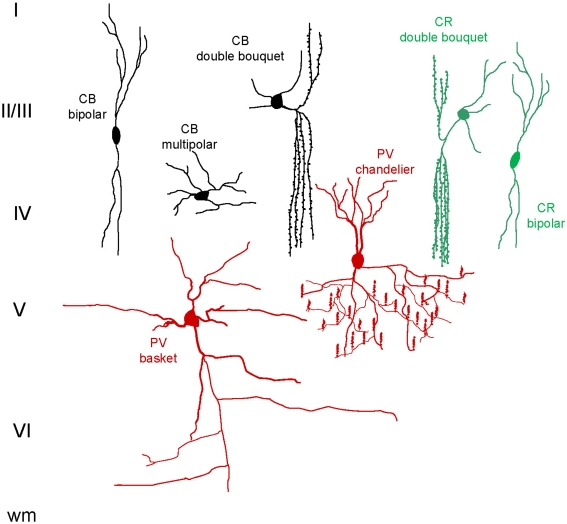
Neocortical columns are functional and morphological units whose architecture may have been under selective evolutionary pressure in different mammalian lineages in response to encephalization and specializations of cognitive abilities. Inhibitory interneurons make a substantial contribution to the morphology and distribution of minicolumns within the cortex. In this context, we review differences in minicolumns and GABAergic interneurons among species and discuss possible implications for signaling among and within minicolumns. Furthermore, we discuss how abnormalities of both minicolumn disposition and inhibitory interneurons might be associated with neuropathological processes, such as Alzheimer's disease, autism, and schizophrenia. Specifically, we explore the possibility that phylogenetic variability in calcium-binding protein-expressing interneuron subtypes is directly related to differences in minicolumn morphology among species and might contribute to neuropathological susceptibility in humans.
新皮层柱是功能和形态单位,其结构可能在不同的哺乳动物谱系中受到选择性进化压力的影响,以适应脑化和认知能力的专门化。抑制性中间神经元对皮层内的小柱形态和分布有很大的贡献。在这方面,我们回顾了物种间小柱和 GABA 能中间神经元的差异,并讨论了它们对小柱内和小柱间信号传递的可能影响。此外,我们还讨论了小柱排列和抑制性中间神经元的异常如何与神经病理学过程相关,如阿尔茨海默病、自闭症和精神分裂症。具体来说,我们探讨了钙结合蛋白表达中间神经元亚型的系统发育变异性是否与物种间小柱形态的差异直接相关,并可能导致人类对神经病理学的易感性。