van Elk Michiel, van Schie Hein T, van den Heuvel Ruby, Bekkering Harold
Donders Institute for Brain, Cognition and Behaviour, Radboud University Nijmegen Nijmegen, Netherlands.
Front Hum Neurosci. 2010 Feb 9;4:8. doi: 10.3389/neuro.09.008.2010. eCollection 2010.
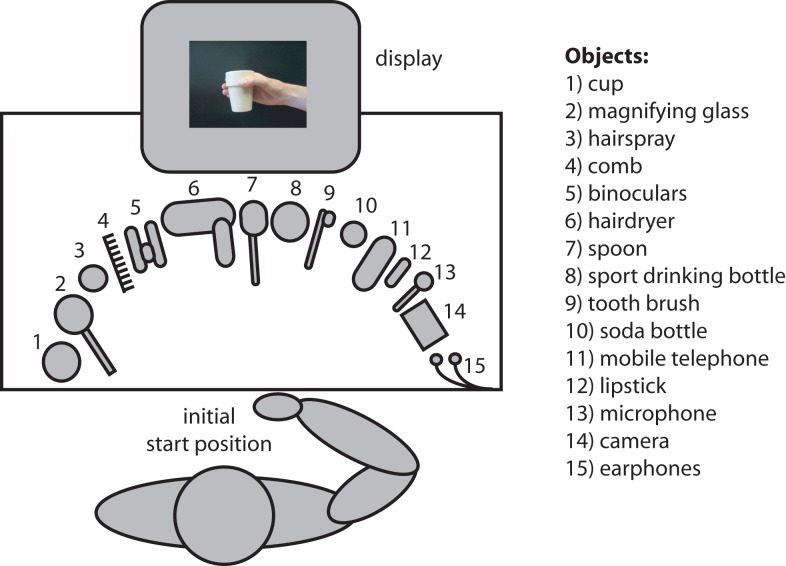
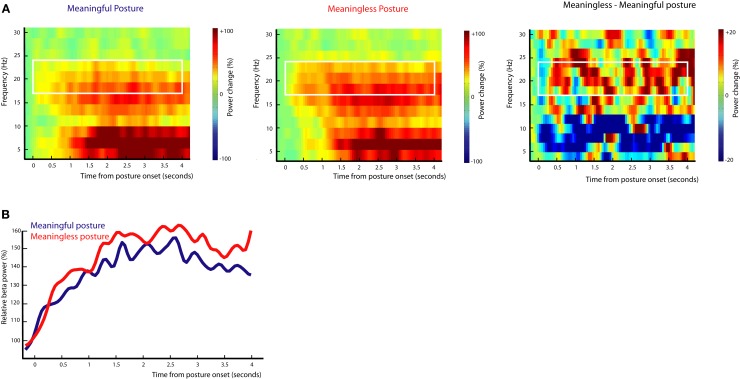
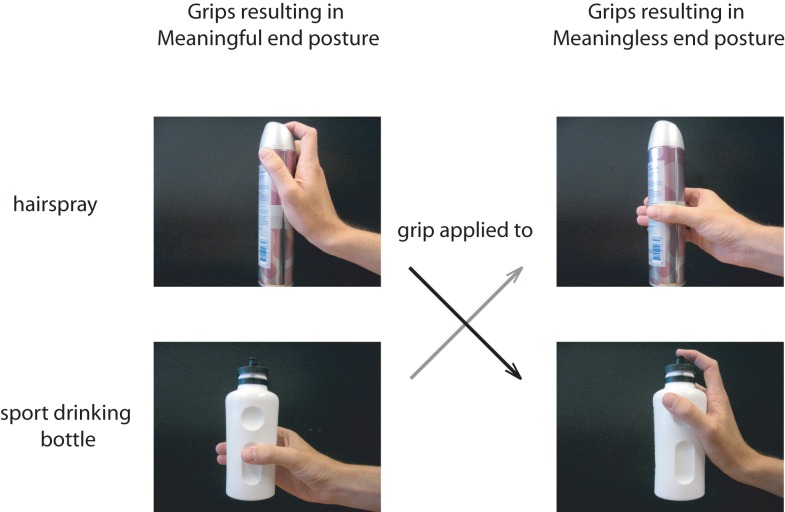
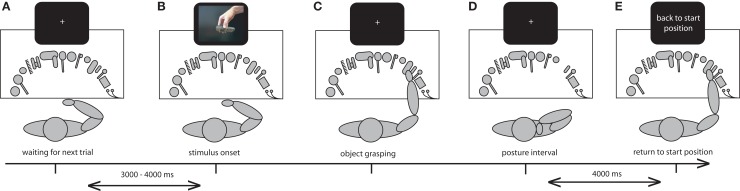
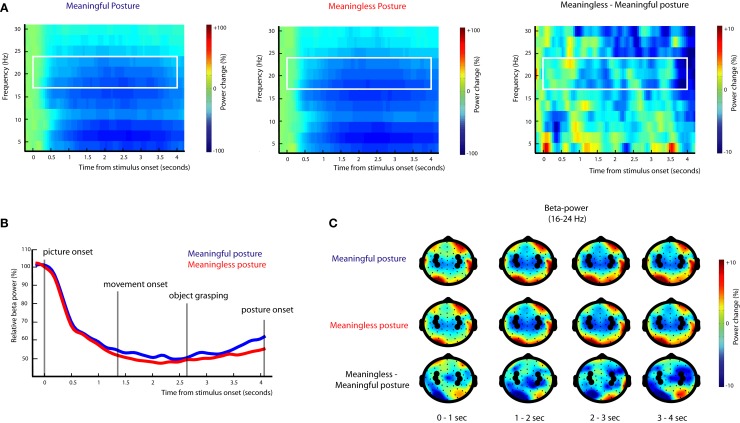
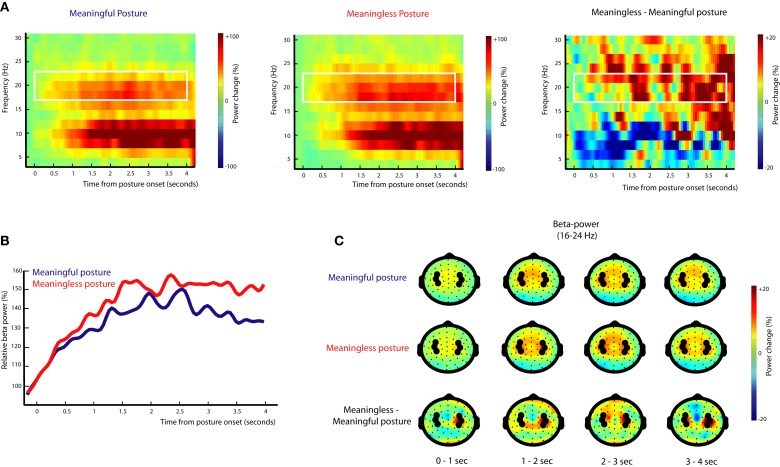
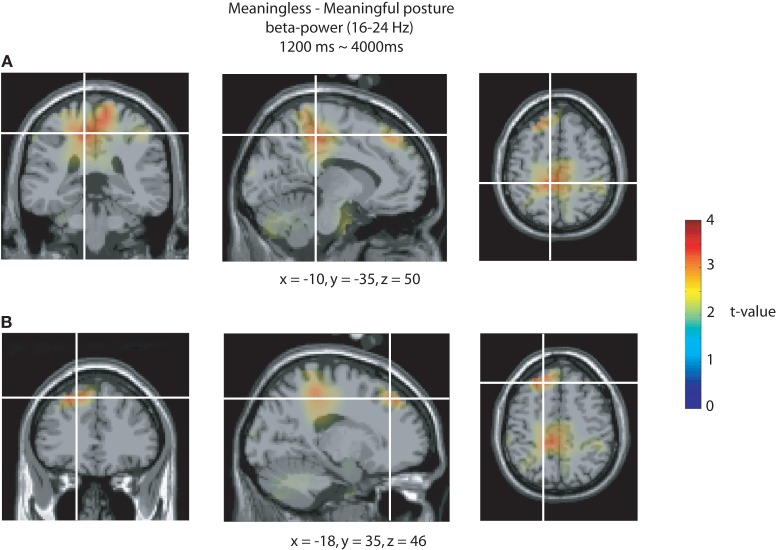
In the present EEG study we investigated whether semantic knowledge for object use is represented in motor-related brain areas. Subjects were required to perform actions with everyday objects and to maintain either a meaningful or a meaningless end posture with the object. Analysis of the EEG data focused on the beta-frequency band, as previous studies have indicated that the maintenance of a posture is reflected in stronger beta-oscillations. Time frequency analysis indicated that the execution of actions resulting in a meaningless compared to a meaningful end posture was accompanied by a stronger beta-desynchronization towards the end of the movement and a stronger subsequent beta-rebound after posture-onset. The effect in the beta-frequency band was localized to premotor, parietal and medial frontal areas and could not be attributed to differences in timing or movement complexity between meaningful and meaningless actions. Together these findings directly show that the motor system is differentially activated during the execution and maintenance of semantically correct or incorrect end postures. This suggests that semantic object knowledge is indeed represented in motor-related brain areas, organized around specific end postures associated with the use of objects.
在当前的脑电图研究中,我们调查了物体使用的语义知识是否在与运动相关的脑区中得到表征。受试者被要求使用日常物品执行动作,并保持物品有意义或无意义的最终姿势。脑电图数据分析集中在β频段,因为先前的研究表明姿势的维持反映在更强的β振荡中。时频分析表明,与有意义的最终姿势相比,导致无意义最终姿势的动作执行在运动结束时伴随着更强的β去同步化,以及姿势开始后更强的后续β反弹。β频段的效应定位于运动前区、顶叶和内侧额叶区域,且不能归因于有意义和无意义动作之间的时间或运动复杂性差异。这些发现共同直接表明,在语义正确或不正确的最终姿势的执行和维持过程中,运动系统被差异性激活。这表明语义物体知识确实在与运动相关的脑区中得到表征,围绕与物体使用相关的特定最终姿势组织起来。