Developmental and Reproductive Toxicology, WIL Research Laboratories, LLC, Ashland, Ohio 44805-8946, USA.
Toxicol Sci. 2010 May;115(1):167-82. doi: 10.1093/toxsci/kfq025. Epub 2010 Feb 17.
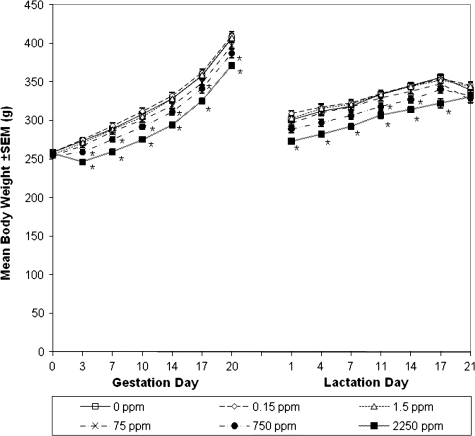
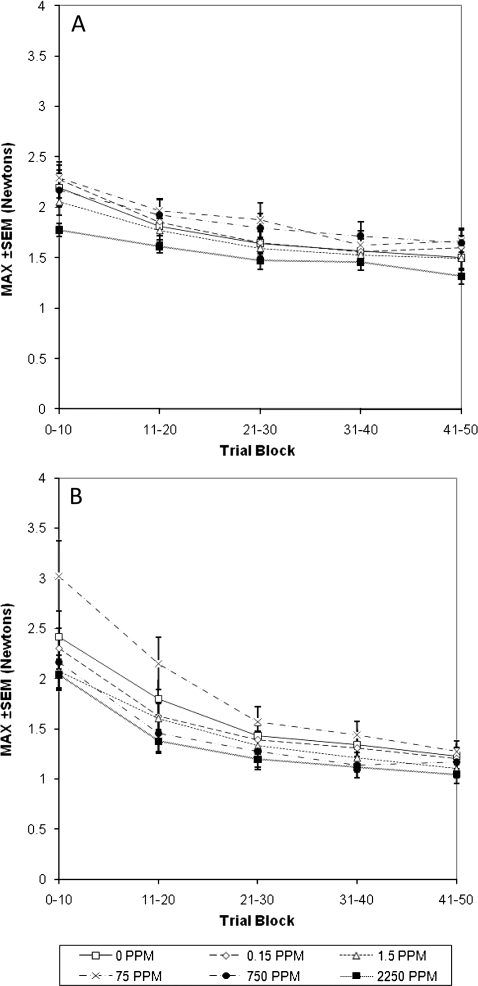
This study was conducted to determine the potential of bisphenol A (BPA) to induce functional and/or morphological effects to the nervous system of F(1) offspring from dietary exposure during gestation and lactation according to the Organization for Economic Cooperation and Development and U.S. Environmental Protection Agency guidelines for the study of developmental neurotoxicity. BPA was offered to female Sprague-Dawley Crl:CD (SD) rats (24 per dose group) and their litters at dietary concentrations of 0 (control), 0.15, 1.5, 75, 750, and 2250 ppm daily from gestation day 0 through lactation day 21. F(1) offspring were evaluated using the following tests: detailed clinical observations (postnatal days [PNDs] 4, 11, 21, 35, 45, and 60), auditory startle (PNDs 20 and 60), motor activity (PNDs 13, 17, 21, and 61), learning and memory using the Biel water maze (PNDs 22 and 62), and brain and nervous system neuropathology and brain morphometry (PNDs 21 and 72). For F(1) offspring, there were no treatment-related neurobehavioral effects, nor was there evidence of neuropathology or effects on brain morphometry. Based on maternal and offspring body weight reductions, the no-observed-adverse-effect level (NOAEL) for systemic toxicity was 75 ppm (5.85 and 13.1 mg/kg/day during gestation and lactation, respectively), with no treatment-related effects at lower doses or nonmonotonic dose responses observed for any parameter. There was no evidence that BPA is a developmental neurotoxicant in rats, and the NOAEL for developmental neurotoxicity was 2250 ppm, the highest dose tested (164 and 410 mg/kg/day during gestation and lactation, respectively).
本研究旨在根据经济合作与发展组织和美国环境保护署制定的发育神经毒性研究指南,确定双酚 A(BPA)在妊娠和哺乳期通过饮食暴露对 F(1)后代神经系统产生功能和/或形态影响的潜力。将 BPA 以 0(对照)、0.15、1.5、75、750 和 2250 ppm 的饮食浓度提供给雌性 Sprague-Dawley Crl:CD(SD)大鼠(每组 24 只)及其幼崽,从妊娠第 0 天到哺乳期第 21 天。使用以下测试评估 F(1)后代:详细的临床观察(出生后第 4、11、21、35、45 和 60 天)、听觉惊跳(第 20 和 60 天)、运动活动(第 13、17、21 和 61 天)、使用 Biel 水迷宫进行学习和记忆测试(第 22 和 62 天)以及大脑和神经系统病理学和大脑形态测量学(第 21 和 72 天)。对于 F(1)后代,没有发现与处理相关的神经行为影响,也没有发现病理学或大脑形态测量学的影响。基于母体和后代体重减轻,全身性毒性的无观察到不良效应水平(NOAEL)为 75 ppm(妊娠和哺乳期分别为 5.85 和 13.1 mg/kg/天),在较低剂量下没有观察到与处理相关的影响,也没有观察到任何参数的非单调剂量反应。没有证据表明 BPA 是大鼠的发育神经毒物,发育神经毒性的 NOAEL 为 2250 ppm,这是测试的最高剂量(妊娠和哺乳期分别为 164 和 410 mg/kg/天)。