
维生素 D 对系统性红斑狼疮患者树突状细胞功能的影响。
The impact of vitamin D on dendritic cell function in patients with systemic lupus erythematosus.
机构信息
Division of Autoimmune and Musculoskeletal Disease, Feinstein Institute for Medical Research, Manhasset, New York, United States of America.
出版信息
PLoS One. 2010 Feb 16;5(2):e9193. doi: 10.1371/journal.pone.0009193.
BACKGROUND
Excessive activity of dendritic cells (DCs) is postulated as a central disease mechanism in Systemic Lupus Erythematosus (SLE). Vitamin D is known to reduce responsiveness of healthy donor DCs to the stimulatory effects of Type I IFN. As vitamin D deficiency is reportedly common in SLE, we hypothesized that vitamin D might play a regulatory role in the IFNalpha amplification loop in SLE. Our goals were to investigate the relationship between vitamin D levels and disease activity in SLE patients and to investigate the effects of vitamin D on DC activation and expression of IFNalpha-regulated genes in vitro.
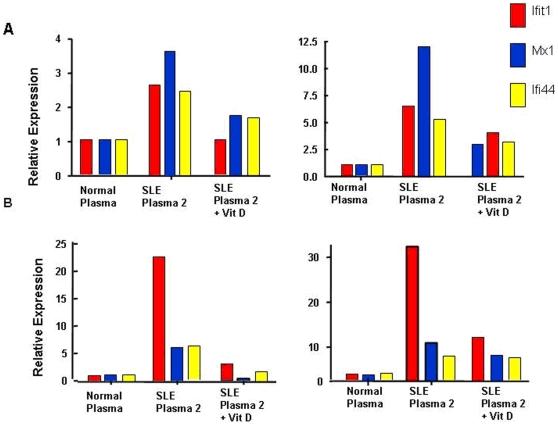
METHODOLOGY/PRINCIPAL FINDINGS: In this study, 25-OH vitamin D (25-D) levels were measured in 198 consecutively recruited SLE patients. Respectively, 29.3% and 11.8% of African American and Hispanic SLE patient had 25-D levels <10 ng/ml. The degree of vitamin D deficiency correlated inversely with disease activity; R = -.234, p = .002. In 19 SLE patients stratified by 25-D levels, there were no differences between circulating DC number and phenotype. Monocyte-derived DCs (MDDCs) of SLE patients were normally responsive to the regulatory effects of vitamin D in vitro as evidenced by decreased activation in response to LPS stimulation in the presence of 1,25-D. Additionally, vitamin D conditioning reduced expression of IFNalpha-regulated genes by healthy donor and SLE MDDCs in response to factors in activating SLE plasma.
CONCLUSIONS/SIGNIFICANCE: We report on severe 25-D deficiency in a substantial percentage of SLE patients tested and demonstrate an inverse correlation with disease activity. Our results suggest that vitamin D supplementation will contribute to restoring immune homeostasis in SLE patients through its inhibitory effects on DC maturation and activation. We are encouraged to support the importance of adequate vitamin D supplementation and the need for a clinical trial to assess whether vitamin D supplementation affects IFNalpha activity in vivo and, most importantly, improves clinical outcome.
背景
树突状细胞(DCs)的过度活跃被认为是系统性红斑狼疮(SLE)的中心疾病机制。已知维生素 D 可降低健康供体 DC 对 I 型 IFN 刺激作用的反应性。由于维生素 D 缺乏症在 SLE 中较为常见,我们假设维生素 D 可能在 SLE 中的 IFNα 扩增环中发挥调节作用。我们的目标是研究 SLE 患者的维生素 D 水平与疾病活动之间的关系,并研究维生素 D 对体外 DC 激活和 IFNα 调节基因表达的影响。
方法/主要发现:本研究中,对 198 例连续招募的 SLE 患者进行了 25-羟维生素 D(25-D)水平的测量。分别有 29.3%和 11.8%的非裔美国人和西班牙裔 SLE 患者 25-D 水平<10ng/ml。维生素 D 缺乏的程度与疾病活动呈负相关;R = -.234,p =.002。在根据 25-D 水平分层的 19 例 SLE 患者中,循环 DC 数量和表型无差异。SLE 患者的单核细胞衍生的 DC(MDDC)在体外对维生素 D 的调节作用具有正常反应性,这表现在存在 1,25-D 的情况下,对 LPS 刺激的激活反应降低。此外,维生素 D 调理可降低健康供体和 SLE MDDC 对激活 SLE 血浆中因子的 IFNα 调节基因的表达。
结论/意义:我们报告了检测到的大量 SLE 患者存在严重的 25-D 缺乏,并证明与疾病活动呈负相关。我们的结果表明,维生素 D 补充将通过其对 DC 成熟和激活的抑制作用有助于恢复 SLE 患者的免疫稳态。我们受到鼓舞,支持适当补充维生素 D 的重要性,需要进行临床试验以评估维生素 D 补充是否会影响体内 IFNα 活性,最重要的是,改善临床结局。


 Zotero 插件