Osada Yoshio, Kanazawa Tamotsu
Department of Immunology and Parasitology, University of Occupational and Environmental Health, Japan, Kitakyushu 807-8555, Japan.
J Biomed Biotechnol. 2010;2010:743758. doi: 10.1155/2010/743758. Epub 2010 Feb 10.
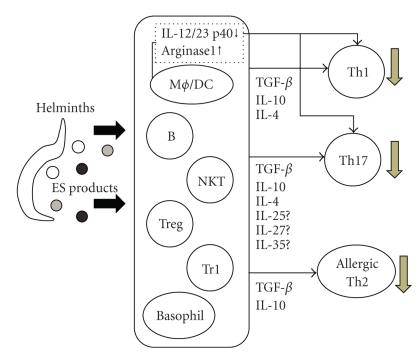
The prevalence of allergic and autoimmune diseases is increasing in developed countries, possibly due to reduced exposure to microorganisms in childhood (hygiene hypothesis). Epidemiological and experimental evidence in support of this hypothesis is accumulating. In this context, parasitic helminths are now important candidates for antiallergic/anti-inflammatory agents. Here we summarize antiallergic/anti-inflammatory effects of helminths together along with our own study of the effects of Schistosoma mansoni on Th17-dependent experimental arthritis. We also discuss possible mechanisms of helminth-induced suppression according to the recent advances of immunology.
在发达国家,过敏性疾病和自身免疫性疾病的患病率正在上升,这可能是由于儿童时期接触微生物减少(卫生假说)。支持这一假说的流行病学和实验证据正在不断积累。在这种背景下,寄生蠕虫现在成为抗过敏/抗炎药物的重要候选者。在此,我们总结了蠕虫的抗过敏/抗炎作用,以及我们自己关于曼氏血吸虫对Th17依赖性实验性关节炎影响的研究。我们还根据免疫学的最新进展讨论了蠕虫诱导抑制的可能机制。