Division of Viral Products, Center for Biologics Evaluation and Research, FDA, 29 Lincoln Drive, Bethesda, MD 20892, USA.
Virol J. 2010 Feb 19;7:44. doi: 10.1186/1743-422X-7-44.
The cytosolic retinoic acid-inducible gene I (RIG-I) is a pattern recognition receptor that senses HCV double-stranded RNA and triggers type I interferon pathways. The clone Huh7.5 of human hepatoma Huh7 cells contains a mutation in RIG-I that is believed to be responsible for the improved replication of HCV in these cells relative to the parental strain. We hypothesized that, in addition to RIG-I, other determinant(s) outside the RIG-I coding sequence are involved in limiting HCV replication in cell culture. To test our hypothesis, we analyzed Huh7 cell clones that support the efficient replication of HCV and analyzed the RIG-I gene.
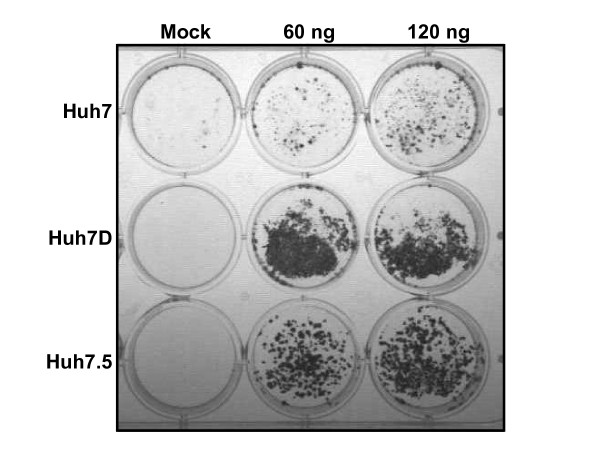
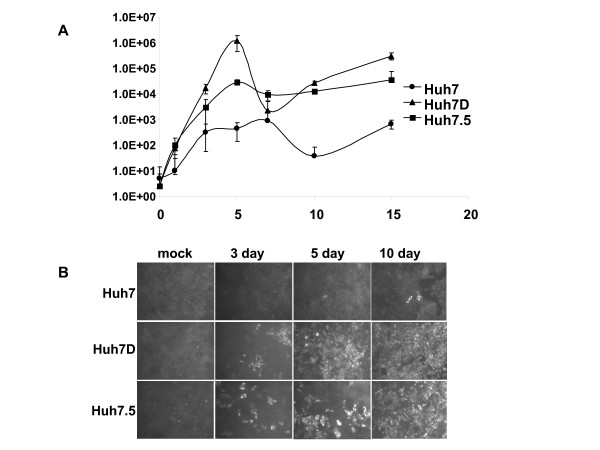
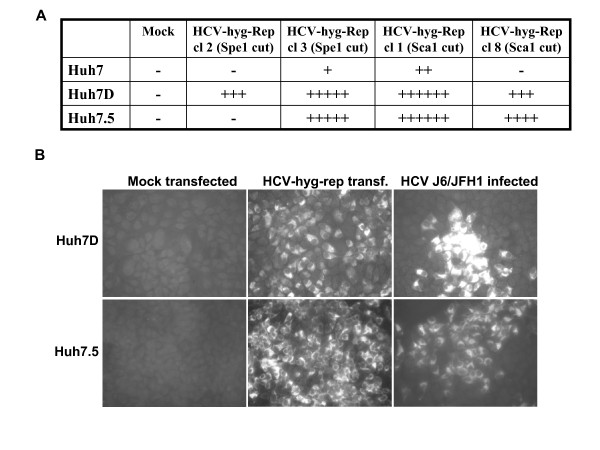
One clone, termed Huh7D, was more permissive for HCV replication and more efficient for HCV-neomycin and HCV-hygromycin based replicon colony formation than parental Huh7 cells. Nucleotide sequence analysis of the RIG-I mRNA coding region from Huh7D cells showed no mutations relative to Huh7 parental cells.
We derived a new Huh7 cell line, Huh7D, which is more permissive for HCV replication than parental Huh7 cells. The higher permissiveness of Huh7D cells is not due to mutations in the RIG-I protein, indicating that cellular determinants other than the RIG-I amino-acid sequence are responsible for controlling HCV replication. In addition, we have selected Huh7 cells resistant to hygromycin via newly generated HCV-replicons carrying the hygromycin resistant gene. Further studies on Huh7D cells will allow the identification of cellular factors that increased the susceptibility to HCV infection, which could be targeted for anti-HCV therapies.
细胞质视黄酸诱导基因 I(RIG-I)是一种模式识别受体,可识别 HCV 双链 RNA 并触发 I 型干扰素途径。人肝癌 Huh7 细胞的 Huh7.5 克隆含有 RIG-I 突变,据信该突变负责相对于亲本株提高 HCV 在这些细胞中的复制。我们假设,除了 RIG-I 之外,RIG-I 编码序列之外的其他决定因素也参与限制 HCV 在细胞培养物中的复制。为了检验我们的假设,我们分析了支持 HCV 有效复制的 Huh7 细胞克隆,并分析了 RIG-I 基因。
一个称为 Huh7D 的克隆对 HCV 复制更具宽容性,并且在 HCV-新霉素和 HCV-潮霉素基于复制子集落形成方面比亲本 Huh7 细胞更有效。从 Huh7D 细胞中分析的 RIG-I mRNA 编码区的核苷酸序列显示相对于亲本 Huh7 细胞没有突变。
我们衍生了一种新的 Huh7 细胞系,Huh7D,它比亲本 Huh7 细胞对 HCV 复制更具宽容性。Huh7D 细胞的更高宽容度不是由于 RIG-I 蛋白中的突变引起的,表明控制 HCV 复制的细胞决定因素不仅限于 RIG-I 氨基酸序列。此外,我们通过携带潮霉素抗性基因的新生成的 HCV 复制子选择了对潮霉素具有抗性的 Huh7 细胞。对 Huh7D 细胞的进一步研究将允许鉴定增加对 HCV 感染易感性的细胞因子,这些因子可能成为抗 HCV 治疗的靶点。