Department of Pharmacology, University of Cambridge, Cambridge, United Kingdom.
PLoS One. 2010 Feb 12;5(2):e9077. doi: 10.1371/journal.pone.0009077.
Environmental enrichment (EE) in laboratory animals improves neurological function and motor/cognitive performance, and is proposed as a strategy for treating neurodegenerative diseases. EE has been investigated in the R6/2 mouse model of Huntington's disease (HD), where increased social interaction, sensory stimulation, exploration, and physical activity improved survival. We have also shown previously that HD patients and R6/2 mice have disrupted circadian rhythms, treatment of which may improve cognition, general health, and survival.
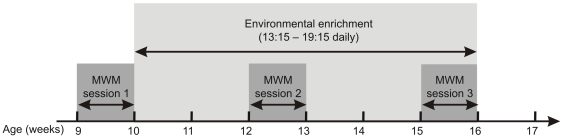
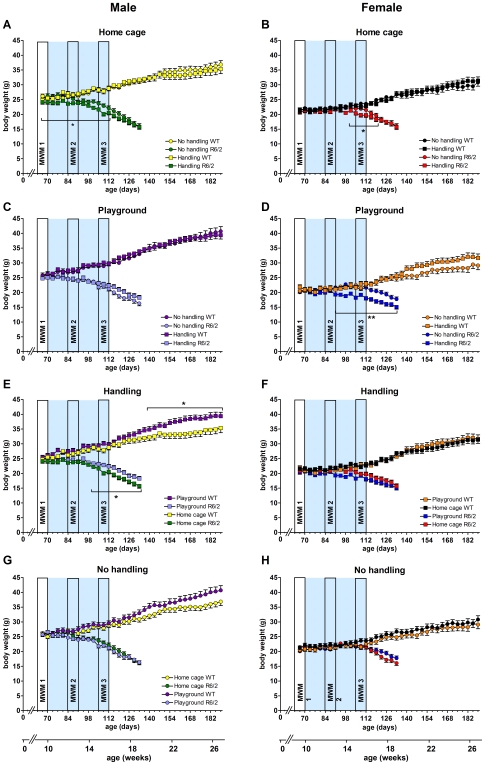
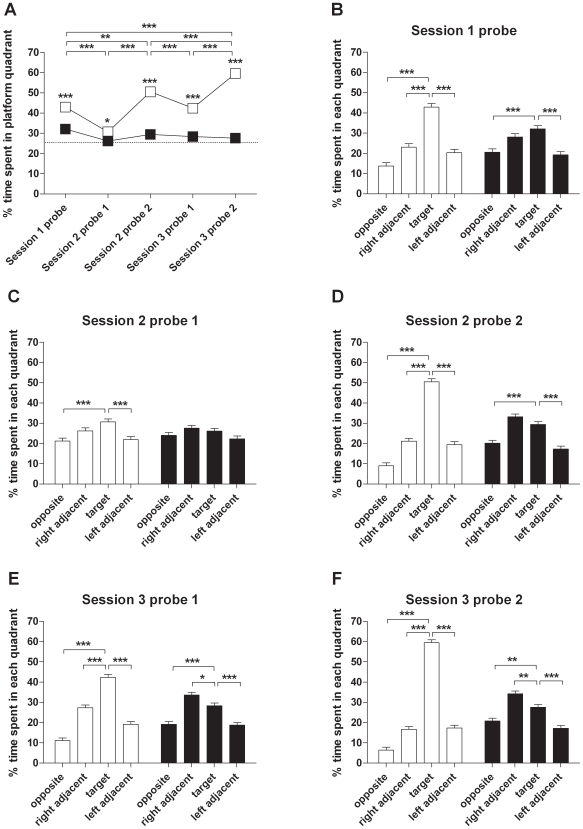
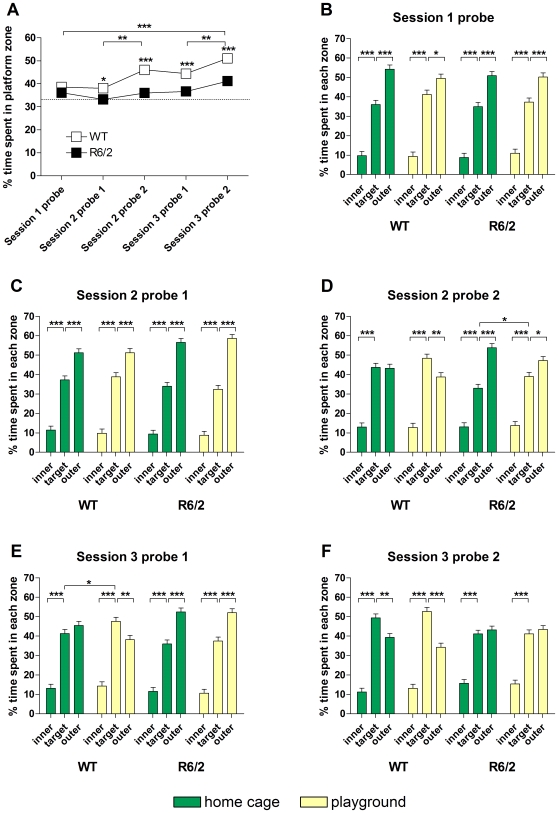
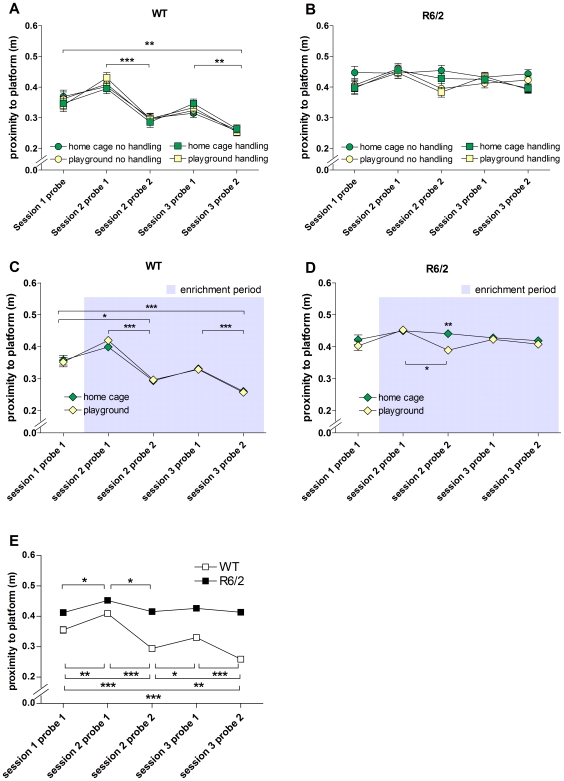
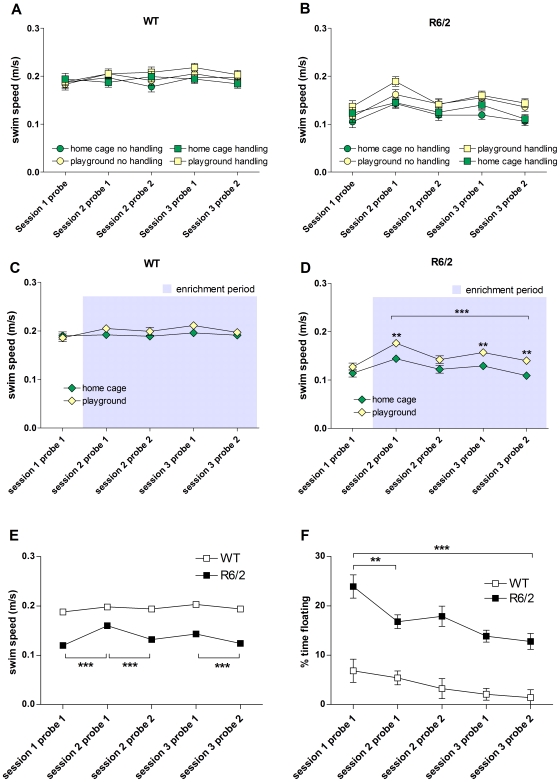
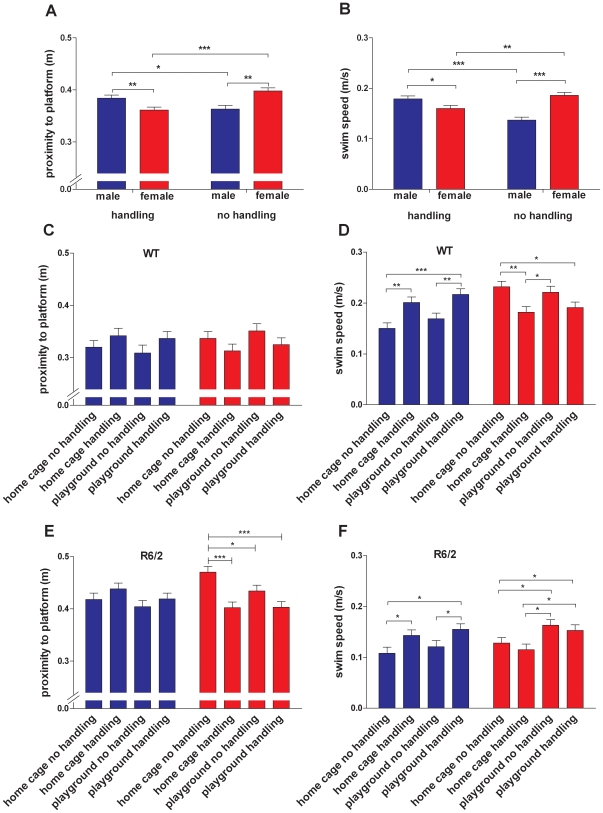
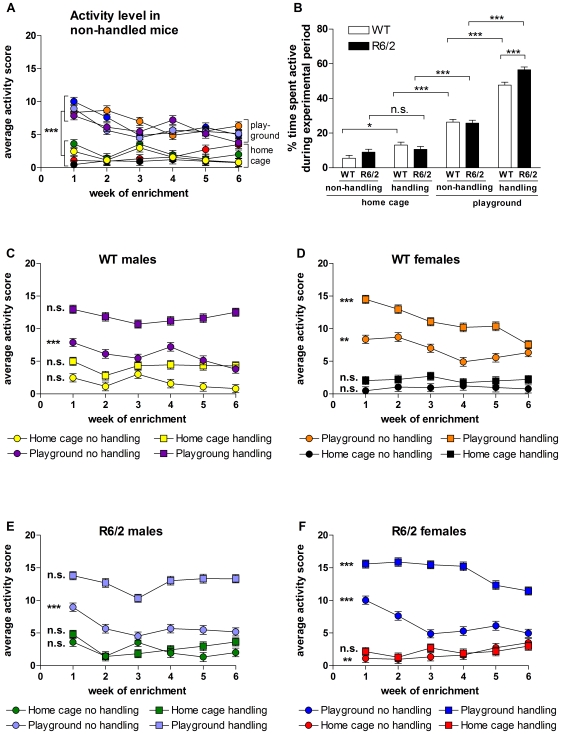
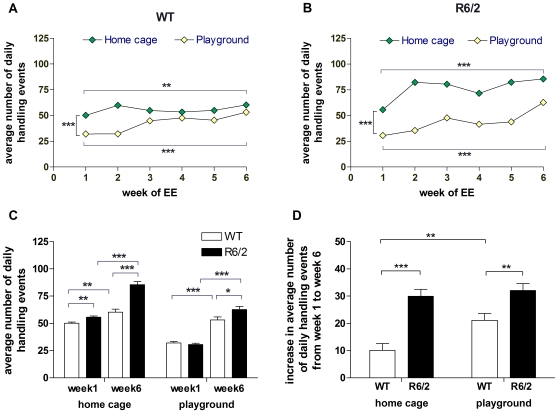
METHODOLOGY/PRINCIPAL FINDINGS: We examined the effects of EE on the behavioral phenotype and circadian activity of R6/2 mice. Our mice are typically housed in an "enriched" environment, so the EE that the mice received was in addition to these enhanced housing conditions. Mice were either kept in their home cages or exposed daily to the EE (a large playground box containing running wheels and other toys). The "home cage" and "playground" groups were subdivided into "handling" (stimulated throughout the experimental period) and "no-handling" groups. All mice were assessed for survival, body weight, and cognitive performance in the Morris water maze (MWM). Mice in the playground groups were more active throughout the enrichment period than home cage mice. Furthermore, R6/2 mice in the EE/no-handling groups had better survival than those in the home cage/no-handling groups. Sex differences were seen in response to EE. Handling was detrimental to R6/2 female mice, but EE increased the body weight of male R6/2 and WT mice in the handling group. EE combined with handling significantly improved MWM performance in female, but not male, R6/2 mice.
CONCLUSIONS/SIGNIFICANCE: We show that even when mice are living in an enriched home cage, further EE had beneficial effects. However, the improvements in cognition and survival vary with sex and genotype. These results indicate that EE may improve the quality of life of HD patients, but we suggest that EE as a therapy should be tailored to individuals.
环境丰富(EE)可改善实验室动物的神经功能和运动/认知表现,被提议作为治疗神经退行性疾病的策略。EE 已在亨廷顿病(HD)的 R6/2 小鼠模型中进行了研究,其中增加社交互动、感官刺激、探索和体育活动可提高存活率。我们之前还表明,HD 患者和 R6/2 小鼠的昼夜节律被打乱,治疗这些节律可能会改善认知、整体健康和存活率。
方法/主要发现:我们研究了 EE 对 R6/2 小鼠行为表型和昼夜节律活动的影响。我们的小鼠通常被安置在“丰富”的环境中,因此,这些增强的饲养条件之外,小鼠还接受了 EE。小鼠要么被安置在自己的笼子里,要么每天被暴露于 EE(一个包含跑步轮和其他玩具的大型游乐箱)中。“笼内”和“游乐场”组进一步细分为“处理”(在整个实验过程中受到刺激)和“非处理”组。所有小鼠均接受了水迷宫(MWM)中的生存、体重和认知表现评估。与笼内组相比,处于 EE 中的小鼠在整个丰富期内更加活跃。此外,EE/非处理组的 R6/2 小鼠的存活率高于笼内/非处理组的小鼠。EE 对性别的影响存在差异。处理对 R6/2 雌性小鼠有害,但 EE 增加了处理组中雄性 R6/2 和 WT 小鼠的体重。EE 与处理相结合可显著改善雌性 R6/2 但非雄性 R6/2 小鼠的 MWM 表现。
结论/意义:我们表明,即使在小鼠生活在丰富的笼内环境中,进一步的 EE 也具有有益作用。但是,认知和存活率的改善因性别和基因型而异。这些结果表明,EE 可能改善 HD 患者的生活质量,但我们建议 EE 作为一种疗法应根据个体情况进行调整。