Searle Laboratory, Sensory Motor Performance Program, Rehabilitation Institute of Chicago, Chicago, IL, USA.
Eur J Appl Physiol. 2010 Jun;109(3):527-36. doi: 10.1007/s00421-010-1391-0. Epub 2010 Feb 20.
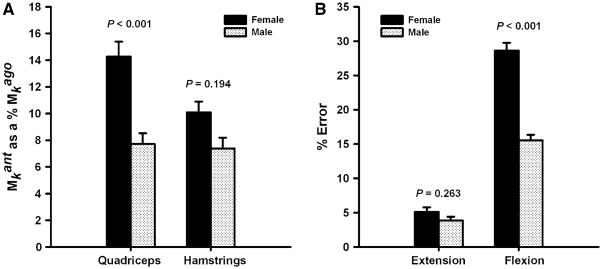
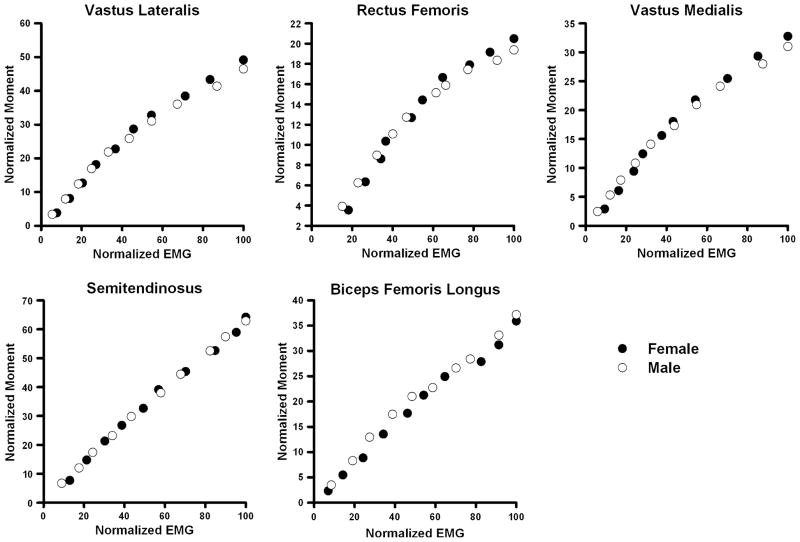
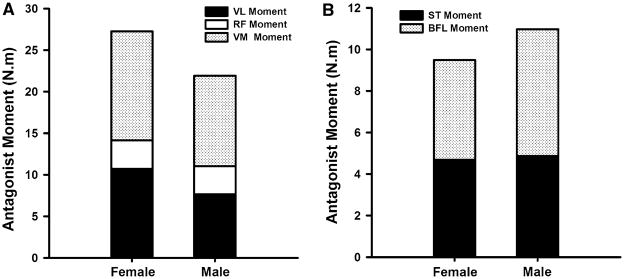
The purpose of this study was to determine the measurement error associated with antagonist muscle activity in isometric knee strength testing at 60 degrees of knee flexion in both sexes. Muscle specific EMG-contraction intensity relationships were obtained from 22 young people by having them match moment targets ranging from 10% to 100% peak moment. The moments attributed to each of the quadriceps and hamstrings muscles were partitioned using a practical mathematical model. Subject specific EMG-moment relationships were defined for each muscle using second-order polynomial equations. These equations were subsequently used to predict the countermoment associated with antagonist muscle activity. Error during strength testing was calculated by expressing net antagonist moments as a percentage of net agonist moments. The net antagonist moments associated with quadriceps and hamstrings muscle activity were 11.0% and 8.7% of the peak moment values recorded when the same muscle groups were acting as agonists. The error associated with antagonist activity was significantly higher in knee flexion (20.1%) than in knee extension (4.5%). Females displayed significantly higher error in knee flexor testing (P < 0.001). Limb symmetry indices did not change significantly when the countermoments generated by the antagonist muscles were accounted for (P > 0.05). The results of this study indicate that the error associated with antagonist activity in knee extensor testing is relatively small, whereas the error in knee flexor testing is larger. This is due to the quadriceps being much stronger than the hamstrings muscles while displaying similar levels of antagonist activity.
本研究旨在确定在男女两性膝关节 60 度等长膝关节力量测试中,拮抗肌活动相关的测量误差。通过让 22 名年轻人匹配从 10%到 100%峰值力矩的力矩目标,获得肌肉特定的肌电图-收缩强度关系。使用实用的数学模型将归因于股四头肌和腘绳肌的力矩进行分区。使用二阶多项式方程为每个肌肉定义特定于个体的肌电图-力矩关系。随后,这些方程被用来预测拮抗肌活动的反力矩。通过将净拮抗力矩表示为净主动力矩的百分比来计算力量测试中的误差。当同一肌肉群作为主动肌时,股四头肌和腘绳肌活动的净拮抗力矩分别为峰值力矩值的 11.0%和 8.7%。与拮抗肌活动相关的误差在膝关节弯曲时(20.1%)明显高于膝关节伸展时(4.5%)。女性在膝关节屈肌测试中的误差明显更高(P<0.001)。当考虑拮抗肌产生的反力矩时,肢体对称性指数没有明显变化(P>0.05)。本研究结果表明,膝关节伸肌测试中与拮抗肌活动相关的误差相对较小,而膝关节屈肌测试中的误差较大。这是由于股四头肌比腘绳肌强壮得多,同时显示出相似水平的拮抗肌活动。