Department of Orthopaedic Surgery, Saint-Luc University Hospital (UCL Université Catholique de Louvain), Brussels, Belgium.
Acta Orthop. 2010 Apr;81(2):250-5. doi: 10.3109/17453671003587127.
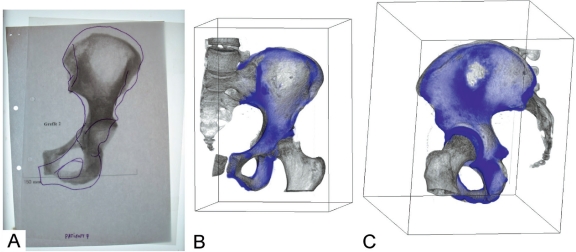
Massive bone allografts are used when surgery causes large segmental defects. Shape-matching is the primary criterion for selection of an allograft. The current selection method, based on 2-dimensional template comparison, is inefficient for 3-dimensional complex bones. We have analyzed a 3-dimensional (3-D) registration method to match the anatomy of the allograft with that of the recipient.
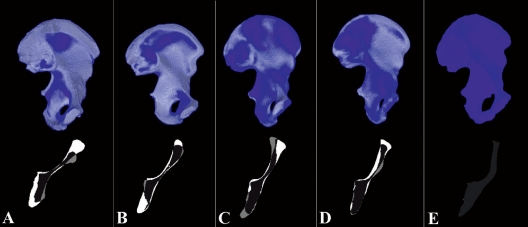
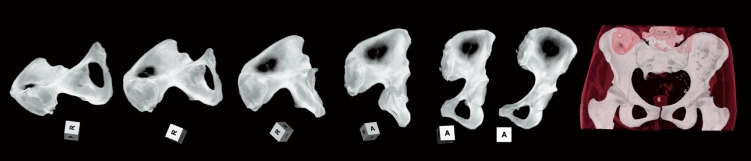
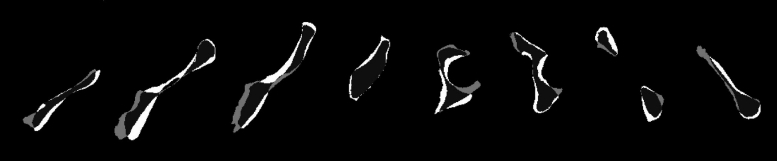
3-D CT-based registration was performed to match the shapes of both bones. We used the registration to align the allograft volume onto the recipient's bone. Hemipelvic allograft selection was tested in 10 virtual recipients with a panel of 10 potential allografts, including one from the recipient himself (trap graft). 4 observers were asked to visually inspect the superposition of allograft over the recipient, to classify the allografts into 4 categories according to the matching of anatomic zones, and to select the 3 best matching allografts. The results obtained using the registration method were compared with those from a previous study on the template method.
Using the registration method, the observers systematically detected the trap graft. Selections of the 3 best matching allografts performed using registration and template methods were different. Selection of the 3 best matching allografts was improved by the registration method. Finally, reproducibility of the selection was improved when using the registration method.
3-D CT registration provides more useful information than the template method but the final decision lies with the surgeon, who should select the optimal allograft according to his or her own preferences and the needs of the recipient.
当手术导致大段节段性缺损时,会使用大量同种异体骨。形状匹配是选择同种异体骨的主要标准。目前的选择方法基于二维模板比较,对于三维复杂骨骼效率不高。我们分析了一种三维(3D)配准方法,以匹配同种异体骨和受者的解剖结构。
使用基于 3D CT 的配准来匹配两块骨骼的形状。我们使用配准将同种异体骨体积与受者的骨骼对齐。我们在 10 个虚拟受者中测试了半骨盆同种异体骨选择,并使用 10 个潜在同种异体骨(包括受者自身的陷阱移植骨)进行了面板测试。4 名观察者被要求直观检查同种异体骨在受者上的重叠情况,根据解剖区域的匹配将同种异体骨分为 4 类,并选择 3 个匹配最佳的同种异体骨。使用配准方法获得的结果与之前模板方法的研究结果进行了比较。
使用配准方法,观察者系统地检测到陷阱移植骨。使用配准和模板方法选择的 3 个最佳匹配同种异体骨不同。使用配准方法提高了选择 3 个最佳匹配同种异体骨的效果。最后,使用配准方法提高了选择的可重复性。
3D CT 配准提供的信息比模板方法更有用,但最终决策取决于外科医生,他应根据自己的偏好和受者的需求选择最佳的同种异体骨。