Limb Deformity Reconstruction Unit, Department of Orthopaedics, the Netherlands.
Acta Orthop. 2010 Apr;81(2):193-8. doi: 10.3109/17453671003619003.
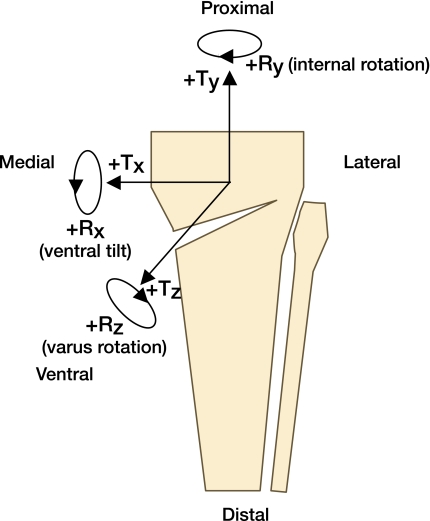
In open-wedge, valgus osteotomy of the upper tibia, there are concerns regarding the initial stability and ability to retain the correction. Rehabilitation protocols vary depending on the osteotomy technique and the fixation method. Angle-stable implants offer superior initial stability. Early full weight bearing appears to be possible using these implants. In this prospective cohort study, we measured migration in open-wedge osteotomy in patients following an early full weight bearing protocol and compared the results to those from a historical cohort of open-wedge osteotomy patients who followed a standard protocol (full weight bearing after 6 weeks) using radiostereometry.
14 open-wedge osteotomies fixated with the angle-stable Tomofix implant were performed; patients were allowed full weight bearing as soon as pain and wound healing permitted. Radiostereometry was used to measure motion across the osteotomy at regular intervals. Improvement in pain and functional outcome were assessed postoperatively. The results were compared to those from a group of 23 patients who had undergone the same operation but had used a standard rehabilitation protocol.
There were no adverse effects because of the early full weight bearing protocol. There were no differences in motion at the osteotomy between groups as measured by radiostereometry. In both groups, pain and function improved substantially without any differences between groups. Patients in the early weight bearing group achieved the same result but in a shorter time.
Tomofix-plate-fixated open-wedge high tibial osteotomy allows early full weight bearing without loss of correction.
在胫骨高位开放楔形截骨术中,人们对初始稳定性和维持矫正能力存在担忧。康复方案因截骨技术和固定方法而异。角度稳定型植入物提供了更高的初始稳定性。使用这些植入物似乎可以早期完全负重。在这项前瞻性队列研究中,我们通过放射学体层摄影术测量了早期完全负重方案下患者开放楔形截骨中的迁移情况,并将结果与遵循标准方案(6 周后完全负重)的历史队列中开放楔形截骨患者的结果进行了比较。
对 14 例采用角度稳定 Tomofix 植入物固定的开放性楔形截骨术患者进行了研究;一旦疼痛和伤口愈合允许,患者即允许完全负重。使用放射学体层摄影术定期测量截骨处的运动。术后评估疼痛和功能改善情况。将结果与 23 例接受相同手术但采用标准康复方案的患者进行比较。
由于采用了早期完全负重方案,没有出现不良反应。放射学体层摄影术测量的两组截骨处的运动无差异。两组患者的疼痛和功能均有显著改善,组间无差异。早期负重组的患者达到了相同的结果,但时间更短。
Tomofix 板固定的开放性楔形胫骨高位截骨术允许早期完全负重,而不会导致矫正丢失。