Laboratoire de Biologie et Physiologie Cellulaires, CNRS-6187, University of Poitiers, 40 Avenue du Recteur Pineau, 86022, Poitiers, France.
Psychopharmacology (Berl). 2010 Apr;209(2):191-202. doi: 10.1007/s00213-010-1789-8. Epub 2010 Feb 24.
Although delta-9-tetreahydrocannabinol (THC)-induced elevations in accumbal dopamine levels are believed to play an important role in the abuse-related effects of cannabis, little direct evidence has been provided that the dopaminergic system is involved in the psychotropic effects of THC.
The objective of this study is to investigate whether drugs activating or blocking the dopaminergic system modulate the discriminative effects of THC.
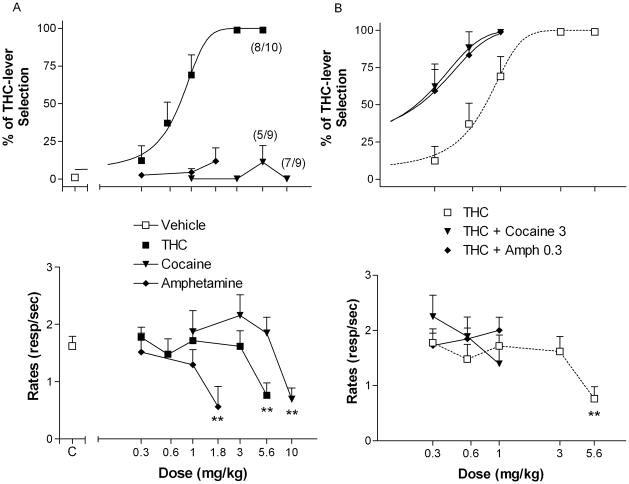
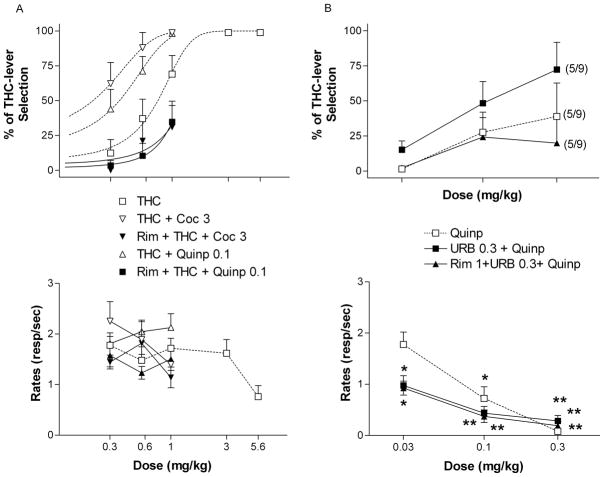
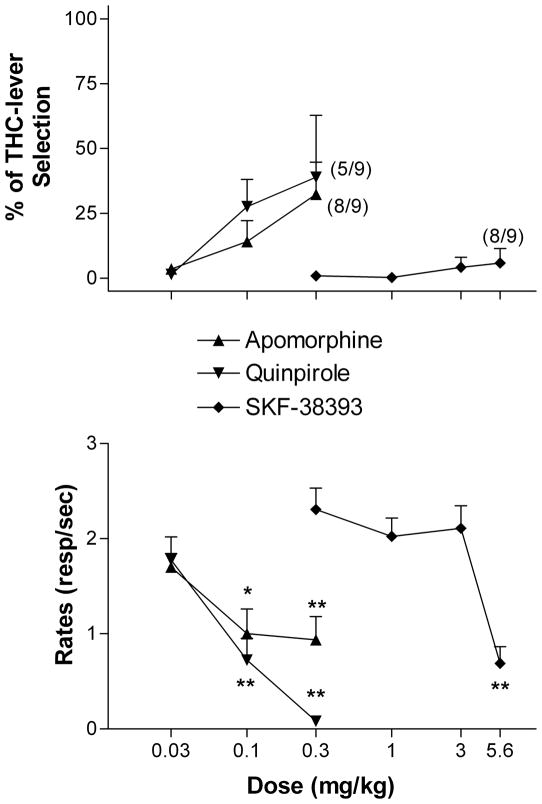
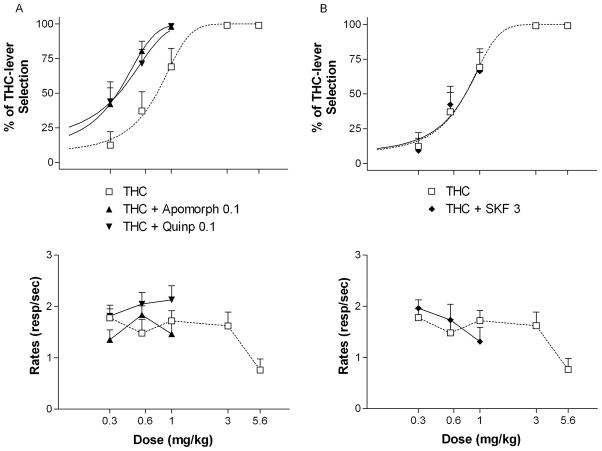
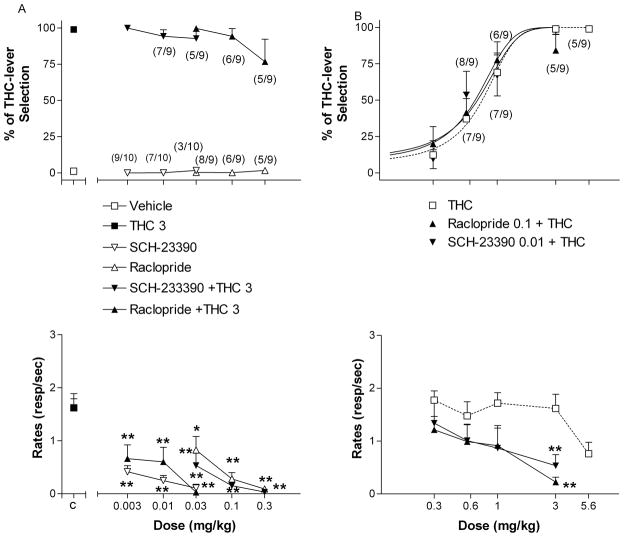
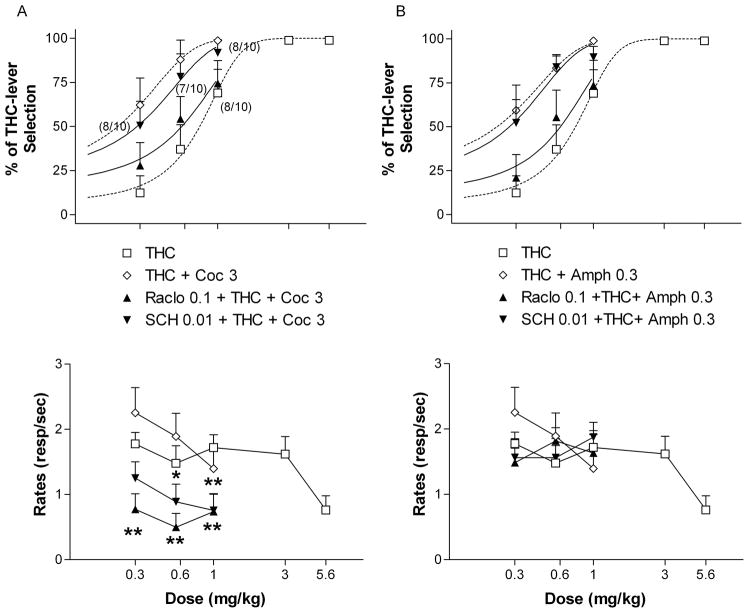
In rats that had learned to discriminate 3 mg/kg of THC from vehicle injections, the indirect dopaminergic agonists cocaine and amphetamine, the D(1)-receptor agonist SKF-38393, and the D(2)-receptor agonists quinpirole and apomorphine did not produce significant THC-like discriminative effects. However, both cocaine and amphetamine and D(2)-, but not the D(1)-, receptor agonists, augmented THC discrimination. Neither the D(1)-receptor antagonist SCH-23390 nor the D(2)-receptor antagonist raclopride reduced the discriminative effects of THC, even at doses that significantly depressed baseline operant responding. However, the D(2)-, but not the D(1)-, antagonist counteracted the augmentation of THC's discriminative effects produced by cocaine and amphetamine. We hypothesized that release of anandamide by activation of D(2) receptors was responsible for the observed augmentation of THC discrimination. This hypothesis was supported by two findings. First, the cannabinoid CB(1)-receptor antagonist rimonabant blocked quinpirole-induced augmentation of THC discrimination. Second, inhibition of anandamide degradation by blockade of fatty acid amide hydrolase augmented the THC-like effects of quinpirole.
Dopamine does not play a major role in THC discrimination. However, activation of the dopaminergic system positively modulates the discriminative effects of THC, possibly through D(2)-induced elevations in brain levels of anandamide.
虽然人们认为δ-9-四氢大麻酚(THC)引起的伏隔核多巴胺水平升高在大麻的滥用相关效应中起重要作用,但很少有直接证据表明多巴胺系统参与了 THC 的精神效应。
本研究旨在探讨激活或阻断多巴胺系统的药物是否会调节 THC 的辨别效应。
在已经学会区分 3 毫克/千克 THC 与载体注射的大鼠中,间接多巴胺激动剂可卡因和安非他命、D1-受体激动剂 SKF-38393 以及 D2-受体激动剂喹吡罗和阿扑吗啡均未产生明显的 THC 样辨别效应。然而,可卡因和安非他命以及 D2-但不是 D1-受体激动剂增强了 THC 的辨别。D1-受体拮抗剂 SCH-23390 或 D2-受体拮抗剂雷氯必利均未降低 THC 的辨别效应,即使在显著抑制基线操作性反应的剂量下也未降低。然而,D2-但不是 D1-拮抗剂抵消了可卡因和安非他命对 THC 辨别效应的增强。我们假设 D2 受体的激活导致了大麻二酚(anandamide)的释放,从而导致观察到的 THC 辨别增强。这一假设得到了两个发现的支持。首先,大麻素 CB1-受体拮抗剂利莫那班阻断了喹吡罗诱导的 THC 辨别增强。其次,通过阻断脂肪酸酰胺水解酶抑制 anandamide 降解增强了 quinpirole 的 THC 样作用。
多巴胺在 THC 辨别中不起主要作用。然而,多巴胺系统的激活正向调节 THC 的辨别效应,可能通过 D2 诱导的 anandamide 脑水平升高。