Lile Joshua A, Kelly Thomas H, Pinsky David J, Hays Lon R
Department of Behavioral Science, University of Kentucky College of Medicine, College of Medicine Office Building, Lexington, KY 40536-0086, USA.
Psychopharmacology (Berl). 2009 Apr;203(2):241-50. doi: 10.1007/s00213-008-1393-3. Epub 2008 Nov 19.
Preclinical evidence suggests that non-cannabinoid neurotransmitter systems are involved in the behavioral and physiological effects of cannabinoids, but relatively little research has been conducted in humans.
The aims of this study were to assess whether oral Delta(9)-tetrahydrocannabinol (Delta(9)-THC) would function as a discriminative stimulus in humans and to examine the substitution profile of drugs acting at opioid, GABA, and dopamine systems.
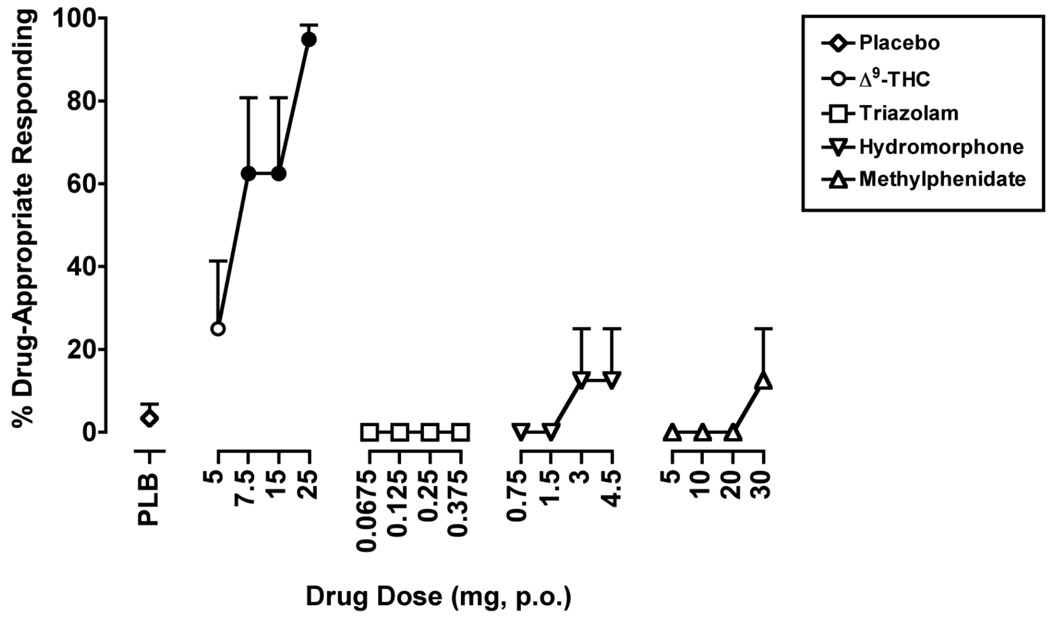
Healthy subjects who reported moderate cannabis use were enrolled. Subjects learned to identify when they received oral 25 mg Delta(9)-THC or placebo under double-blind conditions. Once subjects acquired the discrimination (i.e., > or =80% drug-appropriate responding for four consecutive sessions), multiple doses of Delta(9)-THC, the GABA(A) positive modulator triazolam, the micro-opioid agonist hydromorphone and the dopamine reuptake inhibitor methylphenidate were tested to determine if they shared discriminative-stimulus effects with the training dose of Delta(9)-THC.
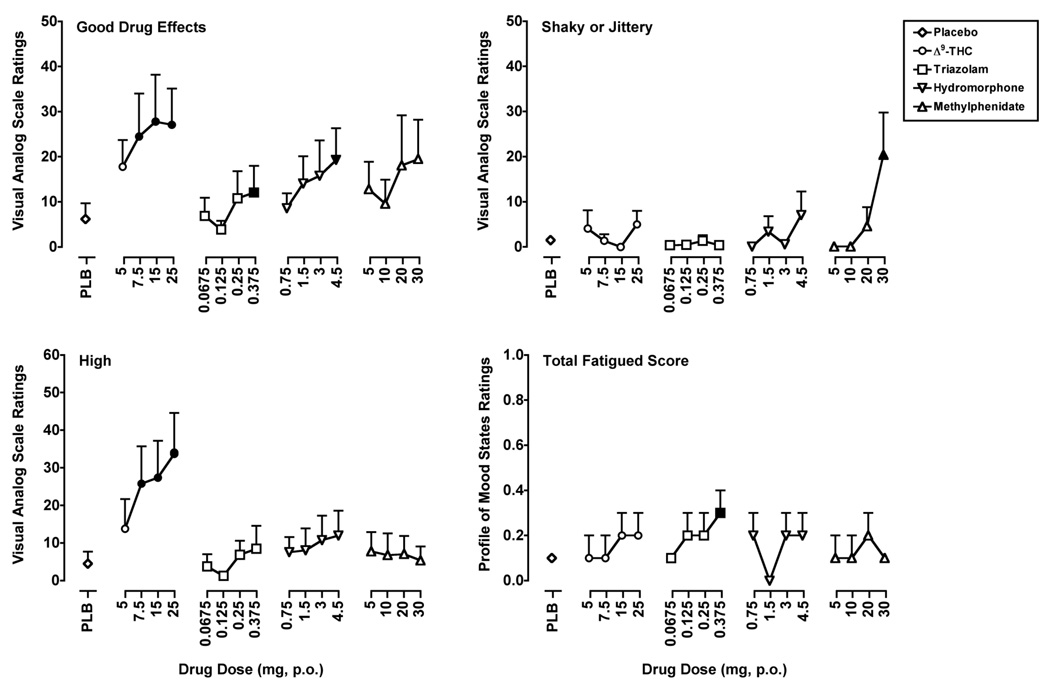
Eight subjects (N = 8) accurately discriminated Delta(9)-THC and completed the study. The training dose of Delta(9)-THC functioned as a discriminative stimulus and produced prototypical subject-rated drug effects. All of the drugs tested produced significant effects on the self-report questionnaires, but only Delta(9)-THC substituted for the training dose.
These results suggest that the discriminative-stimulus effects of Delta(9)-THC in humans are not directly mediated through central neurotransmitter systems acted upon by the drugs tested in this study.
临床前证据表明,非大麻素神经递质系统参与了大麻素的行为和生理效应,但在人类身上进行的相关研究相对较少。
本研究的目的是评估口服Δ⁹-四氢大麻酚(Δ⁹-THC)在人类中是否会作为一种辨别刺激,并研究作用于阿片类、γ-氨基丁酸(GABA)和多巴胺系统的药物的替代特征。
招募报告有中度大麻使用史的健康受试者。受试者在双盲条件下学会识别何时接受口服25毫克Δ⁹-THC或安慰剂。一旦受试者获得辨别能力(即连续四个疗程中药物适当反应率≥80%),就对多剂量的Δ⁹-THC、GABA(A)阳性调节剂三唑仑、微阿片激动剂氢吗啡酮和多巴胺再摄取抑制剂哌甲酯进行测试,以确定它们是否与Δ⁹-THC的训练剂量具有共同的辨别刺激效应。
八名受试者(N = 8)准确辨别了Δ⁹-THC并完成了研究。Δ⁹-THC的训练剂量起到了辨别刺激的作用,并产生了典型的受试者评定的药物效应。所有测试药物对自我报告问卷都产生了显著影响,但只有Δ⁹-THC能替代训练剂量。
这些结果表明,Δ⁹-THC在人类中的辨别刺激效应并非直接通过本研究中测试药物所作用的中枢神经递质系统介导。