Yip Kawai, Gosling Roly D, Jones Victoria, Hosein Ian K
North Middlesex University Hospital Trust, Sterling Way, London, Greater London, N18 1QX, UK.
Cases J. 2009 Sep 17;2:6335. doi: 10.1186/1757-1626-0002-0000006335.
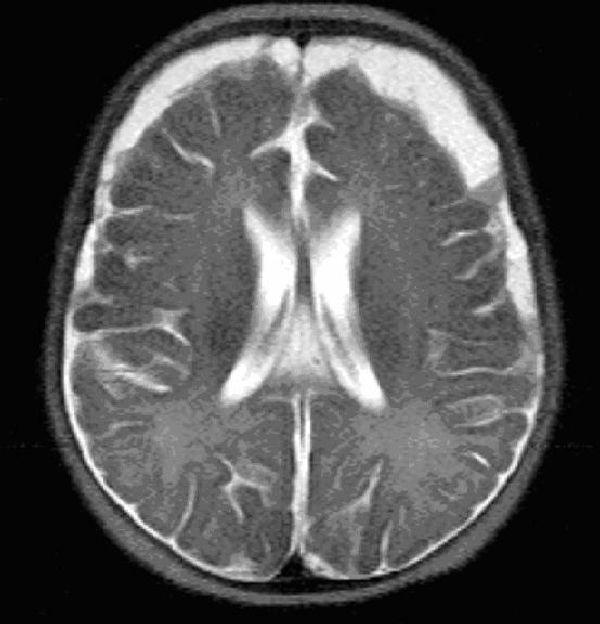
Subdural empyema is an unusual complication of meningococcal meningitis, and in acute cases can be rapidly fatal. We present a case of an 8 week old infant who presented with atypical Neisseria meningitis with bifrontal subdural empyema formation. Through the utilisation of modern polymerise chain reaction tests on cerebrospinal fluid samples, we were able to confirm the diagnosis and institute appropriate treatment. Early surgical intervention and appropriate intravenous antibiotics meant that the patient fully recovered. In summary, early treatment of meningitis without adequate microbiological investigations can complicate later diagnosis of subdural empyema. Early suspicion of empyema should be considered when patient fails to improve after 48 hrs, seizures are a late sign and gives a poorer prognosis. Computed tomography scanning is still the modality of choice although in this case, magnetic resonance imaging had its benefits. Polymerase chain reaction of cerebrospinal fluid testing may also provide an important confirmatory test in future.
硬脑膜下积脓是脑膜炎球菌性脑膜炎的一种罕见并发症,在急性病例中可能迅速致命。我们报告一例8周大婴儿,表现为非典型奈瑟菌性脑膜炎并伴有双侧额叶硬脑膜下积脓形成。通过对脑脊液样本进行现代聚合酶链反应检测,我们得以确诊并实施适当治疗。早期手术干预及适当的静脉抗生素治疗使患者完全康复。总之,在未进行充分微生物学检查的情况下对脑膜炎进行早期治疗,可能会使硬脑膜下积脓的后续诊断复杂化。当患者在48小时后病情未改善时,应考虑早期怀疑积脓,癫痫发作是晚期体征且预后较差。计算机断层扫描仍是首选检查方式,尽管在此病例中,磁共振成像也有其优势。脑脊液检测的聚合酶链反应未来可能也会提供重要的确诊检查。