Centre for Research on Inner City Health, The Keenan Research Centre in the Li Ka Shing Knowledge Institute of St, Michael's Hospital, Toronto, Canada.
BMC Public Health. 2010 Feb 24;10:94. doi: 10.1186/1471-2458-10-94.
Drug use is believed to be an important factor contributing to the poor health and increased mortality risk that has been widely observed among homeless individuals. The objective of this study was to determine the prevalence and characteristics of drug use among a representative sample of homeless individuals and to examine the association between drug problems and physical and mental health status.
Recruitment of 603 single men, 304 single women, and 284 adults with dependent children occurred at homeless shelters and meal programs in Toronto, Canada. Information was collected on demographic characteristics and patterns of drug use. The Addiction Severity Index was used to assess whether participants suffered from drug problems. Associations of drug problems with physical and mental health status (measured by the SF-12 scale) were examined using regression analyses.
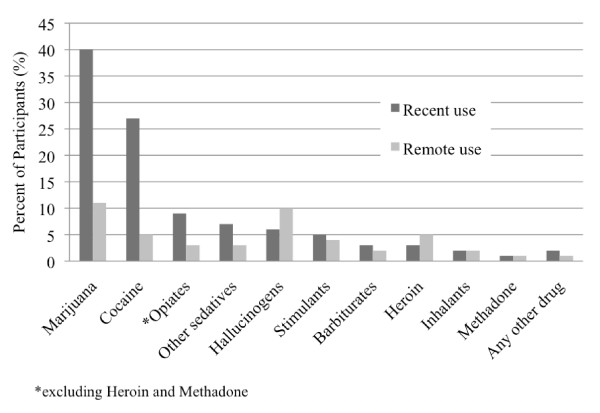
Forty percent of the study sample had drug problems in the last 30 days. These individuals were more likely to be single men and less educated than those without drug problems. They were also more likely to have become homeless at a younger age (mean 24.8 vs. 30.9 years) and for a longer duration (mean 4.8 vs. 2.9 years). Marijuana and cocaine were the most frequently used drugs in the past two years (40% and 27%, respectively). Drug problems within the last 30 days were associated with significantly poorer mental health status (-4.9 points, 95% CI -6.5 to -3.2) but not with poorer physical health status (-0.03 points, 95% CI -1.3 to 1.3)).
Drug use is common among homeless individuals in Toronto. Current drug problems are associated with poorer mental health status but not with poorer physical health status.
药物使用被认为是导致无家可归者健康状况不佳和死亡风险增加的一个重要因素,这在广泛的研究中已经得到了证实。本研究的目的是确定在多伦多无家可归者的代表性样本中药物使用的流行率和特征,并研究药物问题与身心健康状况之间的关联。
在多伦多的收容所和餐饮项目中招募了 603 名单身男性、304 名单身女性和 284 名有子女的成年人。收集了人口统计学特征和药物使用模式的信息。使用成瘾严重程度指数评估参与者是否存在药物问题。使用回归分析检查药物问题与身心健康状况(用 SF-12 量表测量)之间的关联。
研究样本中有 40%的人在过去 30 天内存在药物问题。这些人更有可能是单身男性,受教育程度较低。与没有药物问题的人相比,他们更早(平均 24.8 岁对 30.9 岁)和更长时间(平均 4.8 年对 2.9 年)成为无家可归者。在过去两年中,大麻和可卡因是最常使用的药物(分别为 40%和 27%)。在过去 30 天内存在药物问题与心理健康状况显著恶化相关(-4.9 分,95%CI-6.5 至-3.2),但与身体健康状况恶化无关(-0.03 分,95%CI-1.3 至 1.3))。
在多伦多,无家可归者中药物使用很常见。目前的药物问题与心理健康状况较差有关,但与身体健康状况较差无关。