Molecular Oncology Laboratory, Department of Surgery, The University of Chicago Medical Center, Chicago, IL 60637, USA.
PPAR Res. 2010;2010:956427. doi: 10.1155/2010/956427. Epub 2010 Feb 16.
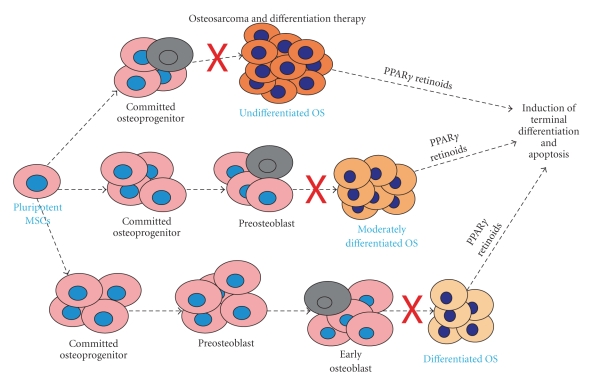
Osteosarcoma (OS) is the most common nonhematologic malignancy of bone in children and adults. Although dysregulation of tumor suppressor genes and oncogenes, such as Rb, p53, and the genes critical to cell cycle control, genetic stability, and apoptosis have been identified in OS, consensus genetic changes that lead to OS development are poorly understood. Disruption of the osteogenic differentiation pathway may be at least in part responsible for OS tumorigenesis. Current OS management involves chemotherapy and surgery. Peroxisome proliferator-activated receptor (PPAR) agonists and/or retinoids can inhibit OS proliferation and induce apoptosis and may inhibit OS growth by promoting osteoblastic terminal differentiation. Thus, safe and effective PPAR agonists and/or retinoid derivatives can be then used as adjuvant therapeutic drugs for OS therapy. Furthermore, these agents have the potential to be used as chemopreventive agents for the OS patients who undergo the resection of the primary bone tumors in order to prevent local recurrence and/or distal pulmonary metastasis.
骨肉瘤(OS)是儿童和成人中最常见的非血液恶性骨肿瘤。虽然在 OS 中已经鉴定出肿瘤抑制基因和癌基因(如 Rb、p53 和对细胞周期控制、遗传稳定性和细胞凋亡至关重要的基因)的失调,但导致 OS 发展的共识遗传变化仍知之甚少。成骨分化途径的破坏至少部分负责 OS 的肿瘤发生。目前的 OS 管理包括化疗和手术。过氧化物酶体增殖物激活受体(PPAR)激动剂和/或维甲酸可以抑制 OS 的增殖并诱导细胞凋亡,并通过促进成骨细胞终末分化来抑制 OS 的生长。因此,安全有效的 PPAR 激动剂和/或维甲酸衍生物可作为 OS 治疗的辅助治疗药物。此外,这些药物具有用作 OS 患者的化学预防剂的潜力,这些患者进行原发性骨肿瘤的切除,以预防局部复发和/或远端肺转移。