Centre for Clinical and Diagnostic Oral Sciences, Institute of Dentistry, Barts and the London School of Medicine and Dentistry, Queen Mary University of London, Turner Street, London E1 2AD, UK.
Mol Cancer. 2010 Feb 26;9:45. doi: 10.1186/1476-4598-9-45.
The human cell cycle transcription factor FOXM1 is known to play a key role in regulating timely mitotic progression and accurate chromosomal segregation during cell division. Deregulation of FOXM1 has been linked to a majority of human cancers. We previously showed that FOXM1 was upregulated in basal cell carcinoma and recently reported that upregulation of FOXM1 precedes malignancy in a number of solid human cancer types including oral, oesophagus, lung, breast, kidney, bladder and uterus. This indicates that upregulation of FOXM1 may be an early molecular signal required for aberrant cell cycle and cancer initiation.
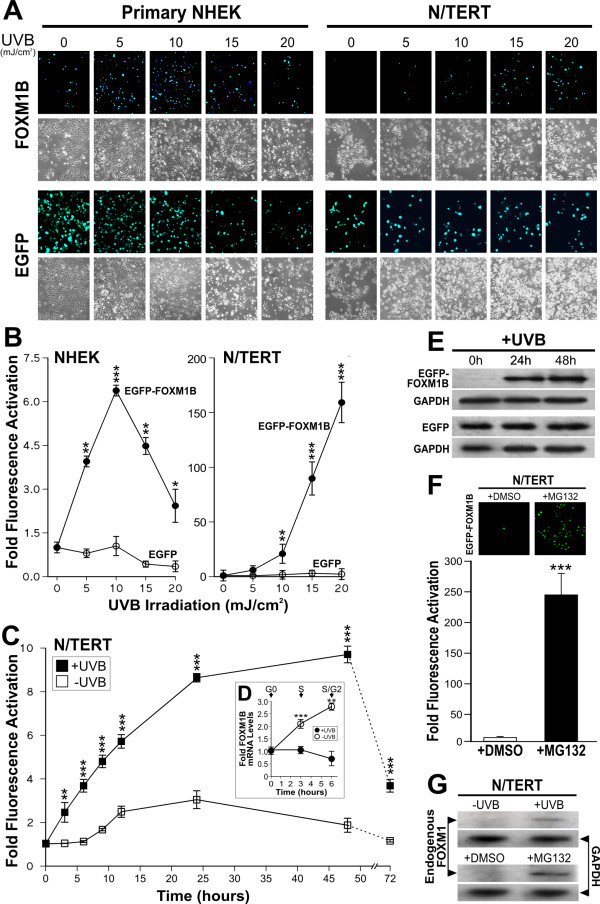
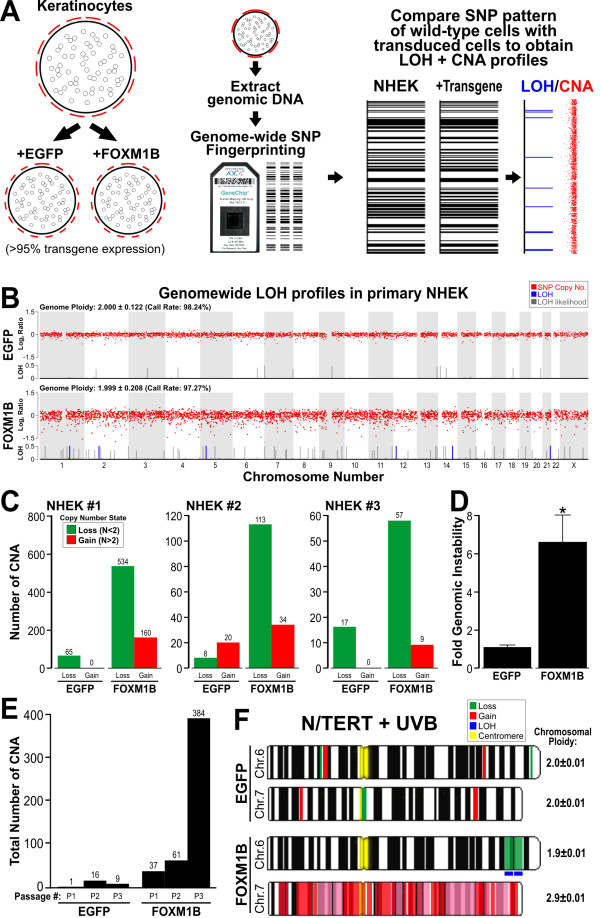
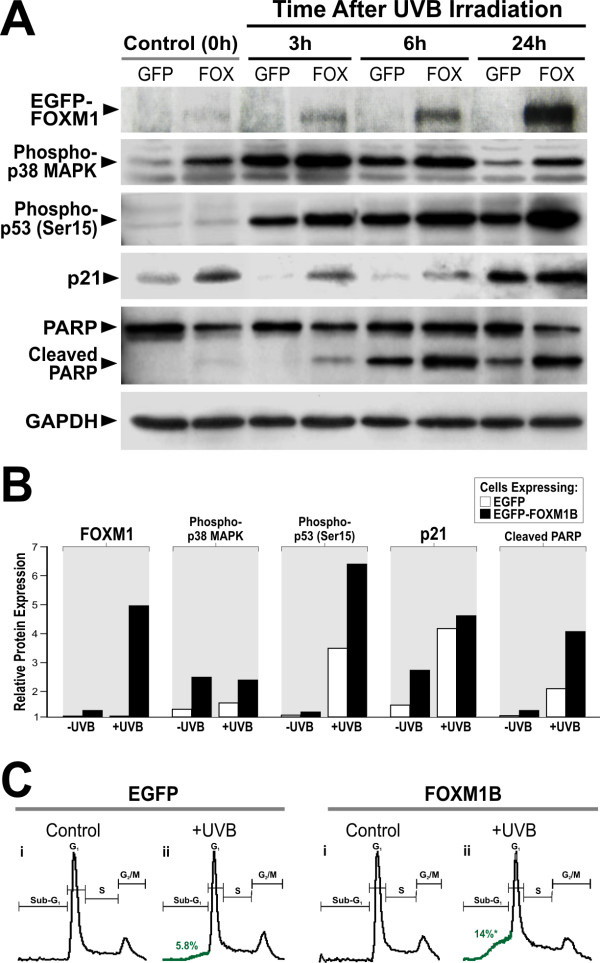
The present study investigated the putative early mechanism of UVB and FOXM1 in skin cancer initiation. We have demonstrated that UVB dose-dependently increased FOXM1 protein levels through protein stabilisation and accumulation rather than de novo mRNA expression in human epidermal keratinocytes. FOXM1 upregulation in primary human keratinocytes triggered pro-apoptotic/DNA-damage checkpoint response genes such as p21, p38 MAPK, p53 and PARP, however, without causing significant cell cycle arrest or cell death. Using a high-resolution Affymetrix genome-wide single nucleotide polymorphism (SNP) mapping technique, we provided the evidence that FOXM1 upregulation in epidermal keratinocytes is sufficient to induce genomic instability, in the form of loss of heterozygosity (LOH) and copy number variations (CNV). FOXM1-induced genomic instability was significantly enhanced and accumulated with increasing cell passage and this instability was increased even further upon exposure to UVB resulting in whole chromosomal gain (7p21.3-7q36.3) and segmental LOH (6q25.1-6q25.3).
We hypothesise that prolonged and repeated UVB exposure selects for skin cells bearing stable FOXM1 protein causes aberrant cell cycle checkpoint thereby allowing ectopic cell cycle entry and subsequent genomic instability. The aberrant upregulation of FOXM1 serves as a 'first hit' where cells acquire genomic instability which in turn predisposes cells to a 'second hit' whereby DNA-damage checkpoint response (eg. p53 or p16) is abolished to allow damaged cells to proliferate and accumulate genetic aberrations/mutations required for cancer initiation.
人类细胞周期转录因子 FOXM1 已知在调节细胞分裂过程中的有丝分裂进展和准确的染色体分离方面发挥关键作用。FOXM1 的失调与大多数人类癌症有关。我们之前曾表明 FOXM1 在基底细胞癌中上调,最近还报告称 FOXM1 在包括口腔、食管、肺、乳腺、肾、膀胱和子宫在内的多种实体人类癌症类型中恶性前上调。这表明 FOXM1 的上调可能是异常细胞周期和癌症起始所需的早期分子信号。
本研究探讨了 UVB 和 FOXM1 在皮肤癌起始中的假定早期机制。我们已经证明,UVB 剂量依赖性地通过蛋白质稳定和积累而不是从头 mRNA 表达来增加人表皮角质形成细胞中的 FOXM1 蛋白水平。FOXM1 在原代人角质形成细胞中的上调引发了促凋亡/DNA 损伤检查点反应基因,如 p21、p38 MAPK、p53 和 PARP,但不会导致明显的细胞周期停滞或细胞死亡。使用高分辨率 Affymetrix 全基因组单核苷酸多态性 (SNP) 映射技术,我们提供了证据表明,表皮角质形成细胞中 FOXM1 的上调足以诱导基因组不稳定性,表现为杂合性丢失 (LOH) 和拷贝数变异 (CNV)。FOXM1 诱导的基因组不稳定性随着细胞传代的增加而显著增强和积累,并且这种不稳定性在暴露于 UVB 后进一步增加,导致整个染色体增益(7p21.3-7q36.3)和片段 LOH(6q25.1-6q25.3)。
我们假设,长时间和反复的 UVB 暴露选择携带稳定 FOXM1 蛋白的皮肤细胞,导致异常的细胞周期检查点,从而允许异位细胞周期进入和随后的基因组不稳定性。FOXM1 的异常上调充当“第一击”,其中细胞获得基因组不稳定性,这反过来又使细胞易受“第二击”影响,其中 DNA 损伤检查点反应(例如 p53 或 p16)被废除,允许受损细胞增殖并积累癌症起始所需的遗传异常/突变。