Department of Pharmacology, University of Cambridge, Tennis Court Road, Cambridge CB2 1PD, United Kingdom.
J Biol Chem. 2010 Apr 23;285(17):12979-89. doi: 10.1074/jbc.M109.096016. Epub 2010 Feb 26.
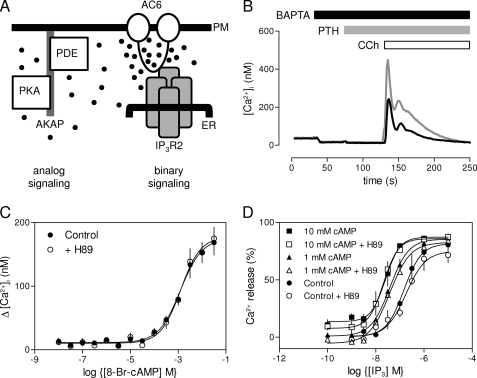
In HEK cells stably expressing type 1 receptors for parathyroid hormone (PTH), PTH causes a sensitization of inositol 1,4,5-trisphosphate receptors (IP(3)R) to IP(3) that is entirely mediated by cAMP and requires cAMP to pass directly from type 6 adenylyl cyclase (AC6) to IP(3)R2. Using DT40 cells expressing single subtypes of mammalian IP(3)R, we demonstrate that high concentrations of cAMP similarly sensitize all IP(3)R isoforms to IP(3) by a mechanism that does not require cAMP-dependent protein kinase (PKA). IP(3) binding to IP(3)R2 is unaffected by cAMP, and sensitization is not mediated by the site through which ATP potentiates responses to IP(3). In single channel recordings from excised nuclear patches of cells expressing IP(3)R2, cAMP alone had no effect, but it increased the open probability of IP(3)R2 activated by a submaximal concentration of IP(3) alone or in combination with a maximally effective concentration of ATP. These results establish that cAMP itself increases the sensitivity of all IP(3)R subtypes to IP(3). For IP(3)R2, this sensitization results from cAMP binding to a novel site that increases the efficacy of IP(3). Using stably expressed short hairpin RNA to reduce expression of the G-protein, G alpha(s), we demonstrate that attenuation of AC activity by loss of G alpha(s) more substantially reduces sensitization of IP(3)R by PTH than does comparable direct inhibition of AC. This suggests that G alpha(s) may also specifically associate with each AC x IP(3)R complex. We conclude that all three subtypes of IP(3)R are regulated by cAMP independent of PKA. In HEK cells, where IP(3)R2 selectively associates with AC6, G alpha(s) also associates with the AC x IP(3)R signaling junction.
在稳定表达甲状旁腺激素 (PTH) 1 型受体的 HEK 细胞中,PTH 通过 cAMP 完全介导并需要 cAMP 直接从 6 型腺苷酸环化酶 (AC6) 传递到 IP(3)R2 来使肌醇 1,4,5-三磷酸受体 (IP(3)R) 对 IP(3) 敏感。使用表达哺乳动物 IP(3)R 单一亚型的 DT40 细胞,我们证明高浓度的 cAMP 通过一种不需要 cAMP 依赖性蛋白激酶 (PKA) 的机制同样使所有 IP(3)R 同工型对 IP(3)敏感。IP(3)与 IP(3)R2 的结合不受 cAMP 影响,并且敏化作用不是通过 ATP 增强对 IP(3)反应的位点介导的。在表达 IP(3)R2 的细胞的核片的单通道记录中,单独的 cAMP 没有作用,但它增加了单独或与最大有效浓度的 ATP 组合的亚最大浓度的 IP(3)激活的 IP(3)R2 的开放概率。这些结果表明 cAMP 本身增加了所有 IP(3)R 亚型对 IP(3)的敏感性。对于 IP(3)R2,这种敏化作用源自 cAMP 与增加 IP(3)效力的新位点结合。使用稳定表达的短发夹 RNA 降低 G 蛋白,G alpha(s) 的表达,我们证明通过丧失 G alpha(s)来衰减 AC 活性比对 AC 的直接抑制更实质性地减少 PTH 对 IP(3)R 的敏化作用。这表明 G alpha(s)也可能与每个 AC x IP(3)R 复合物特异性结合。我们得出结论,所有三种 IP(3)R 亚型都通过与 PKA 无关的 cAMP 调节。在 HEK 细胞中,IP(3)R2 选择性地与 AC6 相关联,G alpha(s)也与 AC x IP(3)R 信号连接点相关联。