Taylor Colin W
Department of Pharmacology, University of Cambridge, Tennis Court Road, Cambridge CB2 1PD, UK.
Cell Calcium. 2017 May;63:48-52. doi: 10.1016/j.ceca.2016.10.005. Epub 2016 Nov 6.
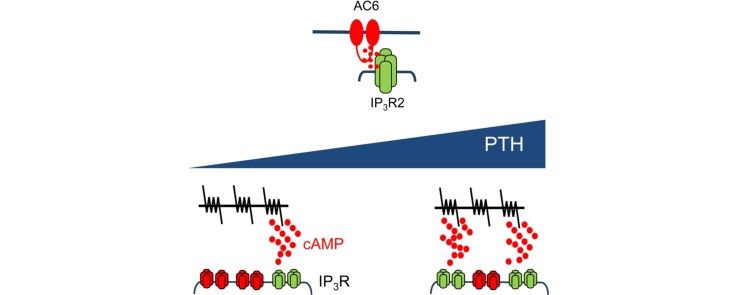
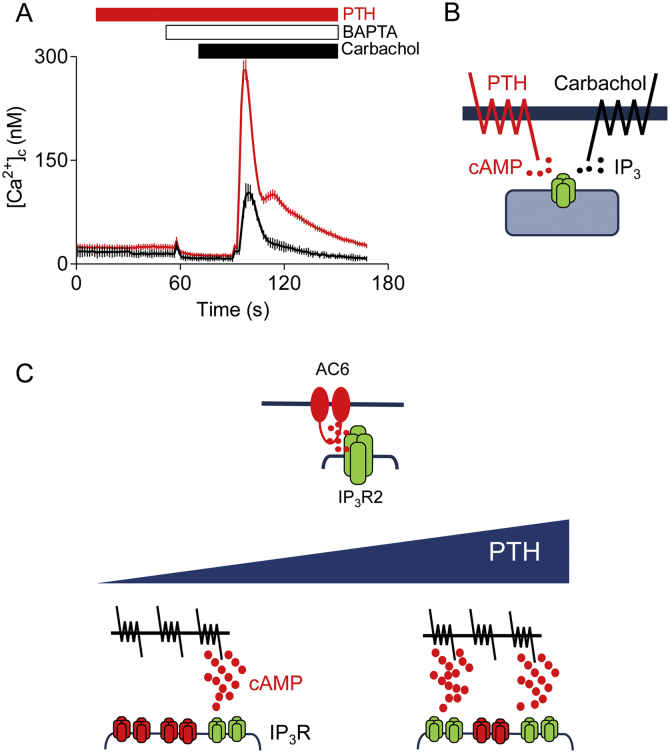
Ca and cAMP are ubiquitous intracellular messengers and interactions between them are commonplace. Here the effects of cAMP on inositol 1,4,5-trisphosphate receptors (IPRs) are briefly reviewed. All three subtypes of IPR are phosphorylated by cAMP-dependent protein kinase (PKA). This potentiates IP-evoked Ca release through IPR1 and IPR2, but probably has little effect on IPR3. In addition, cAMP can directly sensitize all three IPR subtypes to IP. The high concentrations of cAMP required for this PKA-independent modulation of IPRs is delivered to them within signalling junctions that include type 6 adenylyl cyclase and IPR2.
钙(Ca)和环磷酸腺苷(cAMP)是普遍存在的细胞内信使,它们之间的相互作用很常见。本文简要综述了cAMP对肌醇1,4,5-三磷酸受体(IPRs)的影响。IPR的所有三种亚型都可被cAMP依赖性蛋白激酶(PKA)磷酸化。这增强了通过IPR1和IPR2由肌醇磷酸(IP)诱发的钙释放,但可能对IPR3影响很小。此外,cAMP可直接使所有三种IPR亚型对IP敏感。这种不依赖PKA对IPR的调节所需的高浓度cAMP在包括6型腺苷酸环化酶和IPR2的信号连接中传递给它们。