Diabetes Epidemiology and Clinical Research Section, National Institute of Diabetes and Digestive and Kidney Diseases, National Institutes of Health, Phoenix, Arizona, USA.
Pediatrics. 2010 Apr;125(4):e844-51. doi: 10.1542/peds.2009-1230. Epub 2010 Mar 1.
To examine the prognostic significance of elevated albuminuria in youth with type 2 diabetes.
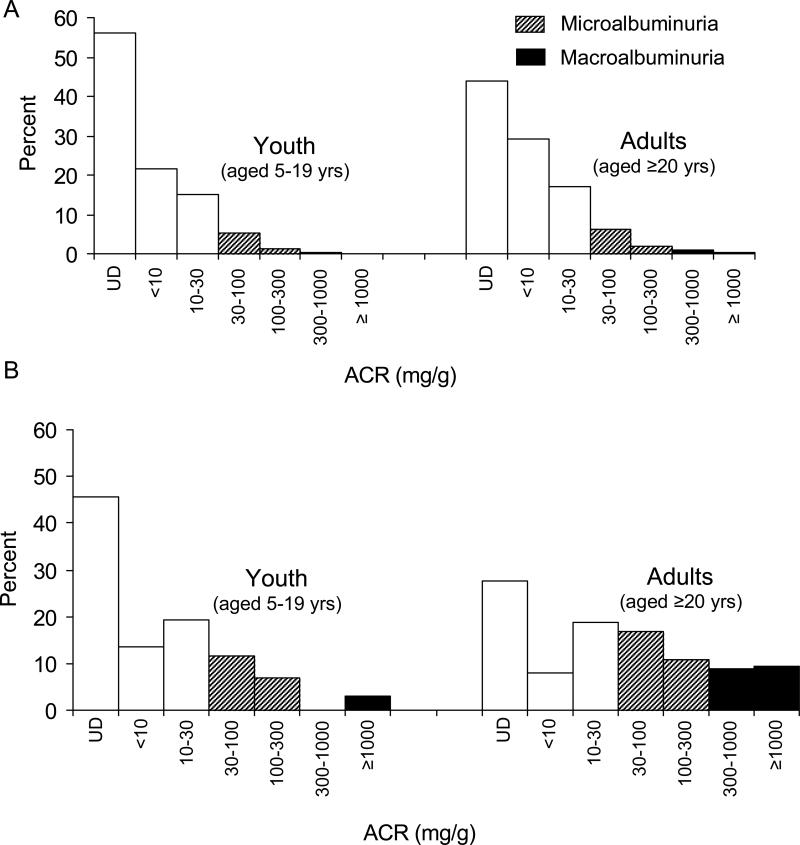
Cross-sectional and prospective studies were conducted on Pima Indian youth aged 5 to 19 years at baseline who were examined between July 1, 1982, and December 31, 2007. Prevalence and sequential changes in the level of microalbuminuria (30 < or = albumin-to-creatinine ratio [ACR] < 300 mg/g) and macroalbuminuria (ACR > or = 300 mg/g) and incidence of macroalbuminuria were computed according to the presence or absence of type 2 diabetes.
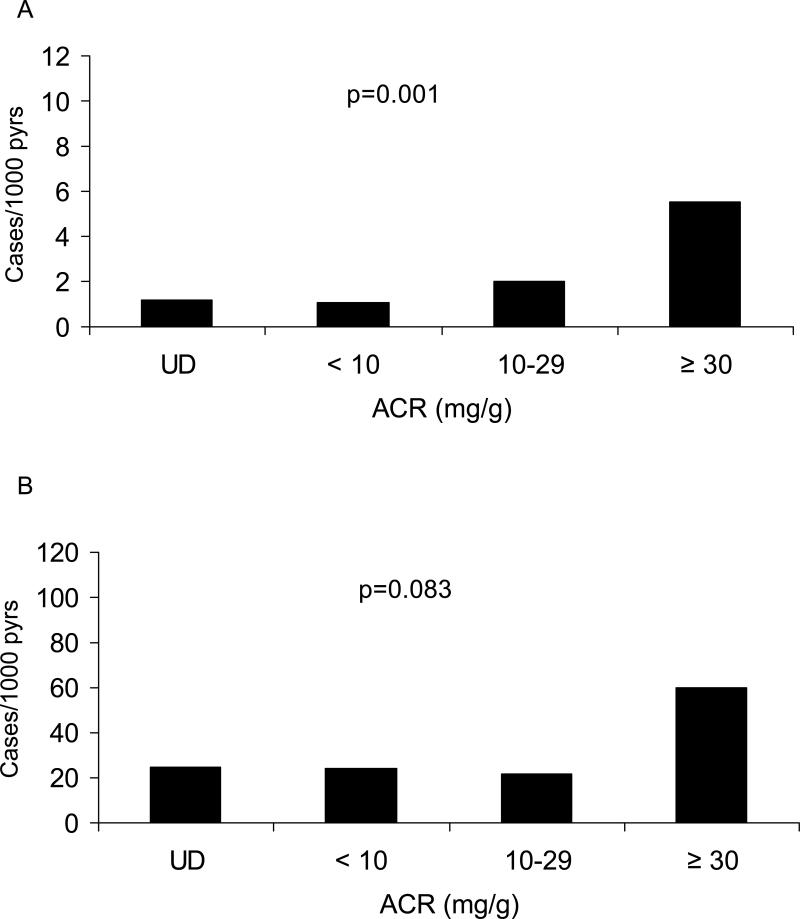
The prevalence of microalbuminuria and macroalbuminuria was 6.5% and 0.6% in the 3856 nondiabetic youth and 18.5% and 2.9% in the 103 youth with diabetes, respectively. One hundred forty-one of 187 (75.4%) nondiabetic youth, but only 1 of 14 (7.1%) diabetic youth with an elevated ACR (> or =30 mg/g) regressed to an undetectable or normal ACR (<30 mg/g) on subsequent examination. In a subset of 2666 youth with a median follow-up of 8.1 years, 36 nondiabetic and 30 diabetic youth with baseline ACRs of <300 mg/g developed macroalbuminuria. For a given ACR, the incidence of macroalbuminuria was 15.9-fold (95% confidence interval: 11.1-22.6) higher in the diabetic than in the nondiabetic youth.
Elevated albuminuria is infrequent and largely transient in nondiabetic youth, but it is relatively frequent and largely persistent in those with diabetes. Microalbuminuria in youth with type 2 diabetes strongly predicts progression to macroalbuminuria, which supports annual screening for albuminuria.
探讨青少年 2 型糖尿病患者白蛋白尿升高的预后意义。
对 1982 年 7 月 1 日至 2007 年 12 月 31 日期间检查的年龄在 5 至 19 岁的皮马印第安青少年进行了横断面和前瞻性研究。根据是否存在 2 型糖尿病,计算了微量白蛋白尿(30≤白蛋白/肌酐比值[ACR]<300mg/g)和大量白蛋白尿(ACR≥300mg/g)的发生率及水平以及大量白蛋白尿的发生率。
在 3856 名非糖尿病青少年中,微量白蛋白尿和大量白蛋白尿的患病率分别为 6.5%和 0.6%,在 103 名糖尿病青少年中,分别为 18.5%和 2.9%。在 187 名(75.4%)非糖尿病青少年中,有 141 名(75.4%)ACR 升高(≥30mg/g)的青少年,随后检查中白蛋白尿恢复至无法检测或正常(<30mg/g),但在 14 名(7.1%)糖尿病青少年中,只有 1 名(7.1%)出现这种情况。在有中位随访时间 8.1 年的 2666 名青少年的亚组中,有 36 名非糖尿病青少年和 30 名糖尿病青少年的基线 ACR <300mg/g 发展为大量白蛋白尿。对于给定的 ACR,糖尿病青少年的大量白蛋白尿发生率比非糖尿病青少年高 15.9 倍(95%置信区间:11.1-22.6)。
在非糖尿病青少年中,白蛋白尿升高不常见且大多是短暂的,但在糖尿病患者中则相对常见且大多是持久的。青少年 2 型糖尿病患者的微量白蛋白尿强烈提示向大量白蛋白尿进展,支持每年筛查白蛋白尿。