Division of Gastroenterology, Department of Internal Medicine, Baylor University Medical Center, Dallas, Texas, United States of America.
PLoS One. 2010 Feb 24;5(2):e9393. doi: 10.1371/journal.pone.0009393.
Microsatellite instability (MSI) is used to screen colorectal cancers (CRC) for Lynch Syndrome, and to predict outcome and response to treatment. The current technique for measuring MSI requires DNA from normal and neoplastic tissues, and fails to identify tumors with specific DNA mismatch repair (MMR) defects. We tested a panel of five quasi-monomorphic mononucleotide repeat markers amplified in a single multiplex PCR reaction (pentaplex PCR) to detect MSI.
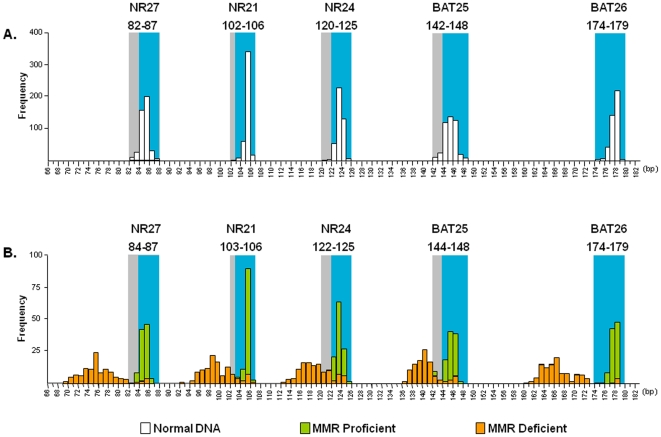
We investigated a cohort of 213 CRC patients, comprised of 114 MMR-deficient and 99 MMR-proficient tumors. Immunohistochemical (IHC) analysis evaluated the expression of MLH1, MSH2, PMS2 and MSH6. MSI status was defined by differences in the quasi-monomorphic variation range (QMVR) from a pool of normal DNA samples, and measuring differences in allele lengths in tumor DNA.
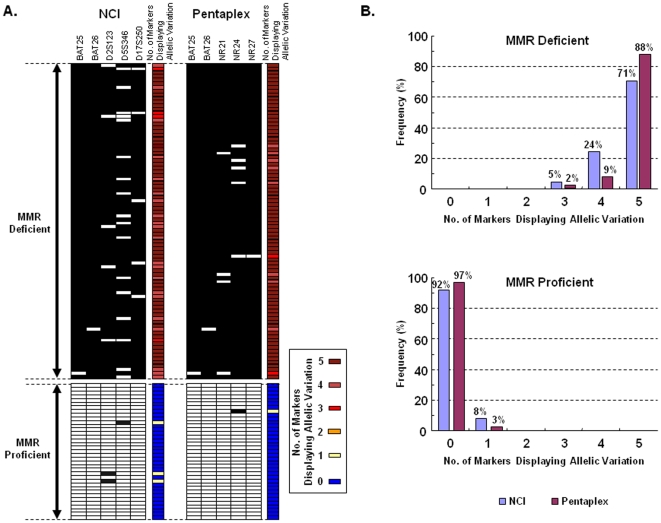
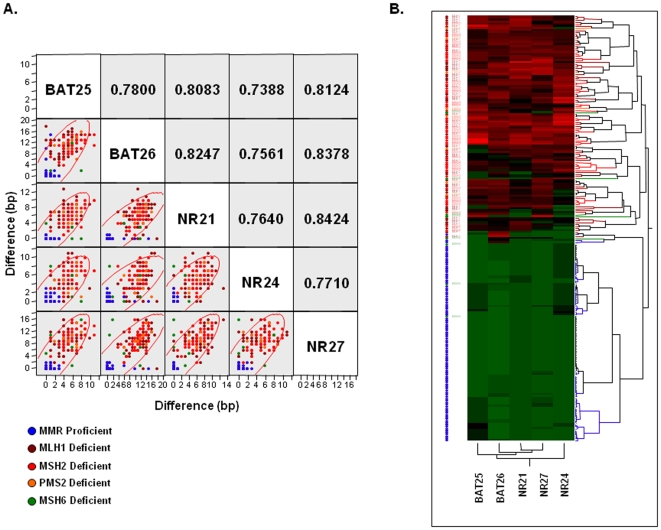
Amplification of 426 normal alleles allowed optimization of the QMVR at each marker, and eliminated the requirement for matched reference DNA to define MSI in each sample. Using > or = 2/5 unstable markers as the criteria for MSI resulted in a sensitivity of 95.6% (95% CI = 90.1-98.1%) and a positive predictive value of 100% (95% CI = 96.6%-100%). Detection of MSH6-deficiency was limited using all techniques. Data analysis with a three-marker panel (BAT26, NR21 and NR27) was comparable in sensitivity (97.4%) and positive predictive value (96.5%) to the five marker panel. Both approaches were superior to the standard approach to measuring MSI.
An optimized pentaplex (or triplex) PCR offers a facile, robust, very inexpensive, highly sensitive, and specific assay for the identification of MSI in CRC.
微卫星不稳定性 (MSI) 用于筛选结直肠癌 (CRC) 的林奇综合征,并预测治疗效果和反应。目前用于测量 MSI 的技术需要来自正常和肿瘤组织的 DNA,并且无法识别具有特定 DNA 错配修复 (MMR) 缺陷的肿瘤。我们测试了一组在单个多重 PCR 反应中扩增的五个拟单态单核苷酸重复标记物 (五重 PCR),以检测 MSI。
我们研究了一个由 213 例 CRC 患者组成的队列,其中包括 114 例 MMR 缺陷型肿瘤和 99 例 MMR 功能正常型肿瘤。免疫组化 (IHC) 分析评估了 MLH1、MSH2、PMS2 和 MSH6 的表达。MSI 状态通过与正常 DNA 样本池的拟单态变异范围 (QMVR) 的差异以及肿瘤 DNA 中等位基因长度的差异来定义。
426 个正常等位基因的扩增允许优化每个标记物的 QMVR,并消除了在每个样本中定义 MSI 时需要匹配参考 DNA 的要求。使用>或= 5 个不稳定标记物中的 2/5 作为 MSI 的标准,灵敏度为 95.6%(95%CI=90.1-98.1%),阳性预测值为 100%(95%CI=96.6%-100%)。使用所有技术均检测到 MSH6 缺陷的局限性。使用三标记物(BAT26、NR21 和 NR27)的数据分析在灵敏度(97.4%)和阳性预测值(96.5%)方面与五标记物相似。这两种方法均优于传统的 MSI 测量方法。
优化的五重 (或三重) PCR 提供了一种简便、稳健、非常廉价、高度敏感和特异的 CRC 中 MSI 鉴定方法。