Thyroid Research Unit, James J. Peters VA Medical Center, Mount Sinai School of Medicine, New York, New York, United States of America.
PLoS One. 2010 Feb 26;5(2):e9449. doi: 10.1371/journal.pone.0009449.
The thyrotropin stimulating hormone receptor (TSHR) is a G protein coupled receptor (GPCR) with a large ectodomain. The ligand, TSH, acting via this receptor regulates thyroid growth and thyroid hormone production and secretion. The TSH receptor (TSHR) undergoes complex post-translational modifications including intramolecular cleavage and receptor multimerization. Since monomeric and multimeric receptors coexist in cells, understanding the functional role of just the TSHR multimers is difficult. Therefore, to help understand the physiological significance of receptor multimerization, it will be necessary to abrogate multimer formation, which requires identifying the ectodomain and endodomain interaction sites on the TSHR. Here, we have examined the contribution of the ectodomain to constitutive multimerization of the TSHR and determined the possible residue(s) that may be involved in this interaction.
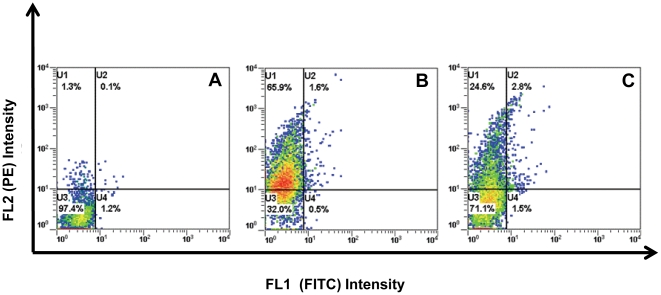
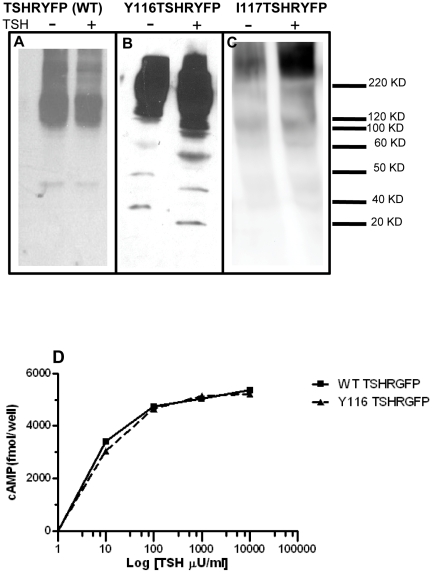
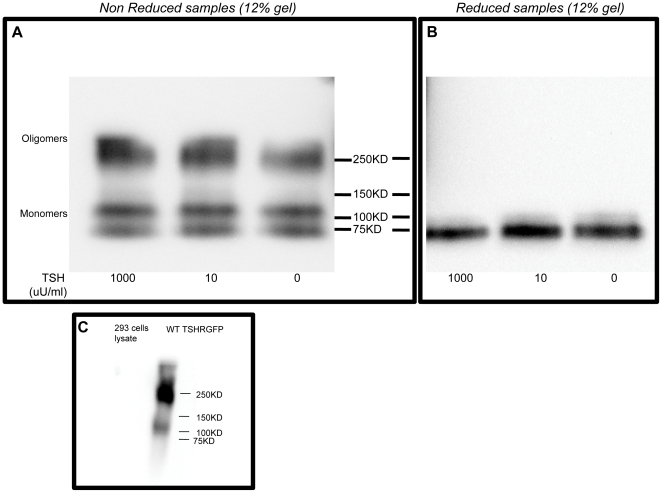
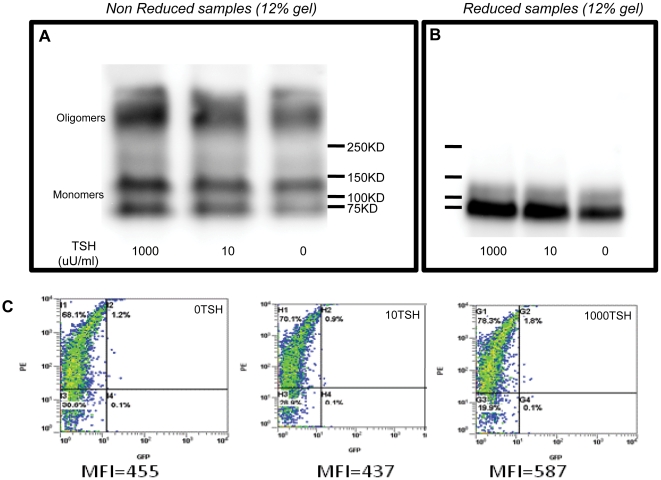
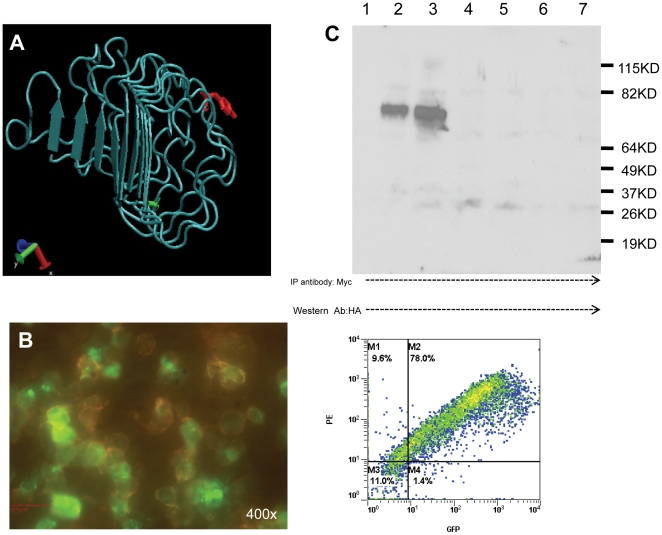
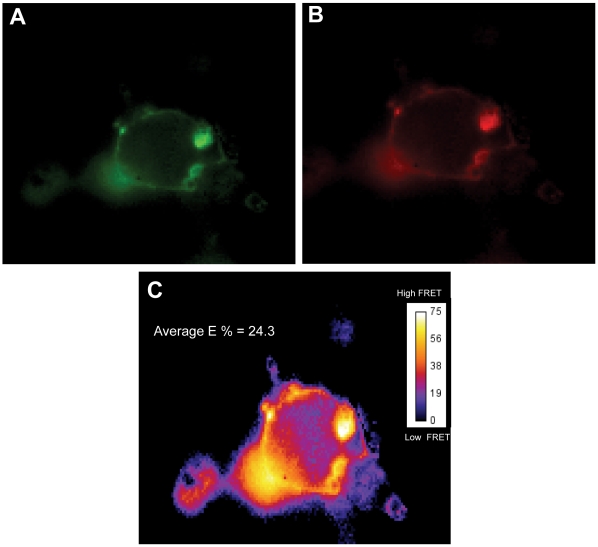
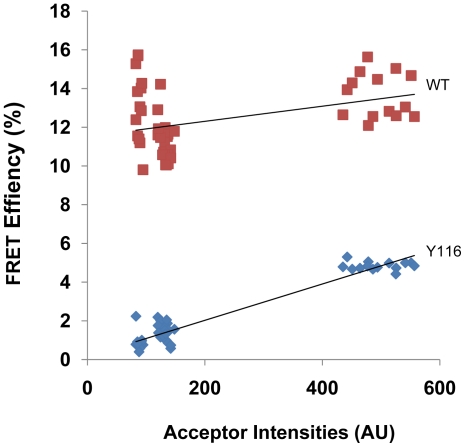
METHODOLOGY/PRINCIPAL FINDINGS: We studied ectodomain multimer formation by expressing the extracellular domain of the TSHR linked to a glycophosphotidyl (GPI) anchor in both stable and transient expression systems. Using co-immunoprecipitation and FRET of tagged receptors, we established that the TSH receptor ectodomain was capable of multimerization even when totally devoid of the transmembrane domain. Further, we studied the effect of two residues that likely made critical contact points in this interaction. We showed that a conserved tyrosine residue (Y116) on the convex surface of the LRR3 was a critical residue in ectodomain multimer formation since mutation of this residue to serine totally abrogated ectodomain multimers. This abrogation was not seen with the mutation of cysteine 176 on the inner side of the LRR5, demonstrating that inter-receptor disulfide bonding was not involved in ectodomain multimer formation. Additionally, the Y116 mutation in the intact wild type receptor enhanced receptor degradation.
CONCLUSIONS/SIGNIFICANCE: These data establish the TSH receptor ectodomain as one site of multimerization, independent of the transmembrane region, and that this interaction was primarily via a conserved tyrosine residue in LRR3.
促甲状腺激素受体(TSHR)是一种具有大胞外结构域的 G 蛋白偶联受体(GPCR)。配体 TSH 通过该受体发挥作用,调节甲状腺生长和甲状腺激素的产生和分泌。TSHR(促甲状腺激素受体)经历复杂的翻译后修饰,包括分子内裂解和受体多聚化。由于单体和多聚体受体共存于细胞中,因此仅了解 TSHR 多聚体的功能作用较为困难。因此,为了帮助理解受体多聚化的生理意义,有必要消除多聚体形成,这需要确定 TSHR 胞外域和胞内域相互作用的部位。在这里,我们研究了 TSHR 胞外域对其组成型多聚化的贡献,并确定了可能参与这种相互作用的残基。
方法/主要发现:我们通过在稳定和瞬时表达系统中表达与糖基磷脂酰肌醇(GPI)锚定连接的 TSHR 胞外结构域,研究了胞外域多聚体的形成。通过共免疫沉淀和标记受体的 FRET,我们证实即使完全缺乏跨膜结构域,TSHR 受体胞外结构域也能够形成多聚体。此外,我们研究了两个可能在这种相互作用中形成关键接触点的残基的影响。我们发现,LRR3 凸面上的一个保守酪氨酸残基(Y116)是胞外域多聚体形成的关键残基,因为将该残基突变为丝氨酸完全消除了胞外域多聚体。在 LRR5 内侧的半胱氨酸 176 突变时,没有看到这种消除现象,这表明在胞外域多聚体形成过程中没有涉及受体间二硫键的形成。此外,完整野生型受体中的 Y116 突变增强了受体的降解。
结论/意义:这些数据确立了 TSH 受体胞外域是多聚化的一个位点,与跨膜区无关,并且这种相互作用主要是通过 LRR3 中的一个保守酪氨酸残基进行的。