Sanford Burnham Medical Research Institute, 10901 North Torrey Pines Road, La Jolla, California 92037, USA.
Biochemistry. 2010 Apr 6;49(13):2768-77. doi: 10.1021/bi100158s.
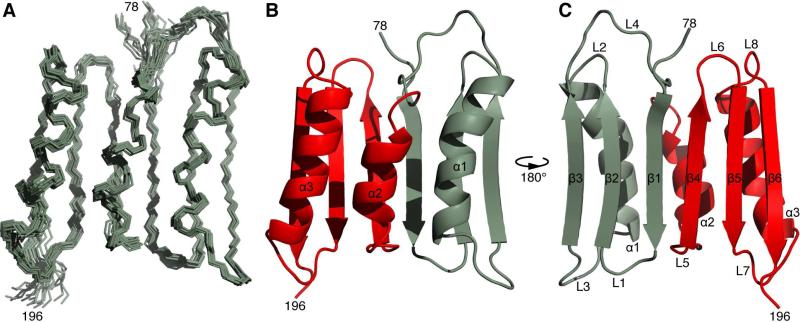
The membrane protein Rv0899 (OmpATb) from Mycobacterium tuberculosis, has been proposed to act as an outer membrane porin and to contribute to the bacterium's adaptation to the acidic environment of the phagosome during infection. The gene is restricted to pathogenic mycobacteria and, thus, is an attractive candidate for the development of anti-tuberculosis chemotherapy. The 326-residue protein contains three domains: an N-terminal domain (residues 1-72) that includes a sequence of 20 hydrophobic amino acids required for membrane translocation, a central B domain (residues 73-200) with homology to the conserved putative lipid-binding BON (bacterial OsmY and nodulation) superfamily, and a C domain (residues 201-326) with homology to the OmpA-C-like superfamily of periplasmic peptidoglycan-binding sequences, found in several types of bacterial membrane proteins, including in the C-terminus of the Escherichia coli outer membrane protein OmpA. We have characterized the structure and dynamics of the B and C domains and have determined the three-dimensional structure of the B domain. Rv0899 does not form a transmembrane beta-barrel. Residues 73-326 form a mixed alpha/beta-globular structure, encompassing two independently folded modules corresponding to the B and C domains connected by a flexible linker. The B domain folds with three parallel/antiparallel alpha-helices packed against six parallel/antiparallel beta-strands that form a flat beta-sheet. The core is hydrophobic, while the exterior is polar and predominantly acidic. The structure of a BON homology domain is revealed here for the first time. In light of this unexpected structure, it is hard to reconcile an outer membrane porin activity with the central domain of the protein. The structure of the B domain and the overall architecture of the protein suggest alternative modes of membrane association.
结核分枝杆菌的膜蛋白 Rv0899(OmpATb)被认为是一种外膜孔蛋白,有助于细菌在感染期间适应吞噬体的酸性环境。该基因仅限于致病性分枝杆菌,因此是开发抗结核化疗药物的有吸引力的候选物。该 326 个残基的蛋白质包含三个结构域:N 端结构域(残基 1-72),其中包含 20 个疏水性氨基酸序列,这些氨基酸序列是膜易位所必需的;中央 B 结构域(残基 73-200)与保守的假定脂质结合 BON(细菌 OsmY 和结瘤)超家族同源;C 结构域(残基 201-326)与几种类型的细菌膜蛋白中的 OmpA-C 样周质肽聚糖结合序列同源,包括大肠杆菌外膜蛋白 OmpA 的 C 末端。我们已经对 B 和 C 结构域的结构和动力学进行了表征,并确定了 B 结构域的三维结构。Rv0899 不形成跨膜β桶。残基 73-326 形成混合的α/β-球蛋白结构,包含两个独立折叠的模块,对应于 B 和 C 结构域,通过柔性接头连接。B 结构域折叠成三个平行/反平行的α-螺旋,与形成平坦β-折叠的六个平行/反平行的β-链结合。核心是疏水性的,而外部是极性的,主要是酸性的。这里首次揭示了 BON 同源结构域的结构。鉴于这种出乎意料的结构,很难将外膜孔蛋白活性与该蛋白的中心结构域联系起来。B 结构域的结构和蛋白质的整体结构提示了替代的膜结合模式。