The Jackson Laboratory, Bar Harbor, ME 04609, USA.
J Bone Miner Res. 2010 Aug;25(8):1808-20. doi: 10.1002/jbmr.72.
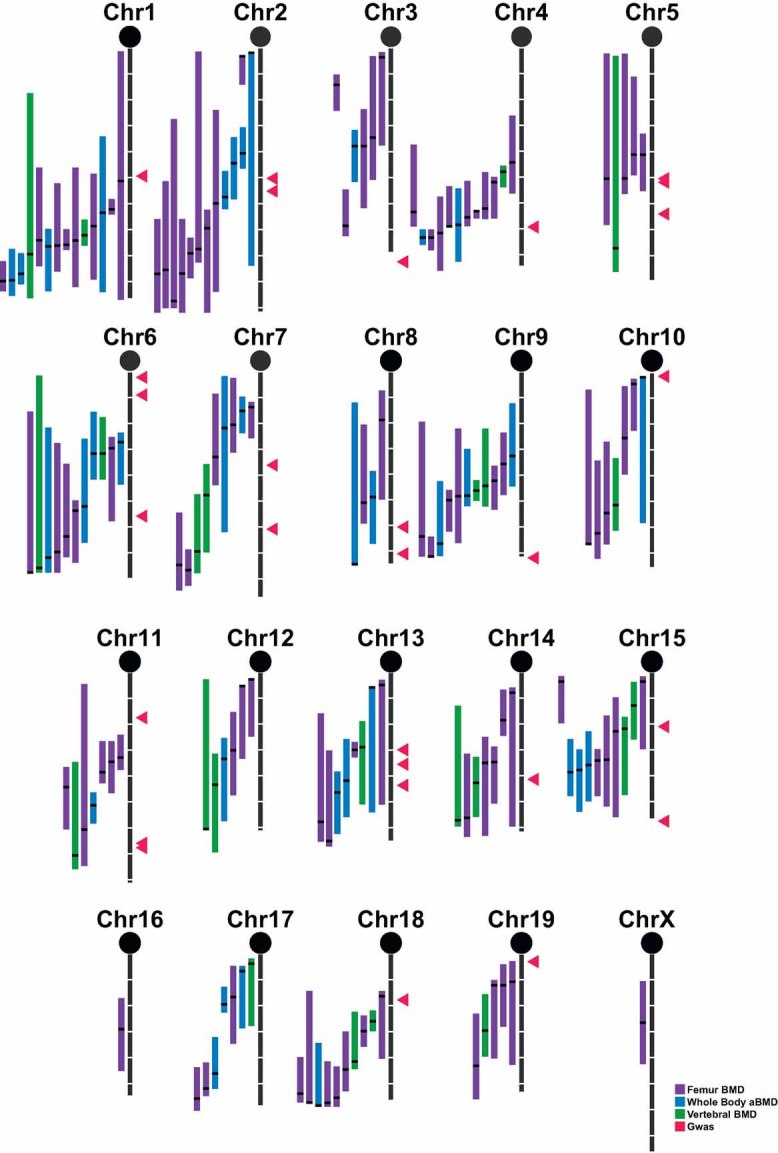
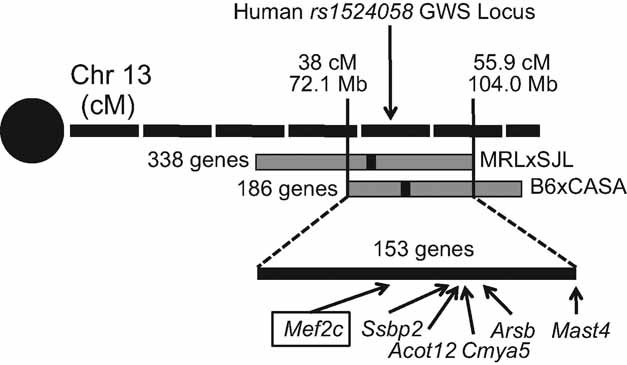
Bone mineral density (BMD) is a heritable trait, and in mice, over 100 quantitative trait loci (QTLs) have been reported, but candidate genes have been identified for only a small percentage. Persistent errors in the mouse genetic map have negatively affected QTL localization, spurring the development of a new, corrected map. In this study, QTLs for BMD were remapped in 11 archival mouse data sets using this new genetic map. Since these QTLs all were mapped in a comparable way, direct comparisons of QTLs for concordance would be valid. We then compared human genome-wide association study (GWAS) BMD loci with the mouse QTLs. We found that 26 of the 28 human GWAS loci examined were located within the confidence interval of a mouse QTL. Furthermore, 14 of the GWAS loci mapped to within 3 cM of a mouse QTL peak. Lastly, we demonstrated that these newly remapped mouse QTLs can substantiate a candidate gene for a human GWAS locus, for which the peak single-nucleotide polymorphism (SNP) fell in an intergenic region. Specifically, we suggest that MEF2C (human chromosome 5, mouse chromosome 13) should be considered a candidate gene for the genetic regulation of BMD. In conclusion, use of the new mouse genetic map has improved the localization of mouse BMD QTLs, and these remapped QTLs show high concordance with human GWAS loci. We believe that this is an opportune time for a renewed effort by the genetics community to identify the causal variants regulating BMD using a synergistic mouse-human approach.
骨密度(BMD)是一种可遗传的特征,在小鼠中,已经报道了超过 100 个数量性状位点(QTL),但只有一小部分确定了候选基因。小鼠遗传图谱中的持续错误严重影响了 QTL 的定位,促使开发了新的、修正的图谱。在这项研究中,使用新的遗传图谱在 11 个存档的小鼠数据集上重新定位了 BMD 的 QTL。由于这些 QTL 都是以类似的方式定位的,因此对 QTL 的一致性进行直接比较是有效的。然后,我们将人类全基因组关联研究(GWAS)的 BMD 位点与小鼠 QTL 进行了比较。我们发现,在检查的 28 个人类 GWAS 位点中,有 26 个位于小鼠 QTL 的置信区间内。此外,14 个 GWAS 位点映射到小鼠 QTL 峰的 3cM 范围内。最后,我们证明了这些新重新定位的小鼠 QTL 可以为人类 GWAS 位点的候选基因提供依据,其中峰值单核苷酸多态性(SNP)位于基因间区域。具体来说,我们建议 MEF2C(人类染色体 5,小鼠染色体 13)应被视为人类 GWAS 位点遗传调控 BMD 的候选基因。总之,新的小鼠遗传图谱的使用提高了小鼠 BMD QTL 的定位精度,并且这些重新定位的 QTL 与人类 GWAS 位点具有高度一致性。我们认为,现在是遗传学界重新努力利用协同的小鼠-人类方法来确定调节 BMD 的因果变异的好时机。