Laboratory of Molecular Medicine, Harvard Medical School, Boston, Massachusetts, USA.
Nat Struct Mol Biol. 2010 Apr;17(4):438-44. doi: 10.1038/nsmb.1772. Epub 2010 Mar 7.
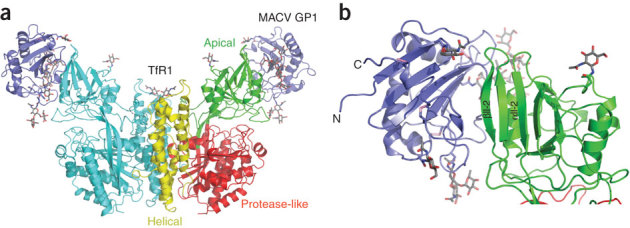
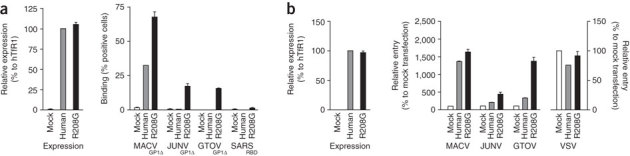
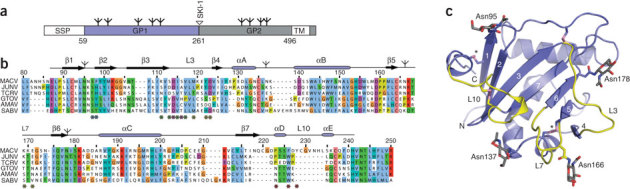
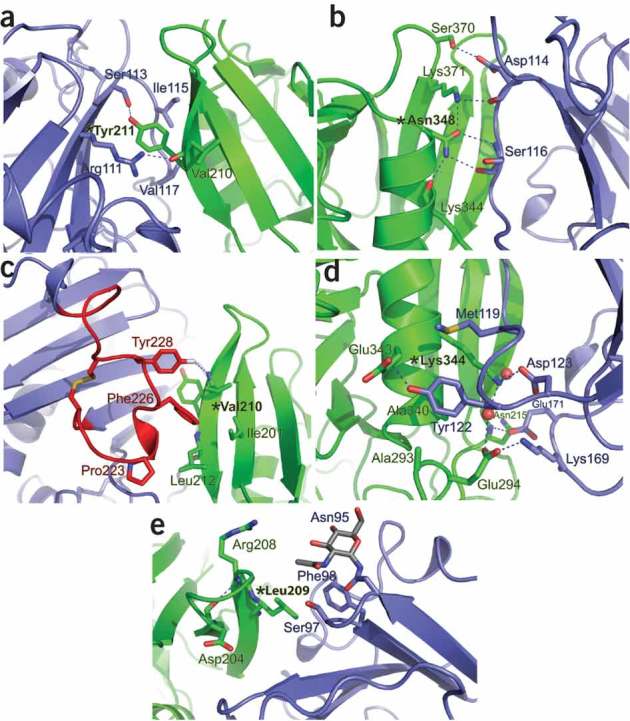
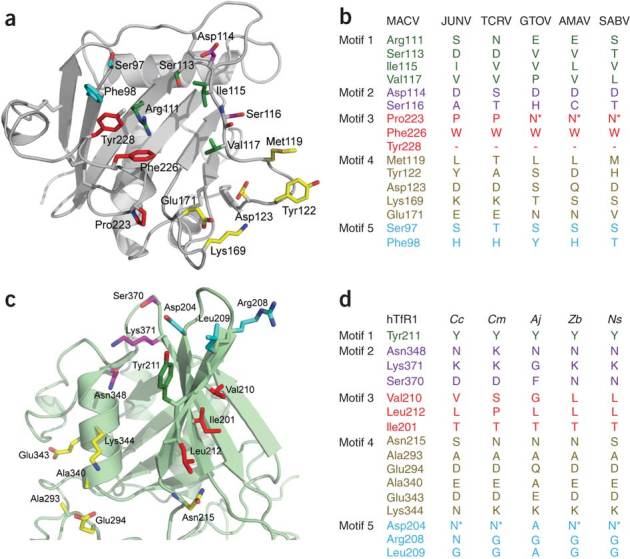
New World hemorrhagic fever arenaviruses are rodent-borne agents that cause severe human disease. The GP1 subunit of the surface glycoprotein mediates cell attachment through transferrin receptor 1 (TfR1). We report the structure of Machupo virus (MACV) GP1 bound with human TfR1. Atomic details of the GP1-TfR1 interface clarify the importance of TfR1 residues implicated in New World arenavirus host specificity. Analysis of sequence variation among New World arenavirus GP1s and their host-species receptors, in light of the molecular structure, indicates determinants of viral zoonotic transmission. Infectivities of pseudoviruses in cells expressing mutated TfR1 confirm that contacts at the tip of the TfR1 apical domain determine the capacity of human TfR1 to mediate infection by particular New World arenaviruses. We propose that New World arenaviruses that are pathogenic to humans fortuitously acquired affinity for human TfR1 during adaptation to TfR1 of their natural hosts.
新型出血热沙粒病毒是通过携带病毒的啮齿动物传播的病原体,可导致人类严重疾病。表面糖蛋白的 GP1 亚单位通过转铁蛋白受体 1(TfR1)介导细胞附着。我们报告了与人类 TfR1 结合的马丘波病毒(MACV)GP1 的结构。GP1-TfR1 界面的原子细节阐明了与新型沙粒病毒宿主特异性相关的 TfR1 残基的重要性。鉴于分子结构,对新型沙粒病毒 GP1 及其宿主物种受体之间的序列变异进行分析,表明了病毒人畜共患病传播的决定因素。在表达突变 TfR1 的细胞中假病毒的感染性证实了 TfR1 顶端结构域尖端的接触决定了特定新型沙粒病毒利用人 TfR1 进行感染的能力。我们提出,对人类具有致病性的新型沙粒病毒在适应其自然宿主的 TfR1 时偶然获得了对人 TfR1 的亲和力。