Department of Biochemistry, University of California Riverside, Riverside, California, United States of America.
PLoS One. 2010 Mar 1;5(3):e9455. doi: 10.1371/journal.pone.0009455.
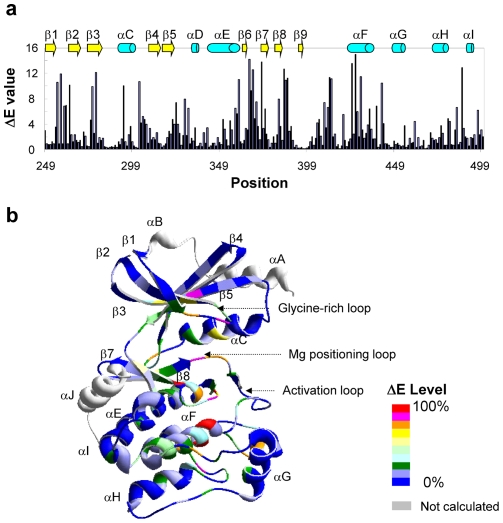
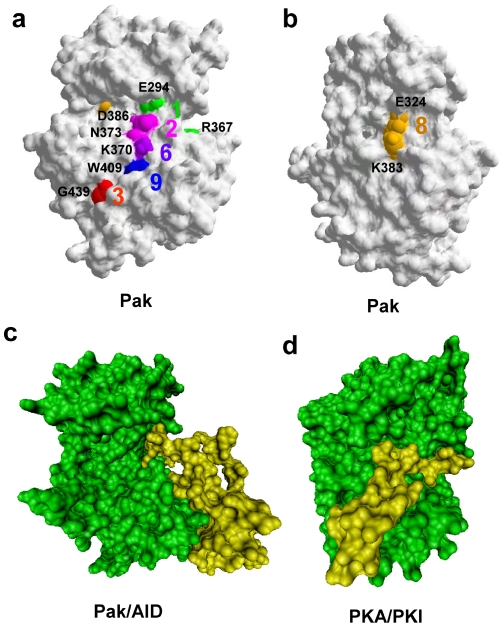
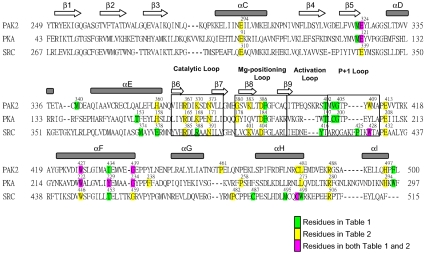
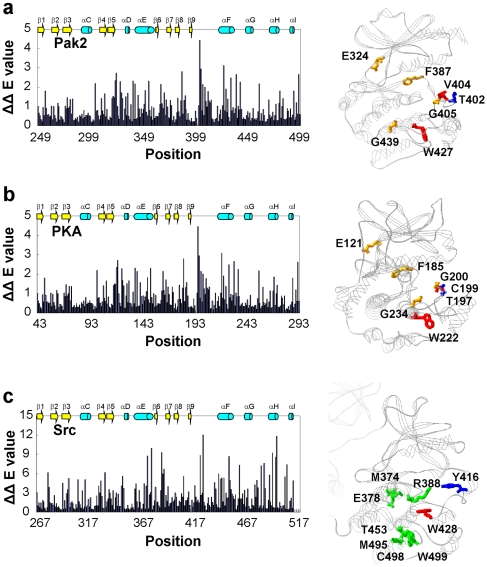
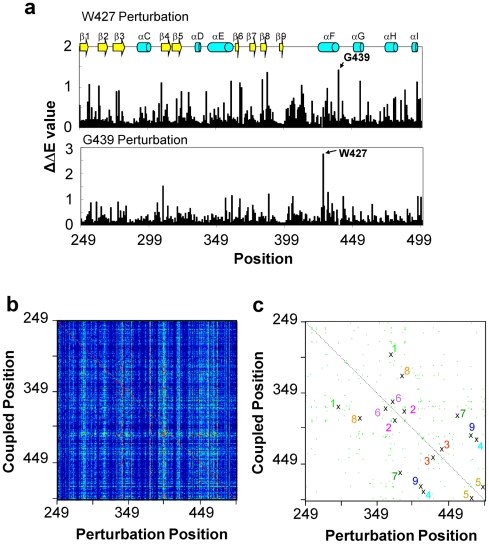
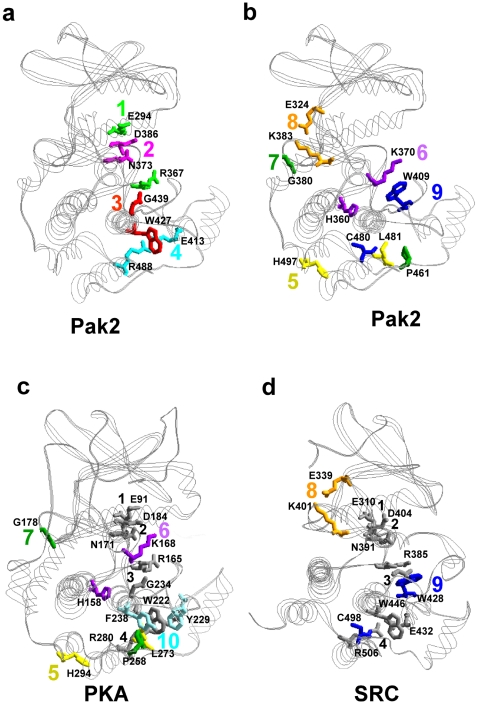
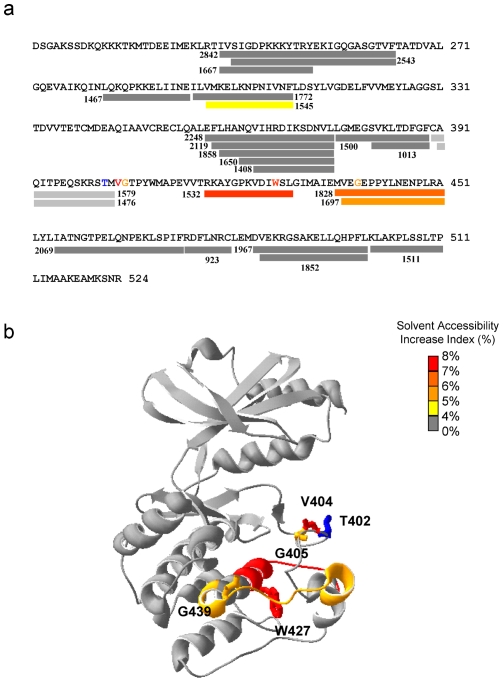
Regulation of Pak2 activity involves at least two mechanisms: (i) phosphorylation of the conserved Thr(402) in the activation loop and (ii) interaction of the autoinhibitory domain (AID) with the catalytic domain. We collected 482 human protein kinase sequences from the kinome database and globally mapped the evolutionary interactions of the residues in the catalytic domain with Thr(402) by sequence-based statistical coupling analysis (SCA). Perturbation of Thr(402) (34.6%) suggests a communication pathway between Thr(402) in the activation loop, and Phe(387) (DeltaDeltaE(387F,402T) = 2.80) in the magnesium positioning loop, Trp(427) (DeltaDeltaE(427W,402T) = 3.12) in the F-helix, and Val(404) (DeltaDeltaE(404V,402T) = 4.43) and Gly(405) (DeltaDeltaE(405G,402T) = 2.95) in the peptide positioning loop. When compared to the cAMP-dependent protein kinase (PKA) and Src, the perturbation pattern of threonine phosphorylation in the activation loop of Pak2 is similar to that of PKA, and different from the tyrosine phosphorylation pattern of Src. Reciprocal coupling analysis by SCA showed the residues perturbed by Thr(402) and the reciprocal coupling pairs formed a network centered at Trp(427) in the F-helix. Nine pairs of reciprocal coupling residues crucial for enzymatic activity and structural stabilization were identified. Pak2, PKA and Src share four pairs. Reciprocal coupling residues exposed to the solvent line up as an activation groove. This is the inhibitor (PKI) binding region in PKA and the activation groove for Pak2. This indicates these evolutionary conserved residues are crucial for the catalytic activity of PKA and Pak2.
Pak2 活性的调节至少涉及两种机制:(i)激活环中保守 Thr(402)的磷酸化,和(ii)自动抑制结构域(AID)与催化结构域的相互作用。我们从激酶组数据库中收集了 482 个人类蛋白激酶序列,并通过基于序列的统计耦合分析(SCA)全局映射了催化结构域中与 Thr(402)相互作用的残基的进化关系。Thr(402)的扰动(34.6%)表明激活环中的 Thr(402)与镁定位环中的 Phe(387)(DeltaDeltaE(387F,402T) = 2.80)、F-螺旋中的 Trp(427)(DeltaDeltaE(427W,402T) = 3.12)和肽定位环中的 Val(404)(DeltaDeltaE(404V,402T) = 4.43)和 Gly(405)(DeltaDeltaE(405G,402T) = 2.95)之间存在通讯途径。与 cAMP 依赖性蛋白激酶(PKA)和 Src 相比,Pak2 激活环中 Thr 磷酸化的扰动模式与 PKA 相似,而与 Src 的酪氨酸磷酸化模式不同。通过 SCA 进行的相互耦合分析表明,被 Thr(402)扰动的残基和形成的相互耦合对以 F-螺旋中的 Trp(427)为中心形成网络。鉴定了 9 对对于酶活性和结构稳定性至关重要的相互耦合残基。Pak2、PKA 和 Src 共享 4 对。暴露于溶剂的相互耦合残基排列成激活槽。这是 PKA 的抑制剂(PKI)结合区和 Pak2 的激活槽。这表明这些进化保守的残基对于 PKA 和 Pak2 的催化活性至关重要。