Department of Experimental Radiation Oncology, University of Texas M. D. Anderson Cancer Center, Houston, Texas, USA.
Environ Mol Mutagen. 2010 Jul;51(6):493-9. doi: 10.1002/em.20558.
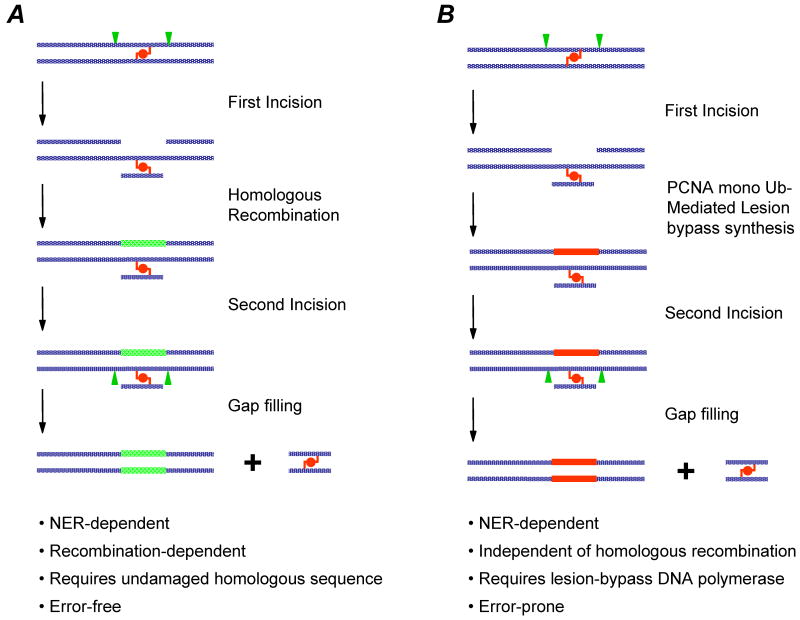
Formation of DNA interstrand crosslinks (ICLs) in chromosomal DNA imposes acute obstruction of all essential DNA functions. For over 70 years bifunctional alkylators, also known as DNA crosslinkers, have been an important class of cancer chemotherapeutic regimens. The mechanisms of ICL repair remains largely elusive. Here, we review a eukaryotic mutagenic ICL repair pathway discovered by work from several laboratories. This repair pathway, alternatively termed recombination-independent ICL repair, involves the incision activities of the nucleotide excision repair (NER) mechanism and lesion bypass polymerase(s). Repair of the ICL is initiated by dual incisions flanking the ICL on one strand of the double helix; the resulting gap is filled in by lesion bypass polymerases. The remaining lesion is subsequently removed by a second round of NER reaction. The mutagenic repair of ICL likely interacts with other cellular mechanisms such as the Fanconi anemia pathway and recombinational repair of ICLs. These aspects will also be discussed.
DNA 链间交联(ICLs)在染色体 DNA 中的形成对所有基本的 DNA 功能造成严重阻碍。70 多年来,双功能烷化剂,也称为 DNA 交联剂,一直是癌症化疗方案的一个重要类别。ICL 修复的机制在很大程度上仍难以捉摸。在这里,我们回顾了几个实验室的工作发现的一种真核突变 ICL 修复途径。这种修复途径,也称为不依赖重组的 ICL 修复,涉及核苷酸切除修复(NER)机制和损伤绕过聚合酶的切口活性。ICL 的修复是由双螺旋中一条链上的 ICL 两侧的双重切口启动的;随后由损伤绕过聚合酶填充缺口。剩余的损伤随后通过第二轮 NER 反应去除。ICL 的诱变修复可能与其他细胞机制相互作用,如范可尼贫血途径和 ICL 的重组修复。这些方面也将进行讨论。