Department of Psychiatry, College of Medicine, McKnight Brain Institute, University of Florida, Gainesville, FL 32610, USA.
Pharmacol Biochem Behav. 2010 Jun;95(4):401-9. doi: 10.1016/j.pbb.2010.02.018. Epub 2010 Mar 6.
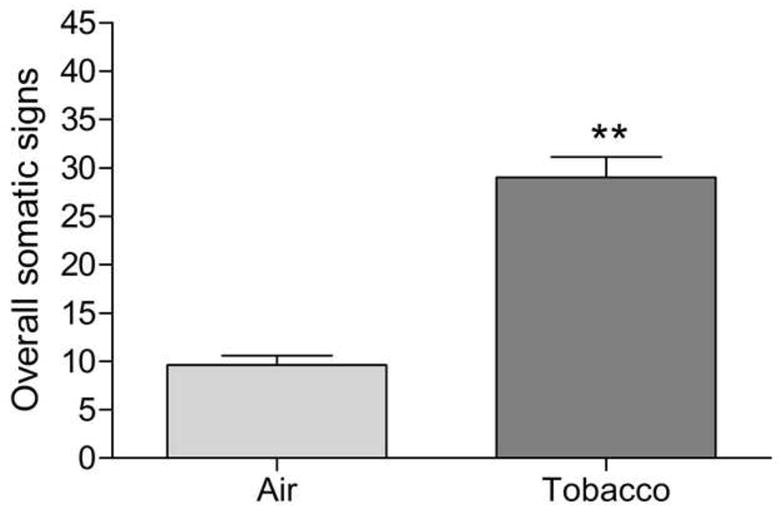
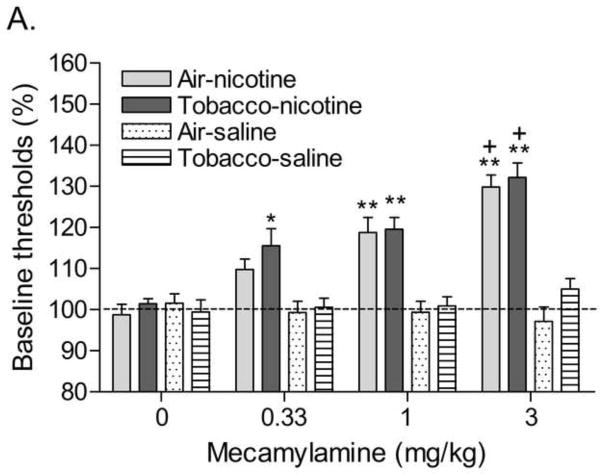
Epidemiological studies indicate that parental smoking increases the risk for smoking in children. However, the underlying mechanisms by which parental smoking increases the risk for smoking are not known. The aim of these studies was to investigate if preadolescent tobacco smoke exposure, postnatal days 21-35, affects the rewarding effects of nicotine and nicotine withdrawal in adult rats. The rewarding effects of nicotine were investigated with the conditioned place preference procedure. Nicotine withdrawal was investigated with the conditioned place aversion procedure and intracranial self-stimulation (ICSS). Elevations in brain reward thresholds in the ICSS paradigm reflect a dysphoric state. Plasma nicotine and cotinine levels in the preadolescent rats immediately after smoke exposure were 188 ng/ml and 716 ng/ml, respectively. Preadolescent tobacco smoke exposure led to the development of nicotine dependence as indicated by an increased number of mecamylamine-precipitated somatic withdrawal signs in the preadolescent tobacco smoke exposed rats compared to the control rats. Nicotine induced a similar place preference in adult rats that had been exposed to tobacco smoke or air during preadolescence. Furthermore, mecamylamine induced place aversion in nicotine dependent rats but there was no effect of preadolescent tobacco smoke exposure. Finally, preadolescent tobacco smoke exposure did not affect the elevations in brain reward thresholds associated with precipitated or spontaneous nicotine withdrawal. These studies indicate that passive exposure to tobacco smoke during preadolescence leads to the development of nicotine dependence but preadolescent tobacco smoke exposure does not seem to affect the rewarding effects of nicotine or nicotine withdrawal in adulthood.
流行病学研究表明,父母吸烟会增加儿童吸烟的风险。然而,父母吸烟增加儿童吸烟风险的潜在机制尚不清楚。这些研究的目的是调查青春期前(21-35 天)接触烟草烟雾是否会影响成年大鼠对尼古丁的奖赏效应和尼古丁戒断。通过条件性位置偏好程序研究尼古丁的奖赏效应。通过条件性位置厌恶程序和颅内自我刺激(ICSS)研究尼古丁戒断。ICSS 范式中大脑奖赏阈值的升高反映了一种不愉快的状态。青春期前大鼠接触烟雾后即刻的血浆尼古丁和可替宁水平分别为 188ng/ml 和 716ng/ml。青春期前接触烟草烟雾导致尼古丁依赖的发展,这表现为与对照组相比,接触烟草烟雾的青春期前大鼠出现了更多的美加仑胺诱发的躯体戒断体征。尼古丁在青春期前接触过烟草烟雾或空气的成年大鼠中诱导出类似的位置偏好。此外,美加仑胺在尼古丁依赖大鼠中诱导出位置厌恶,但青春期前接触烟草烟雾没有影响。最后,青春期前接触烟草烟雾不会影响与诱发或自发尼古丁戒断相关的大脑奖赏阈值升高。这些研究表明,青春期前被动接触烟草烟雾会导致尼古丁依赖的发展,但青春期前接触烟草烟雾似乎不会影响成年后尼古丁的奖赏效应或尼古丁戒断。