Department of Epidemiology and Research Support, Trimbos Institute, Utrecht, The Netherlands.
Behavioural Science Institute, Radboud University, Nijmegen, The Netherlands.
Brain Behav. 2020 Aug;10(8):e01619. doi: 10.1002/brb3.1619. Epub 2020 Jul 1.
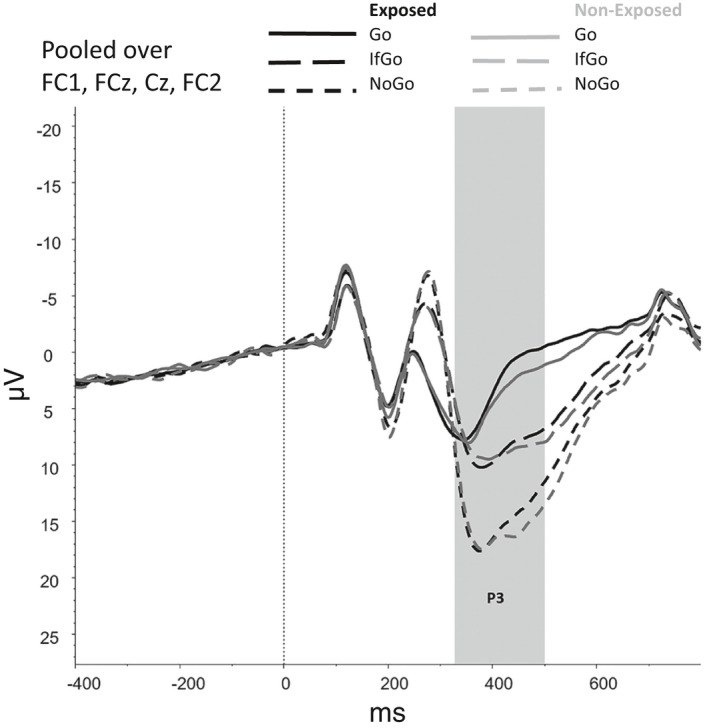
Brain functioning, as indexed by event-related potentials (ERPs) representing smoking cue reactivity, inhibitory control, and reward processing, has been found to be compromised in smokers. However, whether environmental tobacco smoke (ETS) exposure in never smokers results in similar brain changes is unknown. This question is particularly relevant during adolescence, given ongoing brain maturation and a high risk of smoking initiation. The present study tested the associations between ETS exposure and ERPs reflecting cue reactivity (P3, LPP), inhibitory control (N2, P3), and reward processing (anticipation P3 (P3), feedback-related negativity (FRN)) among never-smoking adolescents.
Eighty-four never-smoking adolescents (nonexposed = 32, exposed = 52) performed a smoking cue reactivity, a Go/NoGo, and a monetary incentive delay (MID) task while ERPs were measured.
Exposed and nonexposed groups did not differ in ERPs reflecting smoking cue reactivity, inhibitory control, and reward processing. A negative correlation between ETS exposure and the anticipatory P3 suggests reduced anticipatory reward sensitivity for nondrug rewards with increased levels of ETS exposure. However, since this effect was not consistent across analyses, no strong conclusions can be formulated. In the current study, few participants reported high levels of ETS exposure; therefore, further study is necessary.
Nevertheless, from this study, it can be concluded that low-to-moderate exposure to ETS during adolescence does not result in functional brain changes related to smoking cue reactivity, inhibitory control, and reward processing.
与吸烟线索反应、抑制控制和奖励处理相关的事件相关电位(ERPs)反映了大脑功能,研究发现吸烟者的大脑功能受到了损害。然而,在从不吸烟的人中,环境烟草烟雾(ETS)暴露是否会导致类似的大脑变化尚不清楚。在青少年时期,由于大脑仍在发育和吸烟风险较高,这个问题尤其重要。本研究测试了在从不吸烟的青少年中,ETS 暴露与反映线索反应(P3、LPP)、抑制控制(N2、P3)和奖励处理(预期 P3(P3)、反馈相关负波(FRN))的 ERPs 之间的关联。
84 名从不吸烟的青少年(无暴露=32 名,暴露=52 名)在进行吸烟线索反应、Go/NoGo 和货币奖励延迟(MID)任务时测量了 ERPs。
暴露组和无暴露组在反映吸烟线索反应、抑制控制和奖励处理的 ERPs 上没有差异。ETS 暴露与预期 P3 之间呈负相关,表明随着 ETS 暴露水平的增加,对非药物奖励的预期奖励敏感性降低。然而,由于这种影响在分析中并不一致,因此无法得出强有力的结论。在目前的研究中,很少有参与者报告了高水平的 ETS 暴露;因此,需要进一步研究。
尽管如此,从这项研究中可以得出结论,青少年时期低至中度暴露于 ETS 不会导致与吸烟线索反应、抑制控制和奖励处理相关的大脑功能变化。