Department of Biological Sciences, University of Calgary, 2500 University Drive NW, Calgary, Alberta, Canada.
BMC Plant Biol. 2010 Mar 9;10:44. doi: 10.1186/1471-2229-10-44.
Puf proteins have important roles in controlling gene expression at the post-transcriptional level by promoting RNA decay and repressing translation. The Pumilio homology domain (PUM-HD) is a conserved region within Puf proteins that binds to RNA with sequence specificity. Although Puf proteins have been well characterized in animal and fungal systems, little is known about the structural and functional characteristics of Puf-like proteins in plants.
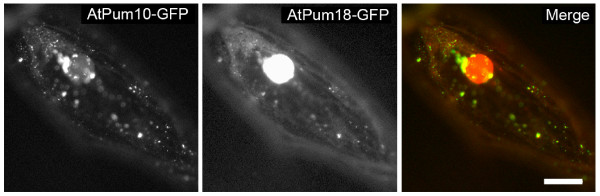
The Arabidopsis and rice genomes code for 26 and 19 Puf-like proteins, respectively, each possessing eight or fewer Puf repeats in their PUM-HD. Key amino acids in the PUM-HD of several of these proteins are conserved with those of animal and fungal homologs, whereas other plant Puf proteins demonstrate extensive variability in these amino acids. Three-dimensional modeling revealed that the predicted structure of this domain in plant Puf proteins provides a suitable surface for binding RNA. Electrophoretic gel mobility shift experiments showed that the Arabidopsis AtPum2 PUM-HD binds with high affinity to BoxB of the Drosophila Nanos Response Element I (NRE1) RNA, whereas a point mutation in the core of the NRE1 resulted in a significant reduction in binding affinity. Transient expression of several of the Arabidopsis Puf proteins as fluorescent protein fusions revealed a dynamic, punctate cytoplasmic pattern of localization for most of these proteins. The presence of predicted nuclear export signals and accumulation of AtPuf proteins in the nucleus after treatment of cells with leptomycin B demonstrated that shuttling of these proteins between the cytosol and nucleus is common among these proteins. In addition to the cytoplasmically enriched AtPum proteins, two AtPum proteins showed nuclear targeting with enrichment in the nucleolus.
The Puf family of RNA-binding proteins in plants consists of a greater number of members than any other model species studied to date. This, along with the amino acid variability observed within their PUM-HDs, suggests that these proteins may be involved in a wide range of post-transcriptional regulatory events that are important in providing plants with the ability to respond rapidly to changes in environmental conditions and throughout development.
Puf 蛋白通过促进 RNA 降解和抑制翻译,在转录后水平上对基因表达具有重要作用。Pumilio 同源结构域(PUM-HD)是 Puf 蛋白内的一个保守区域,能与具有序列特异性的 RNA 结合。尽管 Puf 蛋白在动物和真菌系统中已得到很好的描述,但在植物中,Puf 样蛋白的结构和功能特征知之甚少。
拟南芥和水稻基因组分别编码 26 种和 19 种 Puf 样蛋白,其 PUM-HD 中每个蛋白含有 8 个或更少的 Puf 重复。这些蛋白的 PUM-HD 中的关键氨基酸与动物和真菌同源物中的氨基酸保守,而其他植物 Puf 蛋白在这些氨基酸中表现出广泛的变异性。三维建模显示,该结构域在植物 Puf 蛋白中的预测结构为结合 RNA 提供了合适的表面。电泳凝胶迁移率变动实验表明,拟南芥 AtPum2 PUM-HD 与果蝇 Nanos 反应元件 I(NRE1)RNA 的 BoxB 具有高亲和力结合,而 NRE1 的核心点突变导致结合亲和力显著降低。将几种拟南芥 Puf 蛋白作为荧光蛋白融合体瞬时表达,发现大多数这些蛋白在细胞质中呈现出动态、点状的定位模式。预测的核输出信号的存在和细胞用莱普霉素 B 处理后 AtPuf 蛋白在核内的积累表明,这些蛋白在细胞质和核之间的穿梭是这些蛋白共有的。除了富含细胞质的 AtPum 蛋白外,两种 AtPum 蛋白显示核靶向,富含核仁。
植物中 Puf 家族的 RNA 结合蛋白比迄今为止研究过的任何其他模式物种都包含更多的成员。这一点,以及在其 PUM-HD 中观察到的氨基酸变异性,表明这些蛋白可能参与广泛的转录后调控事件,这对植物快速响应环境变化和发育过程中的变化具有重要意义。