• 文献检索
  • 文档翻译
  • 深度研究
  • 学术资讯
  • Suppr Zotero 插件Zotero 插件
  • 邀请有礼
  • 套餐&价格
  • 历史记录
应用&插件
Suppr Zotero 插件Zotero 插件浏览器插件Mac 客户端Windows 客户端微信小程序
定价
高级版会员购买积分包购买API积分包
服务
文献检索文档翻译深度研究API 文档MCP 服务
关于我们
关于 Suppr公司介绍联系我们用户协议隐私条款
关注我们

Suppr 超能文献

核心技术专利:CN118964589B侵权必究
粤ICP备2023148730 号-1Suppr @ 2026

文献检索

告别复杂PubMed语法,用中文像聊天一样搜索,搜遍4000万医学文献。AI智能推荐,让科研检索更轻松。

立即免费搜索

文件翻译

保留排版,准确专业,支持PDF/Word/PPT等文件格式,支持 12+语言互译。

免费翻译文档

深度研究

AI帮你快速写综述,25分钟生成高质量综述,智能提取关键信息,辅助科研写作。

立即免费体验

度拉糖肽每周一次治疗可在 52 周内持续控制血糖和减轻体重。

DURATION-1: exenatide once weekly produces sustained glycemic control and weight loss over 52 weeks.

机构信息

Division of Endocrinology, Department of Medicine, University of North Carolina School of Medicine, Chapel Hill, North Carolina, USA.

出版信息

Diabetes Care. 2010 Jun;33(6):1255-61. doi: 10.2337/dc09-1914. Epub 2010 Mar 9.

DOI:10.2337/dc09-1914
PMID:20215461
原文链接:https://pmc.ncbi.nlm.nih.gov/articles/PMC2875434/
Abstract

OBJECTIVE

In the Diabetes Therapy Utilization: Researching Changes in A1C, Weight and Other Factors Through Intervention with Exenatide Once Weekly (DURATION-1) study, the safety and efficacy of 30 weeks of treatment with the glucagon-like peptide-1 receptor agonist exenatide once weekly (exenatide QW; 2 mg) was compared with exenatide BID in 295 patients with type 2 diabetes. We now report the safety and efficacy of exenatide QW in 1) patients who continued treatment for an additional 22 weeks (52 weeks total) and 2) patients who switched from exenatide BID to exenatide QW after 30 weeks.

RESEARCH DESIGN AND METHODS

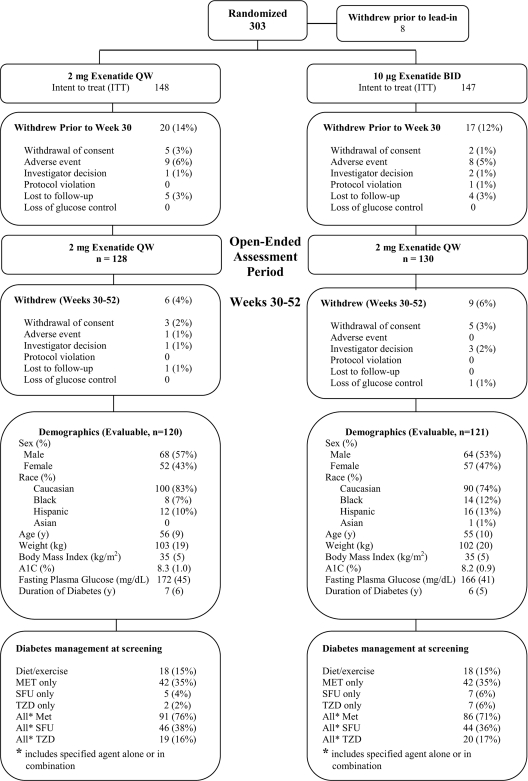
In this randomized, multicenter, comparator-controlled, open-label trial, 258 patients entered the 22-week open-ended assessment phase (n = 128 QW-only; n = 130 BID-->QW). A1C, fasting plasma glucose (FPG), body weight, blood pressure, fasting lipids, safety, and tolerability were assessed.

RESULTS

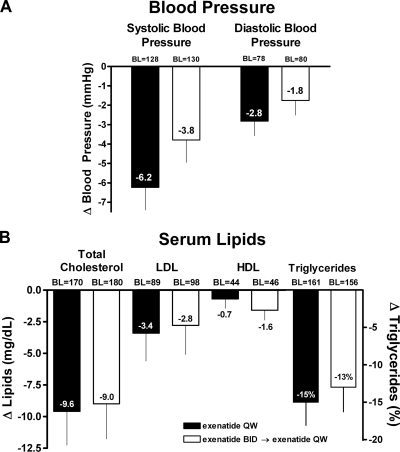
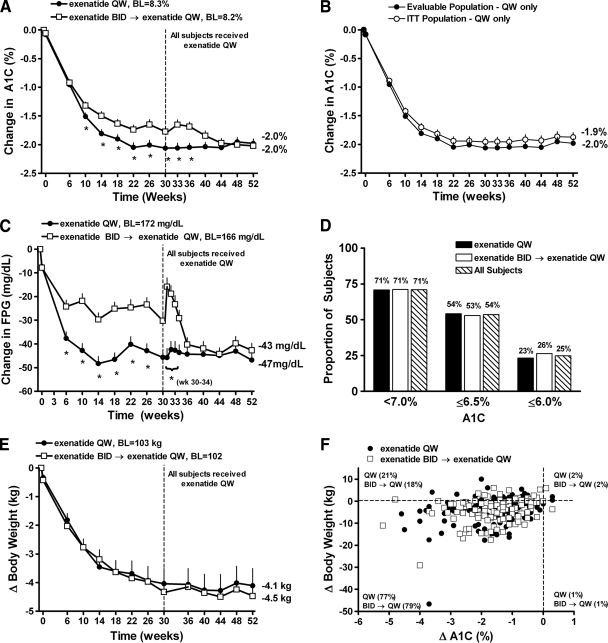
Patients continuing exenatide QW maintained A1C improvements through 52 weeks (least squares mean -2.0% [95% CI -2.1 to -1.8%]). Patients switching from exenatide BID to exenatide QW achieved further A1C improvements; both groups exhibited the same A1C reduction and mean A1C (6.6%) at week 52. At week 52, 71 and 54% of all patients achieved A1C <7.0% and <or=6.5%, respectively. In both treatment arms, FPG was reduced by >40 mg/dl, and body weight was reduced by >4 kg after 52 weeks. Nausea occurred less frequently in this assessment period and was predominantly mild. No major hypoglycemia was observed.

CONCLUSION

Exenatide QW elicited sustained improvements in glycemic control and body weight through 52 weeks of treatment. Patients switching to exenatide QW experienced further improvements in A1C and FPG, with sustained weight loss.

摘要

目的

在糖尿病治疗中的应用:通过每周一次给予艾塞那肽(DURATION-1)研究中干预措施,研究每周一次给予胰高血糖素样肽-1 受体激动剂艾塞那肽 2 毫克(艾塞那肽 QW)治疗 30 周的安全性和疗效,与每日两次给予艾塞那肽(艾塞那肽 BID)在 295 例 2 型糖尿病患者中的疗效进行比较。我们现将每周一次给予艾塞那肽 QW 在以下方面的安全性和疗效进行报告:1)患者继续接受治疗另外 22 周(共 52 周);2)患者在 30 周后从每日两次给予艾塞那肽转换为每周一次给予艾塞那肽。

研究设计和方法

在这项随机、多中心、对照药物、开放性试验中,258 例患者进入 22 周开放性延长评估阶段(每周一次给予艾塞那肽组 128 例;每日两次给予艾塞那肽转换为每周一次给予艾塞那肽组 130 例)。评估糖化血红蛋白(A1C)、空腹血糖(FPG)、体重、血压、空腹血脂、安全性和耐受性。

结果

继续接受每周一次给予艾塞那肽 QW 治疗的患者在 52 周时保持 A1C 的改善(最小二乘均值 -2.0%[95%CI-2.1 至-1.8%])。从每日两次给予艾塞那肽转换为每周一次给予艾塞那肽的患者进一步实现 A1C 的改善;两组在第 52 周时均表现出相同的 A1C 降低和平均 A1C(6.6%)。在第 52 周时,所有患者中分别有 71%和 54%达到 A1C<7.0%和<或=6.5%。在两个治疗组中,FPG 降低超过 40mg/dl,体重减轻超过 4kg。在这个评估期间,恶心发生频率较低,主要为轻度。未观察到严重低血糖。

结论

每周一次给予艾塞那肽 QW 在 52 周的治疗期间可使血糖控制和体重持续改善。转换为每周一次给予艾塞那肽 QW 的患者 A1C 和 FPG 进一步改善,体重持续减轻。
https://cdn.ncbi.nlm.nih.gov/pmc/blobs/d9b4/2875434/4fa1ad67491b/zdc0061082590003.jpg
https://cdn.ncbi.nlm.nih.gov/pmc/blobs/d9b4/2875434/f3c551740067/zdc0061082590001.jpg
https://cdn.ncbi.nlm.nih.gov/pmc/blobs/d9b4/2875434/f2dc58c2b7bf/zdc0061082590002.jpg
https://cdn.ncbi.nlm.nih.gov/pmc/blobs/d9b4/2875434/4fa1ad67491b/zdc0061082590003.jpg
https://cdn.ncbi.nlm.nih.gov/pmc/blobs/d9b4/2875434/f3c551740067/zdc0061082590001.jpg
https://cdn.ncbi.nlm.nih.gov/pmc/blobs/d9b4/2875434/f2dc58c2b7bf/zdc0061082590002.jpg
https://cdn.ncbi.nlm.nih.gov/pmc/blobs/d9b4/2875434/4fa1ad67491b/zdc0061082590003.jpg

相似文献

1
DURATION-1: exenatide once weekly produces sustained glycemic control and weight loss over 52 weeks.度拉糖肽每周一次治疗可在 52 周内持续控制血糖和减轻体重。
Diabetes Care. 2010 Jun;33(6):1255-61. doi: 10.2337/dc09-1914. Epub 2010 Mar 9.
2
Five-year efficacy and safety data of exenatide once weekly: long-term results from the DURATION-1 randomized clinical trial.每周一次艾塞那肽的 5 年疗效和安全性数据:来自 DURATION-1 随机临床试验的长期结果。
Mayo Clin Proc. 2015 Mar;90(3):356-65. doi: 10.1016/j.mayocp.2015.01.008.
3
Efficacy and safety profile of exenatide once weekly compared with insulin once daily in Japanese patients with type 2 diabetes treated with oral antidiabetes drug(s): results from a 26-week, randomized, open-label, parallel-group, multicenter, noninferiority study.每周一次艾塞那肽对比每日一次胰岛素用于口服降糖药治疗的日本 2 型糖尿病患者的疗效和安全性:一项 26 周、随机、开放标签、平行分组、多中心、非劣效性研究结果。
Clin Ther. 2012 Sep;34(9):1892-908.e1. doi: 10.1016/j.clinthera.2012.07.007. Epub 2012 Aug 9.
4
Efficacy, safety, and tolerability of exenatide once weekly in patients with type 2 diabetes mellitus: an integrated analysis of the DURATION trials.每周一次艾塞那肽治疗 2 型糖尿病患者的疗效、安全性和耐受性:DURATION 试验的综合分析。
Postgrad Med. 2013 May;125(3):47-57. doi: 10.3810/pgm.2013.05.2660.
5
Exenatide once weekly treatment maintained improvements in glycemic control and weight loss over 2 years.艾塞那肽每周一次治疗可在 2 年内维持血糖控制和体重减轻的改善。
BMC Endocr Disord. 2011 Apr 29;11:9. doi: 10.1186/1472-6823-11-9.
6
Three-year efficacy and safety of exenatide once weekly: A pooled analysis of three trials.西格列汀每周一次治疗的 3 年疗效和安全性:三项试验的汇总分析。
J Diabetes Complications. 2017 Sep;31(9):1415-1422. doi: 10.1016/j.jdiacomp.2017.06.004. Epub 2017 Jun 20.
7
Safety, tolerability, pharmacokinetics, and pharmacodynamics of exenatide once weekly in Japanese patients with type 2 diabetes.每周一次给予日本 2 型糖尿病患者艾塞那肽的安全性、耐受性、药代动力学和药效学。
Endocr J. 2009;56(8):951-62. doi: 10.1507/endocrj.k09e-147. Epub 2009 Aug 25.
8
Efficacy and Tolerability of Exenatide Once Weekly Over 6 Years in Patients with Type 2 Diabetes: An Uncontrolled Open-Label Extension of the DURATION-1 Study.艾塞那肽每周一次治疗2型糖尿病患者6年的疗效和耐受性:DURATION-1研究的非对照开放标签延长期研究
Diabetes Technol Ther. 2016 Nov;18(11):677-686. doi: 10.1089/dia.2016.0107. Epub 2016 Aug 15.
9
DURATION-5: exenatide once weekly resulted in greater improvements in glycemic control compared with exenatide twice daily in patients with type 2 diabetes.DURATION-5 研究结果显示,与每日两次给予艾塞那肽相比,每周一次给予艾塞那肽可使 2 型糖尿病患者的血糖控制得到更大改善。
J Clin Endocrinol Metab. 2011 May;96(5):1301-10. doi: 10.1210/jc.2010-2081. Epub 2011 Feb 9.
10
Improved treatment satisfaction and weight-related quality of life with exenatide once weekly or twice daily.每周一次或每日两次给予艾塞那肽治疗可提高治疗满意度和体重相关生活质量。
Diabet Med. 2009 Jul;26(7):722-8. doi: 10.1111/j.1464-5491.2009.02752.x.

引用本文的文献

1
Strategies for the Secondary Prevention of Atherosclerotic Cardiovascular Disease.动脉粥样硬化性心血管疾病的二级预防策略
US Cardiol. 2025 Apr 28;19:e11. doi: 10.15420/usc.2024.33. eCollection 2025.
2
Multiomics insight into the role of glucagon-like peptide-1 receptor agonists in heart failure.多组学揭示胰高血糖素样肽-1受体激动剂在心力衰竭中的作用
ESC Heart Fail. 2025 Apr 28. doi: 10.1002/ehf2.15310.
3
GLP-1-based therapies for diabetes, obesity and beyond.基于胰高血糖素样肽-1(GLP-1)的糖尿病、肥胖症及其他疾病治疗方法。

本文引用的文献

1
Medical management of hyperglycemia in type 2 diabetes: a consensus algorithm for the initiation and adjustment of therapy: a consensus statement of the American Diabetes Association and the European Association for the Study of Diabetes.2 型糖尿病患者高血糖的医学管理:起始和调整治疗的共识算法:美国糖尿病协会和欧洲糖尿病研究协会的共识声明。
Diabetes Care. 2009 Jan;32(1):193-203. doi: 10.2337/dc08-9025. Epub 2008 Oct 22.
2
Exenatide once weekly versus twice daily for the treatment of type 2 diabetes: a randomised, open-label, non-inferiority study.每周一次与每日两次注射艾塞那肽治疗2型糖尿病的随机、开放标签、非劣效性研究
Lancet. 2008 Oct 4;372(9645):1240-50. doi: 10.1016/S0140-6736(08)61206-4. Epub 2008 Sep 7.
3
Nat Rev Drug Discov. 2025 Apr 25. doi: 10.1038/s41573-025-01183-8.
4
Targeting Diabetic Atherosclerosis: The Role of GLP-1 Receptor Agonists, SGLT2 Inhibitors, and Nonsteroidal Mineralocorticoid Receptor Antagonists in Vascular Protection and Disease Modulation.靶向糖尿病动脉粥样硬化:胰高血糖素样肽-1受体激动剂、钠-葡萄糖协同转运蛋白2抑制剂和非甾体盐皮质激素受体拮抗剂在血管保护和疾病调节中的作用
Biomedicines. 2025 Mar 17;13(3):728. doi: 10.3390/biomedicines13030728.
5
Glucagon-like Peptide-1 Receptor Agonists in the Context of Pathophysiology of Diverse Heart Failure with Preserved Ejection Fraction Phenotypes: Potential Benefits and Mechanisms of Action.射血分数保留的不同类型心力衰竭病理生理学背景下的胰高血糖素样肽-1受体激动剂:潜在益处及作用机制
Card Fail Rev. 2024 Oct 16;10:e14. doi: 10.15420/cfr.2024.06. eCollection 2024.
6
Comparing Glucagon-like peptide-1 receptor agonists versus metformin in drug-naive patients: A nationwide cohort study.比较胰高血糖素样肽-1 受体激动剂与二甲双胍在初治患者中的疗效:一项全国性队列研究。
J Diabetes. 2024 Oct;16(10):e70000. doi: 10.1111/1753-0407.70000.
7
Glucagon-Like Peptide-1 (GLP-1) Receptor Agonists: Exploring Their Impact on Diabetes, Obesity, and Cardiovascular Health Through a Comprehensive Literature Review.胰高血糖素样肽-1(GLP-1)受体激动剂:通过全面文献综述探讨其对糖尿病、肥胖症和心血管健康的影响
Cureus. 2024 Sep 1;16(9):e68390. doi: 10.7759/cureus.68390. eCollection 2024 Sep.
8
Quantification of the effect of GLP-1R agonists on body weight using in vitro efficacy information: An extension of the Hall body composition model.利用体外药效学信息定量评估 GLP-1R 激动剂对体重的影响:对 Hall 体成分模型的扩展。
CPT Pharmacometrics Syst Pharmacol. 2024 Sep;13(9):1488-1502. doi: 10.1002/psp4.13183. Epub 2024 Jun 12.
9
Drug release profile of a novel exenatide long-term drug delivery system (OKV-119) administered to cats.一种新型艾塞那肽长效药物递送系统(OKV-119)在猫体内的药物释放曲线。
BMC Vet Res. 2024 May 18;20(1):211. doi: 10.1186/s12917-024-04051-6.
10
Use of Continuous Glucose Monitoring and Glucagon-Like Peptide 1 Receptor Agonist Therapy to Achieve Individualized Treatment Goals in Insulin-Treated People With Type 2 Diabetes: A Case Series and Expert Opinion.使用持续葡萄糖监测和胰高血糖素样肽1受体激动剂疗法在胰岛素治疗的2型糖尿病患者中实现个体化治疗目标:病例系列与专家意见
Clin Diabetes. 2024 Spring;42(2):341-350. doi: 10.2337/cd23-0047. Epub 2023 Dec 5.
Tolerability and efficacy of exenatide and titrated insulin glargine in adult patients with type 2 diabetes previously uncontrolled with metformin or a sulfonylurea: a multinational, randomized, open-label, two-period, crossover noninferiority trial.
艾塞那肽与滴定剂量的甘精胰岛素在既往使用二甲双胍或磺脲类药物治疗未达控制目标的成年2型糖尿病患者中的耐受性和疗效:一项多国、随机、开放标签、两阶段、交叉非劣效性试验
Clin Ther. 2007 Nov;29(11):2333-48. doi: 10.1016/j.clinthera.2007.11.006.
4
Exenatide effects on diabetes, obesity, cardiovascular risk factors and hepatic biomarkers in patients with type 2 diabetes treated for at least 3 years.艾塞那肽对接受至少3年治疗的2型糖尿病患者的糖尿病、肥胖、心血管危险因素及肝脏生物标志物的影响。
Curr Med Res Opin. 2008 Jan;24(1):275-86. doi: 10.1185/030079908x253870.
5
The effect of adding exenatide to a thiazolidinedione in suboptimally controlled type 2 diabetes: a randomized trial.在控制欠佳的2型糖尿病患者中,将艾塞那肽添加至噻唑烷二酮类药物的疗效:一项随机试验。
Ann Intern Med. 2007 Apr 3;146(7):477-85. doi: 10.7326/0003-4819-146-7-200704030-00003.
6
Effects of once-weekly dosing of a long-acting release formulation of exenatide on glucose control and body weight in subjects with type 2 diabetes.艾塞那肽长效释放制剂每周一次给药对2型糖尿病患者血糖控制和体重的影响。
Diabetes Care. 2007 Jun;30(6):1487-93. doi: 10.2337/dc06-2375. Epub 2007 Mar 12.
7
A comparison of twice-daily exenatide and biphasic insulin aspart in patients with type 2 diabetes who were suboptimally controlled with sulfonylurea and metformin: a non-inferiority study.磺脲类药物和二甲双胍治疗控制不佳的2型糖尿病患者中,每日两次艾塞那肽与双相门冬胰岛素的比较:一项非劣效性研究。
Diabetologia. 2007 Feb;50(2):259-67. doi: 10.1007/s00125-006-0510-2. Epub 2006 Dec 8.
8
Exenatide versus insulin glargine in patients with suboptimally controlled type 2 diabetes: a randomized trial.艾塞那肽与甘精胰岛素治疗2型糖尿病控制不佳患者的疗效比较:一项随机试验
Ann Intern Med. 2005 Oct 18;143(8):559-69. doi: 10.7326/0003-4819-143-8-200510180-00006.
9
Effects of exenatide (exendin-4) on glycemic control and weight over 30 weeks in metformin-treated patients with type 2 diabetes.艾塞那肽(艾塞那肽-4)对二甲双胍治疗的2型糖尿病患者30周血糖控制及体重的影响。
Diabetes Care. 2005 May;28(5):1092-100. doi: 10.2337/diacare.28.5.1092.
10
Effects of exenatide (exendin-4) on glycemic control over 30 weeks in patients with type 2 diabetes treated with metformin and a sulfonylurea.艾塞那肽(艾塞那肽-4)对接受二甲双胍和磺脲类药物治疗的2型糖尿病患者30周血糖控制的影响。
Diabetes Care. 2005 May;28(5):1083-91. doi: 10.2337/diacare.28.5.1083.