Axilbund Jennifer E, Brune Kieran A, Canto Marcia I, Brehon Brenda C, Wroblewski Lori D, Griffin Constance A
Department of Oncology, School of Medicine, The Johns Hopkins University, Baltimore, Maryland, USA.
Hered Cancer Clin Pract. 2005 Aug 15;3(3):115-22. doi: 10.1186/1897-4287-3-3-115.
To assess patient views regarding the value of genetic counselling for familial pancreas cancer in the absence of predictive genetic testing.
At-risk adults with three or more relatives with pancreas cancer received genetic counselling prior to research screening via endoscopic ultrasound. Questionnaires were mailed after the visit to assess perceived value of the counselling session.
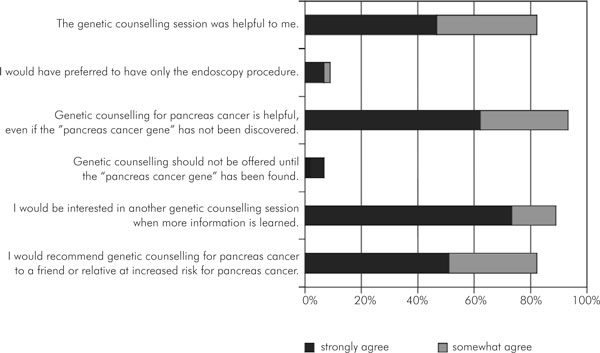
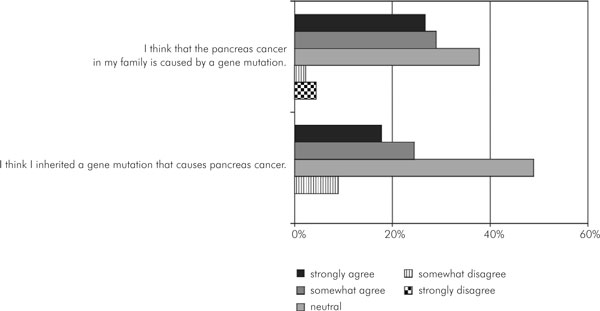
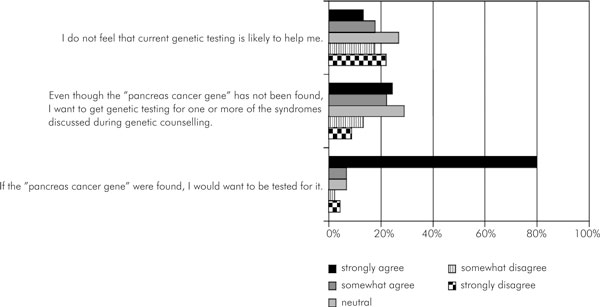
Ninety-three percent of respondents felt genetic counselling for pancreas cancer was helpful despite the lack of a causative gene, while only 7% felt that it should not be offered until such a gene is discovered. Over half of respondents believed the pancreas cancer in their family was caused by a gene mutation, and 42% thought they had inherited the mutation. The average perceived lifetime risk of developing pancreas cancer was 51%, and 87% of respondents would ultimately seek predictive genetic testing. When more information is gained, 89% would be interested in another genetic counselling session, and 82% would recommend current genetic counselling for pancreas cancer to a friend or relative with a family history of the disease.
Despite the lack of an identified major causative gene for pancreas cancer, respondents found genetic counselling for this malignancy to be helpful. These patients perceive their personal cancer risk to be high, and would seek predictive genetic testing if it were available. Referral for genetic counselling should be offered to appropriate individuals.
在未进行预测性基因检测的情况下,评估患者对家族性胰腺癌基因咨询价值的看法。
有三名或更多胰腺癌亲属的高危成年人在通过内镜超声进行研究筛查前接受基因咨询。访视后邮寄问卷以评估咨询 session 的感知价值。
93%的受访者认为,尽管缺乏致病基因,但胰腺癌的基因咨询仍有帮助,而只有7%的人认为在发现此类基因之前不应提供咨询。超过一半的受访者认为其家族中的胰腺癌是由基因突变引起的,42%的人认为自己继承了该突变。发展为胰腺癌的平均感知终生风险为51%,87%的受访者最终会寻求预测性基因检测。当获得更多信息时,89%的人会对另一次基因咨询 session 感兴趣,82%的人会将当前的胰腺癌基因咨询推荐给有家族病史的朋友或亲属。
尽管缺乏已确定的胰腺癌主要致病基因,但受访者认为这种恶性肿瘤的基因咨询是有帮助的。这些患者认为自己患癌的个人风险很高,如果有预测性基因检测,他们会寻求检测。应向合适的个体提供基因咨询转诊。