Conchon Monika, Sanabani Sabri S, Serpa Mariana, Novaes Mafalda M Y, Nardinelli Luciana, Ferreira Patrícia B, Dorliac-Llacer Pedro Enrique, Bendit Israel
Department of Hematology, Faculty of Medicine, University of São Paulo, SP 05403-000, Brazil.
Adv Hematol. 2010;2010:136252. doi: 10.1155/2010/136252. Epub 2010 Mar 7.
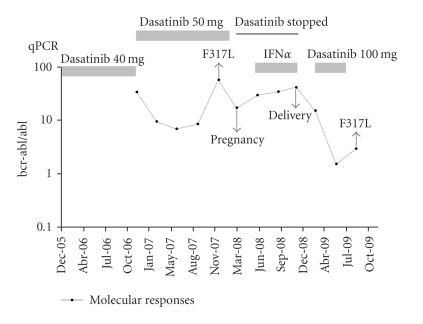
Here we report the case of an 18-year-old woman with chronic myeloid leukemia (CML) who became pregnant while undergoing treatment with dasatinib. Before pregnancy, she received imatinib mesylate therapy but could not tolerate the treatment. The regimen was then changed to dasatinib at a dose of 70 mg b.i.d. While she was in hematological remission and on dasatinib therapy, she became pregnant. The unplanned pregnancy was identified after the patient had experienced four weeks of amenorrhea. Because the patient elected to continue the pregnancy to term, dasatinib was stopped immediately. Meanwhile, CML hematological relapse occurred and then she was treated with interferon-alpha (IFN-alpha) (9 million IU/day) throughout the pregnancy without a complete hematological response. She successfully gave birth to a male baby at 33 weeks by cesarean section delivery with no sequelae or malformations. Although this experience is limited to a single patient, it provides a useful contribution for counselling patients inadvertently exposed to dasatinib during pregnancy.
在此,我们报告一例18岁慢性髓性白血病(CML)女性患者,她在接受达沙替尼治疗期间怀孕。怀孕前,她接受甲磺酸伊马替尼治疗,但无法耐受该治疗。随后治疗方案改为达沙替尼,剂量为70mg,每日两次。在她处于血液学缓解期并接受达沙替尼治疗时,她怀孕了。患者停经四周后发现意外怀孕。由于患者选择继续妊娠至足月,达沙替尼立即停药。与此同时,CML血液学复发,随后她在整个孕期接受α干扰素(IFN-α)(900万IU/天)治疗,但未获得完全血液学缓解。她在33周时通过剖宫产成功产下一名男婴,无后遗症或畸形。尽管这一经验仅限于一名患者,但它为咨询孕期意外接触达沙替尼的患者提供了有益的参考。