Institute of Molecular Tumor Biology (IMTB), University of Muenster, Robert-Koch-Str, Muenster, Germany.
Genome Biol. 2010;11(3):R33. doi: 10.1186/gb-2010-11-3-r33. Epub 2010 Mar 15.
The general transcription factor TFIIB and its antagonist negative cofactor 2 (NC2) are hallmarks of RNA polymerase II (RNAPII) transcription. Both factors bind TATA box-binding protein (TBP) at promoters in a mutually exclusive manner. Dissociation of NC2 is thought to be followed by TFIIB association and subsequent preinitiation complex formation. TFIIB dissociates upon RNAPII promoter clearance, thereby providing a specific measure for steady-state preinitiation complex levels. As yet, genome-scale promoter mapping of human TFIIB has not been reported. It thus remains elusive how human core promoters contribute to preinitiation complex formation in vivo.
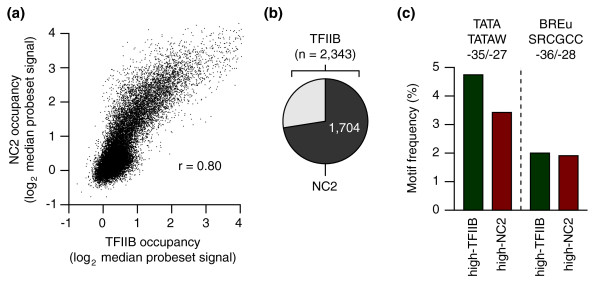
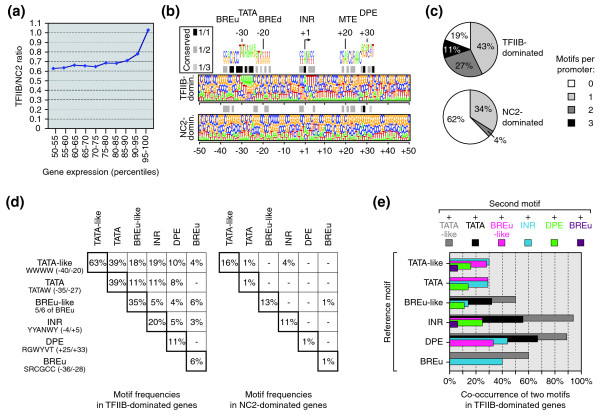
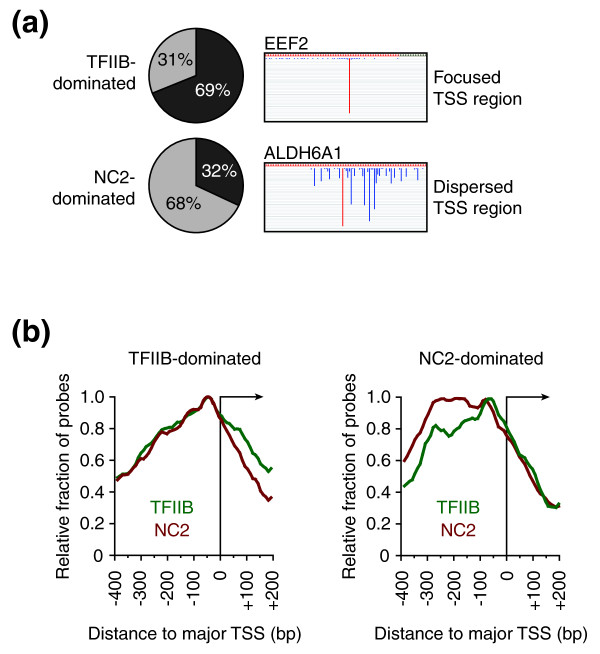
We compare target genes of TFIIB and NC2 in human B cells and analyze associated core promoter architectures. TFIIB occupancy is positively correlated with gene expression, with the vast majority of promoters being GC-rich and lacking defined core promoter elements. TATA elements, but not the previously in vitro defined TFIIB recognition elements, are enriched in some 4 to 5% of the genes. NC2 binds to a highly related target gene set. Nonetheless, subpopulations show strong variations in factor ratios: whereas high TFIIB/NC2 ratios select for promoters with focused start sites and conserved core elements, high NC2/TFIIB ratios correlate to multiple start-site promoters lacking defined core elements.
TFIIB and NC2 are global players that occupy active genes. Preinitiation complex formation is independent of core elements at the majority of genes. TATA and TATA-like elements dictate TFIIB occupancy at a subset of genes. Biochemical data support a model in which preinitiation complex but not TBP-NC2 complex formation is regulated.
通用转录因子 TFIIB 和其拮抗剂负协同因子 2(NC2)是 RNA 聚合酶 II(RNAPII)转录的标志。这两个因子以相互排斥的方式结合在启动子上的 TATA 结合蛋白(TBP)。NC2 的解离被认为紧随 TFIIB 结合和随后的起始前复合物形成之后。TFIIB 在 RNAPII 启动子清除后解离,从而提供了一个稳定起始前复合物水平的特定衡量标准。然而,人类 TFIIB 的全基因组启动子图谱尚未报道。因此,人类核心启动子如何在体内有助于起始前复合物的形成仍然难以捉摸。
我们比较了人类 B 细胞中 TFIIB 和 NC2 的靶基因,并分析了相关的核心启动子结构。TFIIB 占据与基因表达呈正相关,绝大多数启动子富含 GC 且缺乏明确的核心启动子元件。TATA 元件,但不是以前在体外定义的 TFIIB 识别元件,在大约 4%到 5%的基因中富集。NC2 结合到一个高度相关的靶基因集。尽管如此,亚群显示出因子比率的强烈变化:高 TFIIB/NC2 比率选择具有焦点起始位点和保守核心元件的启动子,而高 NC2/TFIIB 比率与缺乏定义核心元件的多个起始位点启动子相关。
TFIIB 和 NC2 是全局参与者,占据活跃基因。起始前复合物的形成不依赖于大多数基因的核心元件。TATA 和 TATA 样元件决定了一组基因的 TFIIB 占据。生化数据支持一种模型,即起始前复合物而不是 TBP-NC2 复合物的形成受到调节。