Gastrointestinal Unit, Department of Medicine, Massachusetts General Hospital, Harvard Medical School, Boston, Massachusetts 02114, USA.
Gastroenterology. 2010 Jun;138(7):2509-18, 2518.e1. doi: 10.1053/j.gastro.2010.03.008. Epub 2010 Mar 12.
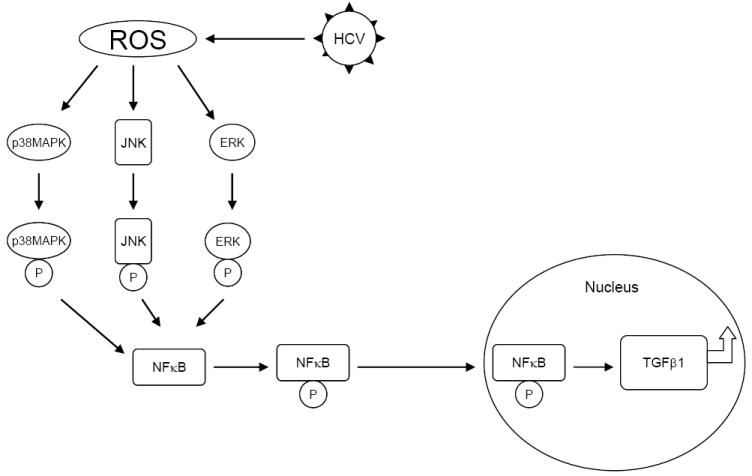
BACKGROUND & AIMS: The generation of oxidative stress and transforming growth factor beta1 (TGF-beta1) production play important roles in liver fibrogenesis. We have previously shown that hepatitis C virus (HCV) increases hepatocyte TGF-beta1 expression. However, the mechanisms by which this induction occurs have not been well studied. We explored the possibility that HCV infection regulates TGF-beta1 expression through the generation of reactive oxygen species (ROS), which act through > or =1 of the p38 mitogen-activated protein kinase (MAPK), extracellular signal-regulated kinase (ERK), c-Jun N-terminal kinase (JNK), and nuclear factor kappaB (NFkappaB) signaling pathways to induce TGF-beta1 expression.
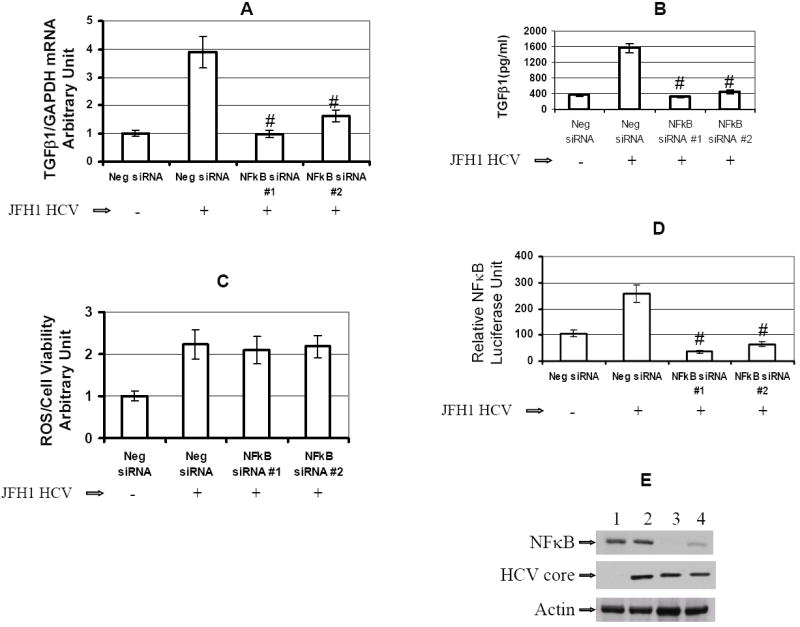
We used small molecule inhibitors and short interfering RNAs to knock down these pathways to study the mechanism by which HCV regulates TGF-beta1 production in the infectious JFH1 model.
We demonstrated that HCV induces ROS and TGF-beta1 expression. We further found that JFH1 induces the phosphorylation of p38MAPK, JNK, ERK, and NFkappaB. We also found that HCV-mediated TGF-beta1 enhancement occurs through a ROS-induced and p38 MAPK, JNK, ERK1/2, NFkappaB-dependent pathway.
These findings provide further evidence to support the hypothesis that HCV enhances hepatic fibrosis progression through the generation of ROS and induction of TGF-beta1. Strategies to limit the viral induction of oxidative stress appear to be warranted to inhibit fibrogenesis.
氧化应激的产生和转化生长因子β1(TGF-β1)的产生在肝纤维化的发生中起重要作用。我们之前已经表明,丙型肝炎病毒(HCV)增加肝细胞 TGF-β1 的表达。然而,这种诱导发生的机制尚未得到很好的研究。我们探讨了 HCV 感染通过产生活性氧(ROS)来调节 TGF-β1 表达的可能性,ROS 通过 >或=1 个丝裂原活化蛋白激酶(MAPK)、细胞外信号调节激酶(ERK)、c-Jun N-末端激酶(JNK)和核因子 kappaB(NFkappaB)信号通路起作用,诱导 TGF-β1 表达。
我们使用小分子抑制剂和短发夹 RNA(shRNA)敲低这些途径,以研究 HCV 调节传染性 JFH1 模型中 TGF-β1 产生的机制。
我们证明了 HCV 诱导 ROS 和 TGF-β1 的表达。我们进一步发现 JFH1 诱导 p38MAPK、JNK、ERK 和 NFkappaB 的磷酸化。我们还发现,HCV 介导的 TGF-β1 增强是通过 ROS 诱导和 p38 MAPK、JNK、ERK1/2、NFkappaB 依赖性途径发生的。
这些发现为 HCV 通过产生 ROS 和诱导 TGF-β1 增强肝纤维化进展的假说提供了进一步的证据。限制病毒诱导氧化应激的策略似乎是抑制纤维化所必需的。