Institute for Social Medicine, Epidemiology and Health Economics, Charité University Medicine, Luisenstrasse 57, Berlin, Germany.
BMC Geriatr. 2010 Mar 17;10:14. doi: 10.1186/1471-2318-10-14.
The benefit of Ginkgo biloba has been discussed controversially. The aim of this review was to assess the effects of Ginkgo biloba in Alzheimer's disease as well as vascular and mixed dementia covering a variety of outcome domains.
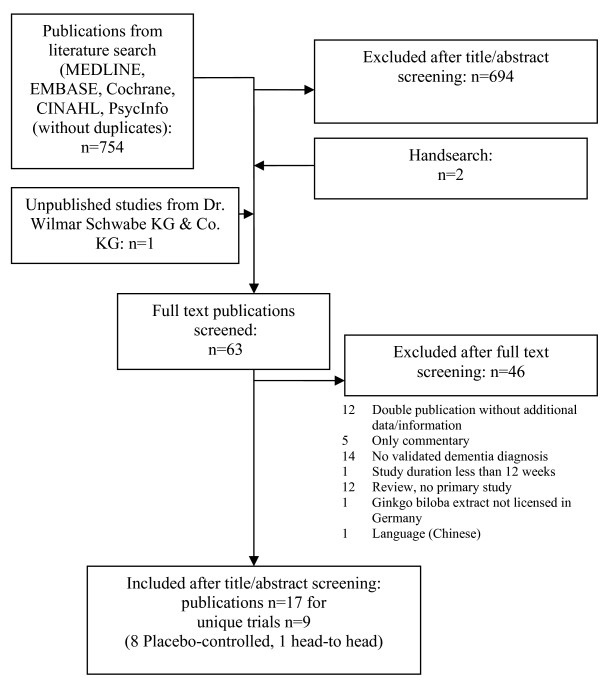
We searched MEDLINE, EMBASE, the Cochrane databases, CINAHL and PsycINFO for controlled trials of ginkgo for Alzheimer's, vascular or mixed dementia. Studies had to be of a minimum of 12 weeks duration with at least ten participants per group. Clinical characteristics and outcomes were extracted. Meta-analysis results were expressed as risk ratios or standardized mean differences (SMD) in scores.
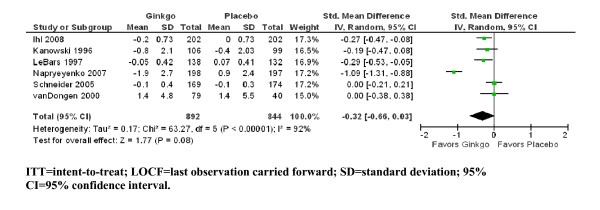
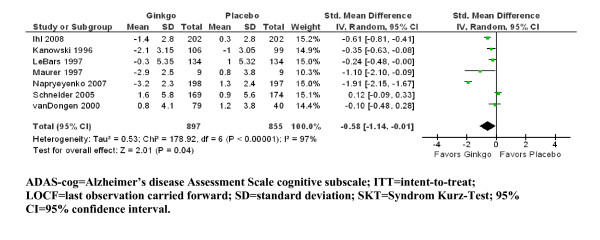
Nine trials using the standardized extract EGb761(R) met our inclusion criteria. Trials were of 12 to 52 weeks duration and included 2372 patients in total. In the meta-analysis, the SMDs in change scores for cognition were in favor of ginkgo compared to placebo (-0.58, 95% confidence interval [CI] -1.14; -0.01, p = 0.04), but did not show a statistically significant difference from placebo for activities in daily living (ADLs) (SMD = -0.32, 95% CI -0.66; 0.03, p = 0.08). Heterogeneity among studies was high. For the Alzheimer subgroup, the SMDs for ADLs and cognition outcomes were larger than for the whole group of dementias with statistical superiority for ginkgo also for ADL outcomes (SMD = -0.44, 95% CI -0.77; -0.12, p = 0.008). Drop-out rates and side effects did not differ between ginkgo and placebo. No consistent results were available for quality of life and neuropsychiatric symptoms, possibly due to the heterogeneity of the study populations.
Ginkgo biloba appears more effective than placebo. Effect sizes were moderate, while clinical relevance is, similar to other dementia drugs, difficult to determine.
银杏叶的益处一直存在争议。本研究旨在评估银杏叶治疗阿尔茨海默病以及血管性和混合性痴呆的效果,涵盖了各种结局指标。
我们检索了 MEDLINE、EMBASE、Cochrane 数据库、CINAHL 和 PsycINFO 中关于银杏叶治疗阿尔茨海默病、血管性或混合性痴呆的对照试验。这些研究的持续时间必须至少为 12 周,每组至少有 10 名参与者。我们提取了研究的临床特征和结局。荟萃分析结果以风险比或标准化均数差值(SMD)表示。
符合纳入标准的共有 9 项使用标准化提取物 EGb761(R)的试验。这些试验的持续时间为 12 至 52 周,总共纳入了 2372 名患者。荟萃分析结果显示,银杏叶治疗组认知功能的变化评分较安慰剂组更优(SMD=-0.58,95%置信区间[CI]-1.14;-0.01,p=0.04),但在日常生活活动(ADL)方面,银杏叶组与安慰剂组之间的差异无统计学意义(SMD=-0.32,95%CI-0.66;0.03,p=0.08)。研究之间的异质性较高。对于阿尔茨海默病亚组,ADL 和认知结局的 SMD 大于所有痴呆症患者,银杏叶组在 ADL 结局方面也具有统计学优势(SMD=-0.44,95%CI-0.77;-0.12,p=0.008)。银杏叶组和安慰剂组的脱落率和不良反应无差异。由于研究人群的异质性,生活质量和神经精神症状方面未得到一致的结果。
银杏叶比安慰剂更有效。效应大小为中等,而临床相关性与其他痴呆症药物相似,难以确定。