Gaucheron F, Malinge J M, Blacker A J, Lehn J M, Leng M
Centre de Biophysique Moléculaire, Orléans, France.
Proc Natl Acad Sci U S A. 1991 May 1;88(9):3516-9. doi: 10.1073/pnas.88.9.3516.
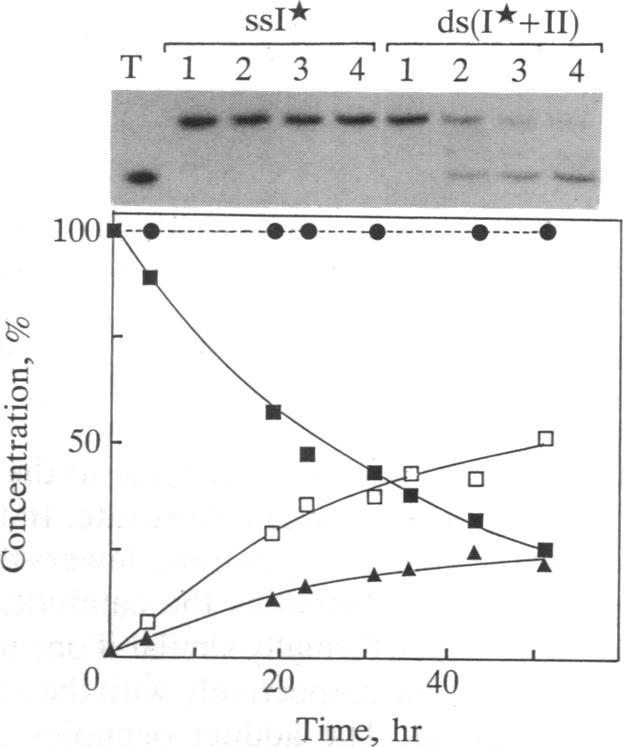
The platinum(II) complex cis-[Pt(NH3)2(N7-N-methyl-2-diazapyrenium)Cl]2+ formed in the reaction between cis-diamminedichloroplatinum(II) and N-methyl-2,7-diazapyrenium reacts with N7 of guanine residues in DNA. The resulting adduct is kinetically inert within single-stranded DNA. Within double-stranded DNA, it is kinetically inert in 1 M NaClO4 and becomes labile as the salt concentration is decreased. Two products, cis-[Pt(NH3)2(N7-N-methyl-2-diazapyrenium)H2O]3+ and N-methyl-2,7-diazapyrenium, are released. The conformation of the platinated DNA is different in low- and high-salt conditions as shown by the chemical probe diethyl pyrocarbonate. These results are discussed in relation with a possible catalytic role played by the double-stranded DNA.
顺式二氯二氨合铂(II)与N-甲基-2,7-二氮杂芘反应生成的铂(II)配合物顺式-[Pt(NH₃)₂(N⁷-N-甲基-2-二氮杂芘鎓)Cl]²⁺与DNA中鸟嘌呤残基的N⁷发生反应。生成的加合物在单链DNA中动力学惰性。在双链DNA中,它在1 M高氯酸钠中动力学惰性,随着盐浓度降低变得不稳定。会释放出两种产物,顺式-[Pt(NH₃)₂(N⁷-N-甲基-2-二氮杂芘鎓)H₂O]³⁺和N-甲基-2,7-二氮杂芘。如焦碳酸二乙酯化学探针所示,在低盐和高盐条件下,铂化DNA的构象不同。结合双链DNA可能发挥的催化作用对这些结果进行了讨论。