Department of Cell Biology, The University of Oklahoma Health Sciences Center, Oklahoma City, Oklahoma, USA.
Diabetes. 2010 Jul;59(7):1809-16. doi: 10.2337/db09-1056. Epub 2010 Mar 18.
Connective tissue growth factor (CTGF) is a major fibrogenic factor. Increased retinal CTGF levels have been implicated to play a role in diabetic retinopathy. SERPINA3K is a serine proteinase inhibitor, and its levels were decreased in retinas with diabetic retinopathy. The purpose of this study was to investigate the role of SERPINA3K in the regulation of CTGF and fibrogenesis and its mechanism of action.
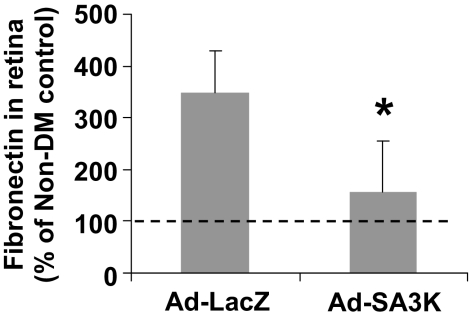
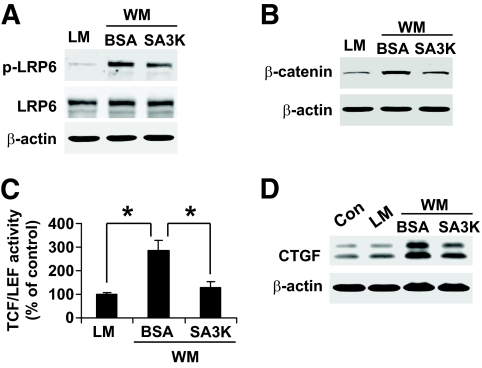
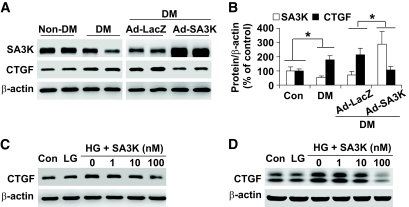
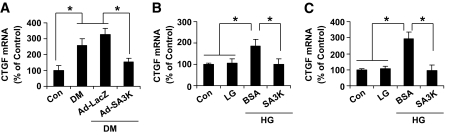
Adenovirus expressing SERPINA3K was injected intravitreally into streptozotocin-induced diabetic rats. CTGF expression was measured using Western blot analysis and real-time RT-PCR. Fibrosis was evaluated by quantifying retinal fibronectin using enzyme-linked immunosorbent assay. Wnt pathway activation was determined by phosphorylation of LDL receptor-related protein 6, a coreceptor of Wnt ligands, and stabilization of beta-catenin, an essential effector of the canonical Wnt pathway.
Ad-SERPINA3K attenuated the CTGF and fibronectin overexpression in retinas of diabetic rats. In cultured retinal cells, SERPINA3K blocked the overproduction of CTGF induced by high glucose. Dickkopf-1, a specific Wnt antagonist, also attenuated the high-glucose-induced CTGF overexpression, indicating a role of Wnt signaling in CTGF overexpression in diabetes. Similarly, increased SERPINA3K blocked Wnt pathway activation in diabetic retinas and in cells treated with high glucose. Further, SERPINA3K also attenuated the Wnt3a-induced activation of the canonical Wnt pathway and the overexpression of CTGF.
SERPINA3K is an antifibrogenic factor, and its antifibrogenic activity is through blocking the Wnt pathway. Decreased SERPINA3K levels may contribute to the fibrosis in diabetic retinopathy.
结缔组织生长因子(CTGF)是一种主要的纤维生成因子。视网膜 CTGF 水平升高与糖尿病视网膜病变有关。丝氨酸蛋白酶抑制剂 SERPINA3K 的水平在糖尿病视网膜病变的视网膜中降低。本研究的目的是研究 SERPINA3K 在调节 CTGF 和纤维化中的作用及其作用机制。
通过玻璃体内注射表达 SERPINA3K 的腺病毒,将 SERPINA3K 导入链脲佐菌素诱导的糖尿病大鼠。通过 Western blot 分析和实时 RT-PCR 测量 CTGF 的表达。通过酶联免疫吸附试验定量测定视网膜纤维连接蛋白来评估纤维化。通过 LDL 受体相关蛋白 6(Wnt 配体的核心受体)的磷酸化和β-连环蛋白(经典 Wnt 途径的必需效应物)的稳定来确定 Wnt 途径的激活。
Ad-SERPINA3K 减轻了糖尿病大鼠视网膜中 CTGF 和纤维连接蛋白的过度表达。在培养的视网膜细胞中,SERPINA3K 阻断了高葡萄糖诱导的 CTGF 过度产生。Dickkopf-1 是一种特异性 Wnt 拮抗剂,也减轻了高葡萄糖诱导的 CTGF 过度表达,表明 Wnt 信号通路在糖尿病中 CTGF 过度表达中起作用。同样,增加的 SERPINA3K 阻断了糖尿病视网膜和高糖处理的细胞中 Wnt 途径的激活。此外,SERPINA3K 还减轻了 Wnt3a 诱导的经典 Wnt 途径的激活和 CTGF 的过度表达。
SERPINA3K 是一种抗纤维化因子,其抗纤维化活性是通过阻断 Wnt 途径实现的。SERPINA3K 水平降低可能导致糖尿病视网膜病变中的纤维化。