St Boniface General Hospital, University of Manitoba, Winnipeg, Manitoba, Canada.
Am J Kidney Dis. 2010 May;55(5):848-55. doi: 10.1053/j.ajkd.2010.01.011. Epub 2010 Mar 19.
2009 pandemic influenza A(H1N1) has led to a global increase in severe respiratory illness. Little is known about kidney outcomes and dialytic requirements in critically ill patients infected with pandemic H1N1.
Prospective observational study.
SETTING & PARTICIPANTS: 50 patients with pandemic H1N1 admitted to any of 7 intensive care units in Manitoba, Canada, were prospectively followed.
OUTCOME & MEASUREMENTS: Outcomes were kidney injury and kidney failure defined using RIFLE (risk, injury, failure, loss, end-stage disease) criteria or need for dialysis therapy.
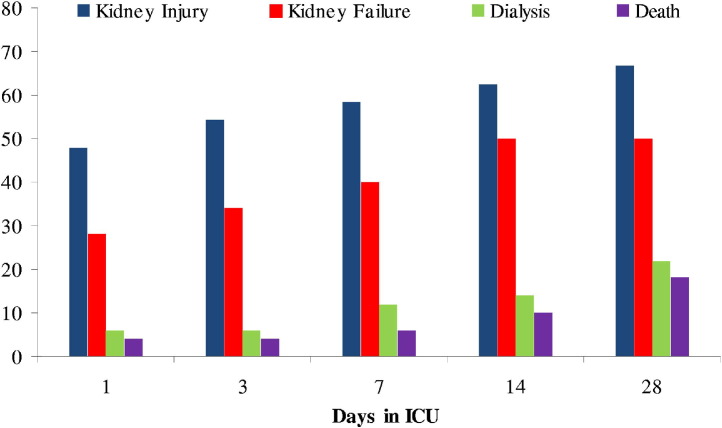
The pandemic H1N1 group was composed of 50 critically ill patients with pandemic H1N1 with severe respiratory syndrome (47 confirmed cases, 3 probable). Kidney injury, kidney failure, and need for dialysis occurred in 66.7%, 66%, and 11% of patients, respectively. Mortality was 16%. Kidney failure was associated with increased death (OR, 11.29; 95% CI, 1.29-98.9), whereas the need for dialysis was associated with an increase in length of stay (RR, 2.38; 95% CI, 2.13-25.75).
Small population studied from single Canadian province; thus, limited generalizability.
In critically ill patients with pandemic H1N1, kidney injury, kidney failure, and the need for dialysis are common and associated with an increase in mortality and length of intensive care unit stay.
2009 年甲型 H1N1 流感大流行导致全球严重呼吸道疾病发病率上升。目前对于感染大流行 H1N1 流感的危重症患者的肾脏结局和透析需求知之甚少。
前瞻性观察性研究。
前瞻性随访加拿大马尼托巴省 7 个重症监护病房收治的 50 例甲型 H1N1 流感患者。
结局为使用 RIFLE(风险、损伤、衰竭、丧失、终末期疾病)标准定义的肾脏损伤和肾衰竭,或需要透析治疗。
甲型 H1N1 组由 50 例患有严重呼吸综合征的甲型 H1N1 危重症患者组成(47 例确诊病例,3 例可能病例)。分别有 66.7%、66%和 11%的患者发生了肾脏损伤、肾衰竭和需要透析治疗。死亡率为 16%。肾衰竭与死亡增加相关(OR,11.29;95%CI,1.29-98.9),而透析需求与住院时间延长相关(RR,2.38;95%CI,2.13-25.75)。
研究人群来自加拿大单一省份,因此,推广性有限。
在感染甲型 H1N1 流感的危重症患者中,肾脏损伤、肾衰竭和需要透析治疗很常见,与死亡率和重症监护病房住院时间延长有关。