Instituto Gulbenkian de Ciência, Oeiras, Portugal.
PLoS One. 2010 Mar 22;5(3):e9778. doi: 10.1371/journal.pone.0009778.
The evolutionary mechanisms structuring the expression pattern of variant surface antigen (VSA) families that allow pathogens to evade immune responses and establish chronic and repeated infections pose major challenges to theoretical research. In Plasmodium falciparum, the best-studied VSA family is erythrocyte membrane protein 1 (PfEMP1). Each parasite genome encodes about 60 PfEMP1 variants, which are important virulence factors and major targets of host antibody responses. Transcriptional switching is the basis of clonal PfEMP1 variation and immune evasion. A relatively conserved subset of PfEMP1 variants tends to dominate in non-immune patients and in patients with severe malaria, while more diverse subsets relate to uncomplicated infection and higher levels of pre-existing protective immunity.
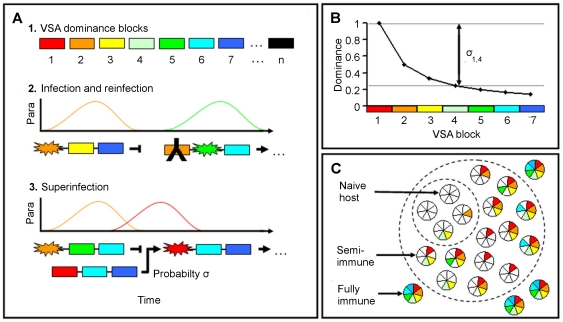
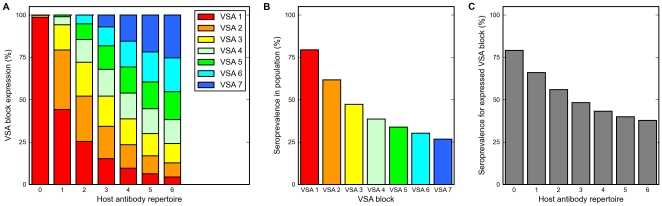
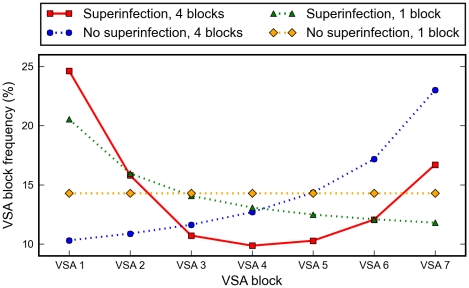
METHODOLOGY/PRINCIPAL FINDINGS: Here, we use the available molecular and serological evidence regarding VSAs, in particular PfEMP1, to formulate a mathematical model of the evolutionary mechanisms shaping VSA organization and expression patterns. The model integrates the transmission dynamics between hosts and the competitive interactions within hosts, based on the hypothesis that the VSAs can be organized into so-called dominance blocks, which characterize their competitive potential. The model reproduces immunological trends observed in field data, and predicts an evolutionary stable balance between inter-clonally conserved dominance blocks that are highly competitive within-host and diverse blocks that are favoured by immune selection at the population level.
CONCLUSIONS/SIGNIFICANCE: The application of a monotonic dominance profile to VSAs encoded by a gene family generates two opposing selective forces and, consequently, two distinct clusters of genes emerge in adaptation to naïve and partially immune hosts, respectively.
导致变体表面抗原(VSA)家族表达模式的进化机制允许病原体逃避免疫反应并建立慢性和反复感染,这对理论研究构成了重大挑战。在恶性疟原虫中,研究得最好的 VSA 家族是红细胞膜蛋白 1(PfEMP1)。每个寄生虫基因组编码约 60 种 PfEMP1 变体,这些变体是重要的毒力因子和宿主抗体反应的主要靶标。转录开关是克隆 PfEMP1 变异和免疫逃避的基础。相对保守的 PfEMP1 变体子集倾向于在非免疫患者和严重疟疾患者中占主导地位,而更多样化的子集与无并发症感染和更高水平的预先存在的保护性免疫有关。
方法/主要发现:在这里,我们利用有关 VSA,特别是 PfEMP1 的现有分子和血清学证据,构建了一个塑造 VSA 组织和表达模式的进化机制的数学模型。该模型基于 VSA 可以组织成所谓的优势块的假设,整合了宿主之间的传播动态和宿主内部的竞争相互作用,该假设描述了它们的竞争潜力。该模型再现了现场数据中观察到的免疫学趋势,并预测了在宿主间保守的优势块之间存在一种进化稳定的平衡,这些优势块在宿主内具有高度竞争力,而多样化的块则在群体水平上受到免疫选择的青睐。
结论/意义:将单调优势分布应用于由基因家族编码的 VSA 会产生两种相反的选择力,因此,在适应新宿主和部分免疫宿主时,分别出现两个不同的基因簇。