University of Warwick, Unit for Diabetes and Metabolism, Warwick Medical School, Clinical Sciences Research Institute, UHCW, Clifford Bridge Road, Coventry, CV2 2DX, UK.
Biochemistry Dept, National Research Center, Dokki, Giza, Egypt.
J Inflamm (Lond). 2010 Mar 30;7:15. doi: 10.1186/1476-9255-7-15.
Emerging data indicate that gut-derived endotoxin may contribute to low-grade systemic inflammation in insulin resistant states. This study aimed to examine the importance of serum endotoxin and inflammatory markers in non-alcoholic fatty liver disease (NAFLD) patients, with and without type 2 diabetes mellitus (T2DM), and to explore the effect of treatment with a lipase inhibitor, Orlistat, on their inflammatory status.
Fasted serum from 155 patients with biopsy proven NAFLD and 23 control subjects were analysed for endotoxin, soluble CD14 (sCD14), soluble tumour necrosis factor receptor II (sTNFRII) and various metabolic parameters. A subgroup of NAFLD patients were re-assessed 6 and 12 months after treatment with diet alone (n = 6) or diet plus Orlistat (n = 8).
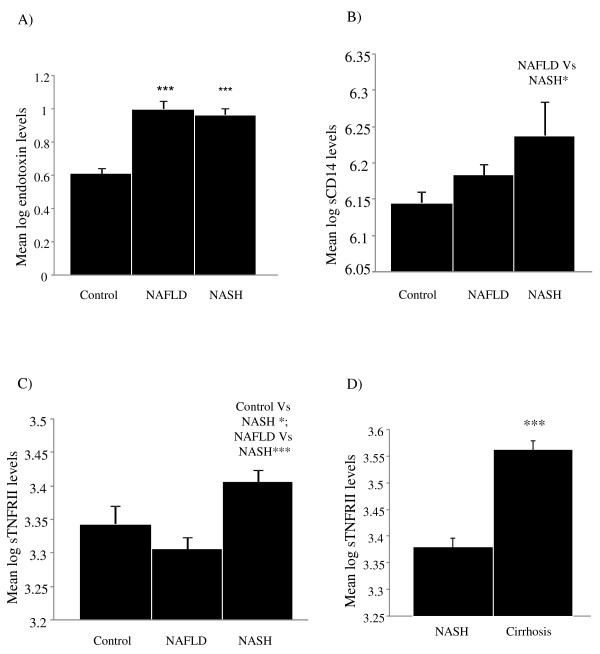
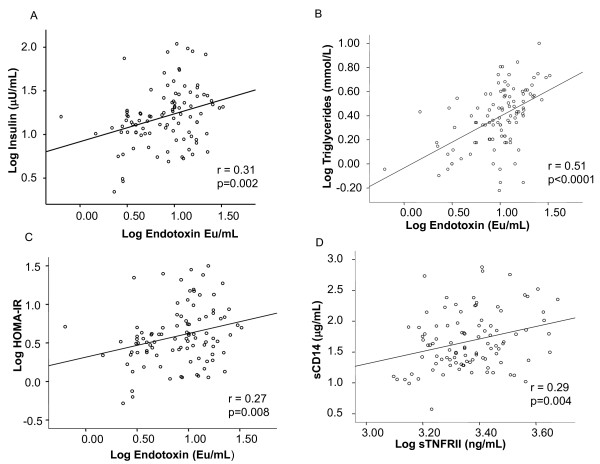
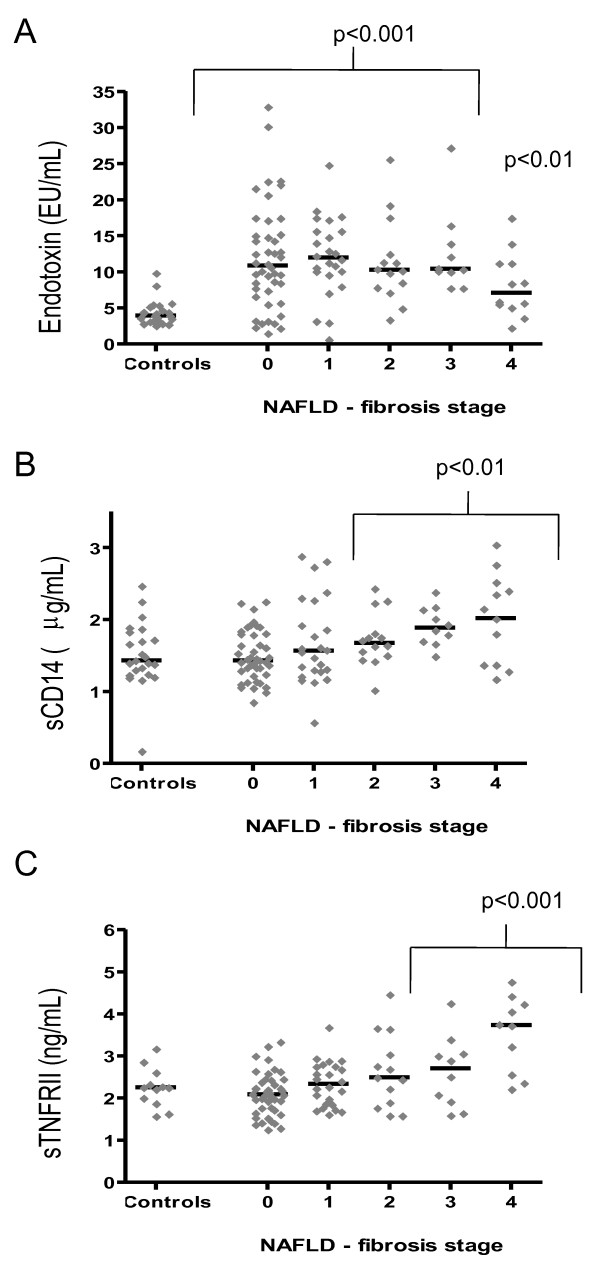
Endotoxin levels were significantly higher in patients with NAFLD compared with controls (NAFLD: 10.6(7.8, 14.8) EU/mL; controls: 3.9(3.2, 5.2) EU/mL, p < 0.001); NAFLD alone produced comparable endotoxin levels to T2DM (NAFLD: T2DM: 10.6(5.6, 14.2) EU/mL; non-diabetic: 10.6(8.5, 15.2) EU/mL), whilst a significant correlation between insulin resistance and serum endotoxin was observed (r = 0.27, p = 0.008). Both sCD14 (p < 0.01) and sTNFRII (p < 0.001) increased with severity of fibrosis. A positive correlation was also noted between sTNFRII and sCD14 in the NAFLD subjects (r = 0.29, p = 0.004).Sub-cohort treatment with Orlistat in patients with NAFLD showed significant decreases in ALT (p = 0.006), weight (p = 0.005) and endotoxin (p = 0.004) compared with the NAFLD, non-Orlistat treated control cohort at 6 and 12 months post therapy, respectively.
Endotoxin levels were considerably increased in NAFLD patients, with marked increases noted in early stage fibrosis compared with controls. These results suggest elevated endotoxin may serve as an early indicator of potential liver damage, perhaps negating the need for invasive liver biopsy. As endotoxin may promote insulin resistance and inflammation, interventions aimed at reducing endotoxin levels in NAFLD patients may prove beneficial in reducing inflammatory burden.
新出现的数据表明,肠道来源的内毒素可能导致胰岛素抵抗状态下的低度全身炎症。本研究旨在探讨血清内毒素和炎症标志物在非酒精性脂肪性肝病(NAFLD)患者(伴或不伴 2 型糖尿病(T2DM))中的重要性,并探讨脂肪酶抑制剂奥利司他治疗对其炎症状态的影响。
对 155 例经肝活检证实的 NAFLD 患者和 23 例对照者的空腹血清进行内毒素、可溶性 CD14(sCD14)、可溶性肿瘤坏死因子受体 II(sTNFRII)和各种代谢参数分析。NAFLD 患者亚组在饮食治疗(n = 6)或饮食加奥利司他治疗(n = 8)6 个月和 12 个月后再次评估。
与对照组相比,NAFLD 患者的内毒素水平显著升高(NAFLD:10.6(7.8,14.8)EU/ml;对照组:3.9(3.2,5.2)EU/ml,p < 0.001);NAFLD 本身产生的内毒素水平与 T2DM 相当(NAFLD:T2DM:10.6(5.6,14.2)EU/ml;非糖尿病:10.6(8.5,15.2)EU/ml),而胰岛素抵抗与血清内毒素之间存在显著相关性(r = 0.27,p = 0.008)。sCD14(p < 0.01)和 sTNFRII(p < 0.001)均随纤维化程度的增加而增加。NAFLD 患者的 sTNFRII 与 sCD14 之间也存在正相关(r = 0.29,p = 0.004)。NAFLD 患者亚组奥利司他治疗 6 个月和 12 个月后,ALT(p = 0.006)、体重(p = 0.005)和内毒素(p = 0.004)均显著下降,与非奥利司他治疗的 NAFLD 对照组相比。
NAFLD 患者的内毒素水平显著升高,与对照组相比,早期纤维化时内毒素水平明显升高。这些结果表明,内毒素升高可能作为潜在肝损伤的早期指标,可能无需进行侵入性肝活检。由于内毒素可能促进胰岛素抵抗和炎症,因此降低 NAFLD 患者内毒素水平的干预措施可能有助于减轻炎症负担。