Department of Internal Medicine, Yonsei University College of Medicine, Seoul, Korea.
J Korean Med Sci. 2010 Apr;25(4):583-8. doi: 10.3346/jkms.2010.25.4.583. Epub 2010 Mar 19.
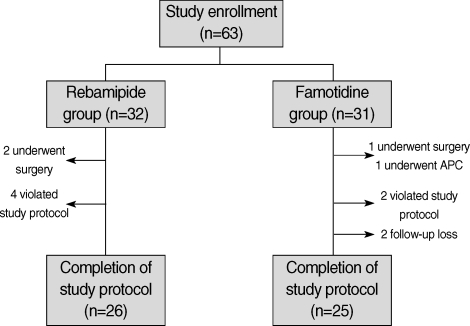
Endoscopic mucosal resection (EMR) results in the formation of iatrogenic gastric ulcers and the optimal treatments for such ulcers are still unclear. We aimed to evaluate the efficacy of rebamipide in the management of EMR-induced ulcers by comparing it with an H(2) receptor antagonist. After EMR, patients were randomly assigned into either rebamipide or famotidine groups. All patients received a one-week lansoprazole 30 mg q.d. therapy followed by three-week famotidine (20 mg b.i.d.) or rebamipide (100 mg t.i.d.) therapy. Four weeks after the treatments, ulcer sizes, stages, bleeding rates, and ulcer-related symptoms were compared using endoscopy and a questionnaire. A total of 63 patients were enrolled in this study. Finally, 51 patients were analyzed, 26 in rebamipide and 25 in famotidine group. Baseline characteristics were not significantly different between the two groups. Four weeks after EMR, the two groups were comparable in terms of ulcer reduction ratio (P=0.297), and ulcer stage (P=1.000). Moreover, no difference was observed with regard to ulcer-related symptoms, drug compliance, adverse drug event rates, and bleeding rates. Our data suggest that rebamipide is not inferior to famotidine in healing iatrogenic gastric ulcers, and could be a therapeutic option in the treatment of such ulcers.
内镜黏膜切除术(EMR)会导致医源性胃溃疡,而此类溃疡的最佳治疗方法仍不清楚。我们旨在通过与 H₂受体拮抗剂进行比较,评估瑞巴派特在 EMR 诱导性溃疡治疗中的疗效。EMR 后,患者被随机分配到瑞巴派特或法莫替丁组。所有患者均接受一周兰索拉唑 30mg qd 治疗,随后接受三周法莫替丁(20mg bid)或瑞巴派特(100mg tid)治疗。治疗 4 周后,通过内镜和问卷调查比较溃疡大小、分期、出血率和溃疡相关症状。本研究共纳入 63 例患者。最终,51 例患者被纳入分析,其中 26 例接受瑞巴派特治疗,25 例接受法莫替丁治疗。两组患者的基线特征无显著差异。EMR 后 4 周,两组在溃疡缩小率方面无差异(P=0.297),溃疡分期也无差异(P=1.000)。此外,溃疡相关症状、药物依从性、不良药物事件发生率和出血率方面也无差异。我们的数据表明,瑞巴派特在治疗医源性胃溃疡方面并不逊于法莫替丁,可作为此类溃疡的治疗选择。