Department of Allergy and Rheumatology, Ajou University School of Medicine, Suwon, Korea.
Allergy Asthma Immunol Res. 2010 Apr;2(2):134-40. doi: 10.4168/aair.2010.2.2.134. Epub 2010 Mar 24.
Aspirin-intolerant asthma (AIA) is characterized by moderate to severe asthma that is aggravated by aspirin or other non-steroidal anti-inflammatory drugs. Affected patients frequently have chronic rhinosinusitis and nasal polyposis due to persistent upper and lower airway inflammation with marked eosinophilia. IL-13 plays a crucial role in the development of allergic asthma by inducing airway eosinophilia and hyper-reactivity and it has been correlated with an increased eosinophil count.
Two promoter polymorphisms of the IL-13 gene (-1510 A>C and -1055C>T) and one coding nonsynonymus Arg110Gln (110G>A) polymorphism were genotyped using primer extension methods in 162 patients with AIA, 301 patients with aspirin-tolerant asthma (ATA), and 430 normal healthy controls (NC).
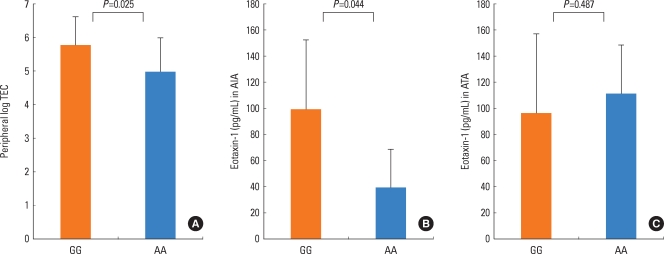
There was no significant difference in the genotype, allele, and haplotype frequencies of the three polymorphisms among the three groups. AIA patients with the AA genotype -1510A>C (P=0.012) and CC genotype -1055C>T (P<0.001) had a significantly higher frequency of rhinosinusitis, as compared to those with the minor alleles of these two single nucleotide polymorphisms. AIA patients with the GG genotype had a higher peripheral eosinophil count (P=0.025) and a higher serum eotaxin-1 level (P=0.044), as compared to patients with the AA genotype IL-13 Arg110Gln (110G>A).
These findings suggest that the IL-13 polymorphisms at -1510A>C and 1055C>T are associated with the development of rhinosinusitis in AIA patients. IL-13 Arg110Gln may be associated with an increased eosinophil count and eotaxin-1 level and could increase eosinophilic inflammation in the upper and lower airways of patients with AIA.
阿司匹林不耐受性哮喘(AIA)的特征是中重度哮喘,由阿司匹林或其他非甾体抗炎药加重。受影响的患者由于持续性上下气道炎症伴明显嗜酸性粒细胞增多,常伴有慢性鼻-鼻窦炎和鼻息肉。IL-13 通过诱导气道嗜酸性粒细胞增多和高反应性,在过敏性哮喘的发展中起关键作用,并且与嗜酸性粒细胞计数增加相关。
采用引物延伸法对 162 例 AIA 患者、301 例阿司匹林耐受性哮喘(ATA)患者和 430 例正常健康对照者(NC)的 IL-13 基因-1510A>C(-1510A>C)和-1055C>T(-1055C>T)两个启动子多态性及一个编码非同义 Arg110Gln(110G>A)多态性进行基因分型。
三组间三种多态性的基因型、等位基因和单体型频率无显著性差异。与这些两个单核苷酸多态性的次要等位基因相比,AIA 患者 AA 基因型-1510A>C(P=0.012)和 CC 基因型-1055C>T(P<0.001)的鼻炎发生率明显更高。与 AA 基因型相比,IL-13 Arg110Gln(110G>A)GG 基因型的 AIA 患者外周血嗜酸性粒细胞计数较高(P=0.025),血清嗜酸性粒细胞趋化因子-1 水平较高(P=0.044)。
这些发现表明,-1510A>C 和 1055C>T 处的 IL-13 多态性与 AIA 患者鼻炎的发生有关。IL-13 Arg110Gln 可能与嗜酸性粒细胞计数和嗜酸性粒细胞趋化因子-1 水平升高有关,并可增加 AIA 患者上下气道的嗜酸性粒细胞炎症。