Institut Pasteur, Unité de Régulation des Infections Rétrovirales, Paris, France.
Retrovirology. 2010 Apr 7;7:31. doi: 10.1186/1742-4690-7-31.
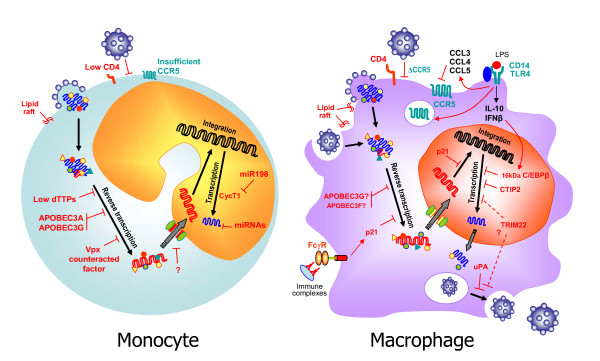
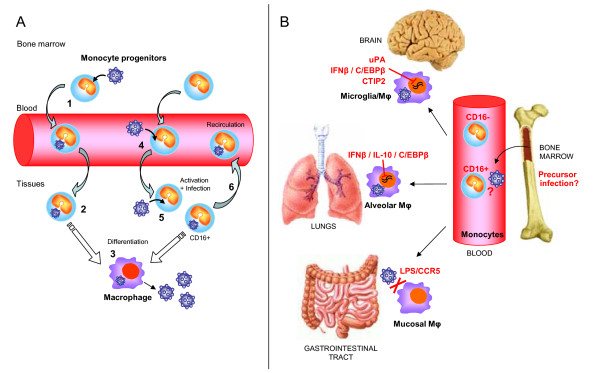
Monocytes and macrophages are targets of HIV-1 infection and play critical roles in multiple aspects of viral pathogenesis. HIV-1 can replicate in blood monocytes, although only a minor proportion of circulating monocytes harbor viral DNA. Resident macrophages in tissues can be infected and function as viral reservoirs. However, their susceptibility to infection, and their capacity to actively replicate the virus, varies greatly depending on the tissue localization and cytokine environment. The susceptibility of monocytes to HIV-1 infection in vitro depends on their differentiation status. Monocytes are refractory to infection and become permissive upon differentiation into macrophages. In addition, the capacity of monocyte-derived macrophages to sustain viral replication varies between individuals. Host determinants regulate HIV-1 replication in monocytes and macrophages, limiting several steps of the viral life-cycle, from viral entry to virus release. Some host factors responsible for HIV-1 restriction are shared with T lymphocytes, but several anti-viral mechanisms are specific to either monocytes or macrophages. Whilst a number of these mechanisms have been identified in monocytes or in monocyte-derived macrophages in vitro, some of them have also been implicated in the regulation of HIV-1 infection in vivo, in particular in the brain and the lung where macrophages are the main cell type infected by HIV-1. This review focuses on cellular factors that have been reported to interfere with HIV-1 infection in monocytes and macrophages, and examines the evidences supporting their role in vivo, highlighting unique aspects of HIV-1 restriction in these two cell types.
单核细胞和巨噬细胞是 HIV-1 感染的靶标,在病毒发病机制的多个方面发挥关键作用。HIV-1 可以在血液单核细胞中复制,尽管只有少数循环单核细胞携带病毒 DNA。组织中的常驻巨噬细胞可以被感染并充当病毒储存库。然而,它们对感染的易感性以及主动复制病毒的能力,取决于组织定位和细胞因子环境。单核细胞在体外对 HIV-1 感染的易感性取决于其分化状态。单核细胞对感染具有抗性,在分化为巨噬细胞后变得易感染。此外,单核细胞衍生的巨噬细胞维持病毒复制的能力在个体之间存在差异。宿主决定因素调节单核细胞和巨噬细胞中的 HIV-1 复制,限制病毒生命周期的几个步骤,从病毒进入到病毒释放。一些负责 HIV-1 限制的宿主因素与 T 淋巴细胞共享,但有几种抗病毒机制是单核细胞或巨噬细胞所特有的。虽然已经在单核细胞或单核细胞衍生的巨噬细胞中鉴定出许多这些机制,但其中一些也与体内 HIV-1 感染的调节有关,特别是在大脑和肺部,巨噬细胞是 HIV-1 感染的主要细胞类型。本文综述了报道中干扰单核细胞和巨噬细胞中 HIV-1 感染的细胞因子,并检查了支持它们在体内作用的证据,突出了这两种细胞类型中 HIV-1 限制的独特方面。