Institut Cochin, Inserm U1016, Paris, France.
CNRS, UMR8104, Paris, France.
PLoS Pathog. 2022 May 27;18(5):e1010335. doi: 10.1371/journal.ppat.1010335. eCollection 2022 May.
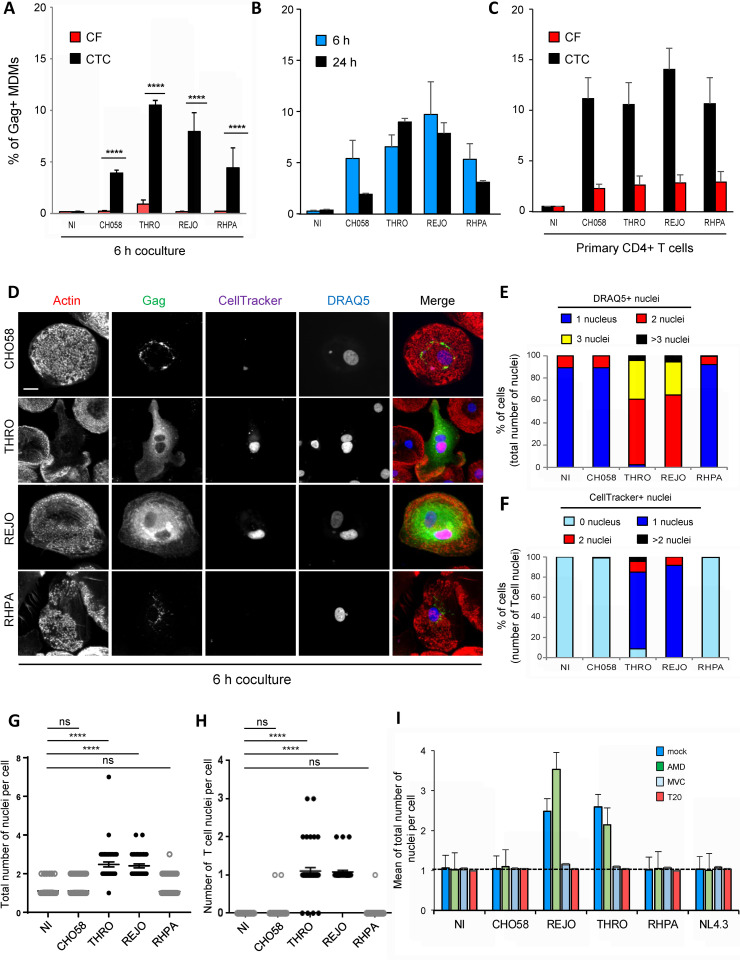
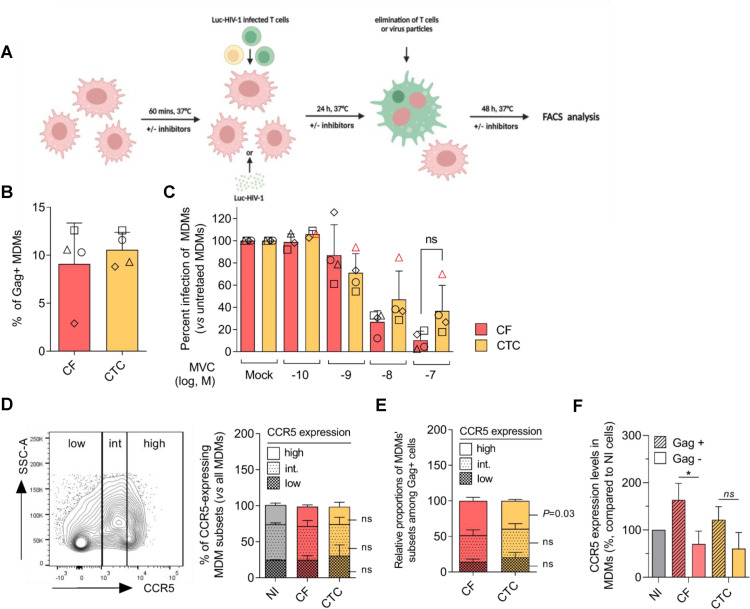
Macrophages (MΦ) are increasingly recognized as HIV-1 target cells involved in the pathogenesis and persistence of infection. Paradoxically, in vitro infection assays suggest that virus isolates are mostly T-cell-tropic and rarely MΦ-tropic. The latter are assumed to emerge under CD4+ T-cell paucity in tissues such as the brain or at late stage when the CD4 T-cell count declines. However, assays to qualify HIV-1 tropism use cell-free viral particles and may not fully reflect the conditions of in vivo MΦ infection through cell-to-cell viral transfer. Here, we investigated the capacity of viruses expressing primary envelope glycoproteins (Envs) with CCR5 and/or CXCR4 usage from different stages of infection, including transmitted/founder Envs, to infect MΦ by a cell-free mode and through cell-to-cell transfer from infected CD4+ T cells. The results show that most viruses were unable to enter MΦ as cell-free particles, in agreement with the current view that non-M-tropic viruses inefficiently use CD4 and/or CCR5 or CXCR4 entry receptors on MΦ. In contrast, all viruses could be effectively cell-to-cell transferred to MΦ from infected CD4+ T cells. We further showed that viral transfer proceeded through Env-dependent cell-cell fusion of infected T cells with MΦ targets, leading to the formation of productively infected multinucleated giant cells. Compared to cell-free infection, infected T-cell/MΦ contacts showed enhanced interactions of R5 M- and non-M-tropic Envs with CD4 and CCR5, resulting in a reduced dependence on receptor expression levels on MΦ for viral entry. Altogether, our results show that virus cell-to-cell transfer overcomes the entry block of isolates initially defined as non-macrophage-tropic, indicating that HIV-1 has a more prevalent tropism for MΦ than initially suggested. This sheds light into the role of this route of virus cell-to-cell transfer to MΦ in CD4+ T cell rich tissues for HIV-1 transmission, dissemination and formation of tissue viral reservoirs.
巨噬细胞(MΦ)越来越被认为是 HIV-1 的靶细胞,参与感染的发病机制和持续存在。矛盾的是,体外感染实验表明,病毒分离株主要是 T 细胞嗜性的,很少是 MΦ 嗜性的。后者被认为是在组织(如大脑)中 CD4+T 细胞匮乏或 CD4 T 细胞计数下降的晚期出现的。然而,用于确定 HIV-1 嗜性的测定使用无细胞病毒颗粒,并且可能不完全反映通过细胞间病毒转移感染体内 MΦ 的条件。在这里,我们研究了表达不同感染阶段的主要包膜糖蛋白(Env)的病毒(包括传播/原始 Env)通过无细胞模式和从感染的 CD4+T 细胞通过细胞间转移感染 MΦ 的能力。结果表明,大多数病毒无法作为无细胞颗粒进入 MΦ,这与当前的观点一致,即非 M-嗜性病毒在 MΦ 上低效地使用 CD4 和/或 CCR5 或 CXCR4 进入受体。相比之下,所有病毒都可以从感染的 CD4+T 细胞中有效地通过细胞间转移到 MΦ。我们进一步表明,病毒转移是通过感染的 T 细胞与 MΦ 靶细胞之间依赖 Env 的细胞-细胞融合进行的,导致形成具有感染性的多核巨细胞。与无细胞感染相比,感染的 T 细胞/MΦ 接触显示出增强的 R5 M-和非 M-嗜性 Env 与 CD4 和 CCR5 的相互作用,从而减少了对 MΦ 上受体表达水平的依赖性病毒进入。总的来说,我们的结果表明,病毒细胞间转移克服了最初定义为非巨噬细胞嗜性的分离株的进入障碍,表明 HIV-1 对 MΦ 的嗜性比最初建议的更为普遍。这为 HIV-1 在富含 CD4+T 细胞的组织中的传播、扩散和形成组织病毒库的细胞间病毒转移途径的作用提供了线索。