Department of Immunology, Mayo Clinic College of Medicine, Mayo Clinic Arizona, Scottsdale, AZ 85259.
Department of Immunology, Mayo Clinic College of Medicine, Mayo Clinic Rochester, Rochester, MN 55905.
J Immunol. 2010 May 15;184(10):5466-5474. doi: 10.4049/jimmunol.0903561. Epub 2010 Apr 7.
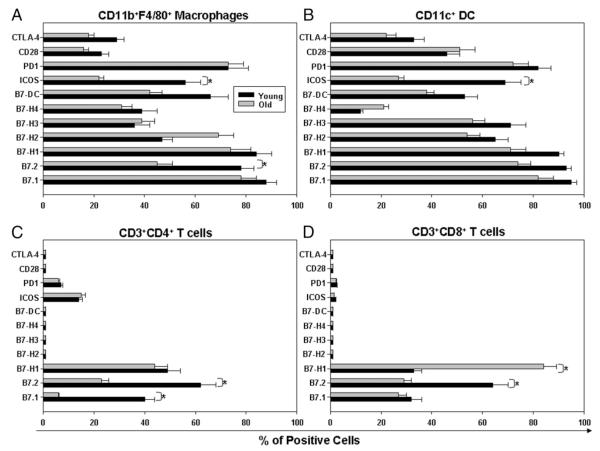
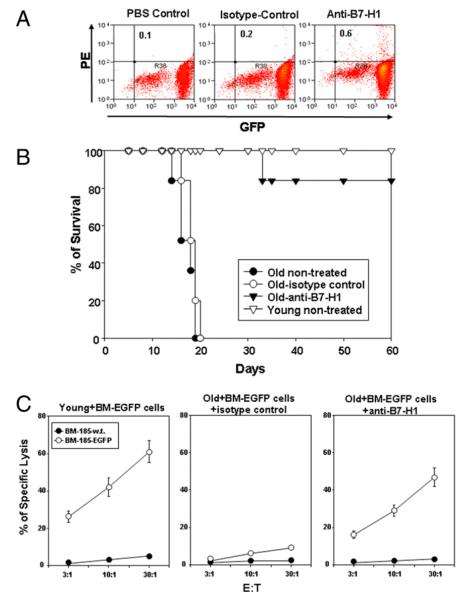
T cell responses are compromised in the elderly. The B7-CD28 family receptors are critical in the regulation of immune responses. We evaluated whether the B7-family and CD28-family receptors were differentially expressed in dendritic cells, macrophages, and CD4(+) and CD8(+) T cells from young and old mice, which could contribute to the immune dysfunction in the old. Although most of the receptors were equally expressed in all cells, >85% of the old naive CD8(+) T cells expressed B7-H1 compared with 25% in the young. Considering that B7-H1 negatively regulates immune responses, we hypothesized that expression of B7-H1 would downregulate the function of old CD8(+) T cells. Old CD8(+) T cells showed reduced ability to proliferate, but blockade of B7-H1 restored the proliferative capacity of old CD8(+) T cells to a level similar to young CD8(+) T cells. In vivo blockade of B7-H1 restored antitumor responses against the B7-H1(-) BM-185-enhanced GFP tumor, such that old animals responded with the same efficiency as young mice. Our data also indicate that old CD8(+) T cells express lower levels of TCR compared with young CD8(+) T cells. However, following antigenic stimulation in the presence of B7-H1 blockade, the levels of TCR expression were restored in old CD8(+) T cells, which correlated with stronger T cell activation. These studies demonstrated that expression of B7-H1 in old CD8(+) T cells impairs the proper activation of these cells and that blockade of B7-H1 could be critical to optimally stimulate a CD8 T cell response in the old.
T 细胞反应在老年人中受损。B7-CD28 家族受体在免疫反应的调节中至关重要。我们评估了 B7 家族和 CD28 家族受体在年轻和老年小鼠的树突状细胞、巨噬细胞和 CD4(+)和 CD8(+)T 细胞中的表达是否存在差异,这可能导致老年人的免疫功能障碍。尽管大多数受体在所有细胞中表达水平相当,但与年轻小鼠相比,>85%的老年幼稚 CD8(+)T 细胞表达 B7-H1,而年轻小鼠中只有 25%表达。考虑到 B7-H1 负调节免疫反应,我们假设 B7-H1 的表达会下调老年 CD8(+)T 细胞的功能。老年 CD8(+)T 细胞的增殖能力降低,但阻断 B7-H1 可恢复老年 CD8(+)T 细胞的增殖能力,使其与年轻 CD8(+)T 细胞相似。体内阻断 B7-H1 可恢复针对 B7-H1(-)BM-185 增强 GFP 肿瘤的抗肿瘤反应,使老年动物的反应效率与年轻小鼠相当。我们的数据还表明,与年轻 CD8(+)T 细胞相比,老年 CD8(+)T 细胞表达的 TCR 水平较低。然而,在存在 B7-H1 阻断的情况下,抗原刺激后,老年 CD8(+)T 细胞中 TCR 的表达水平得到恢复,这与更强的 T 细胞激活相关。这些研究表明,B7-H1 在老年 CD8(+)T 细胞中的表达会损害这些细胞的适当激活,并且阻断 B7-H1 可能对在老年中最佳刺激 CD8 T 细胞反应至关重要。