Laboratory for Clinical and Evolutionary Virology, Rega Institute for Medical Research, Katholieke Universiteit Leuven, Leuven, Belgium.
PLoS One. 2010 Apr 1;5(4):e9936. doi: 10.1371/journal.pone.0009936.
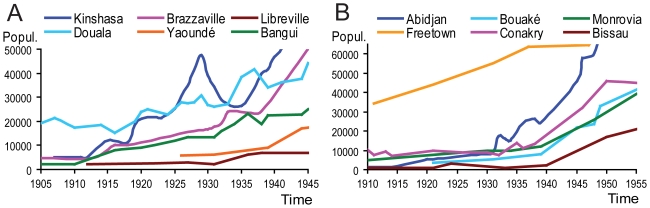
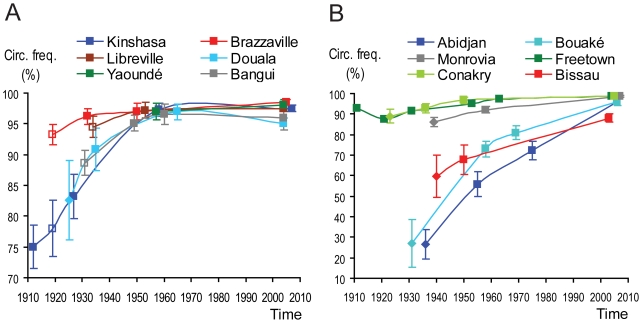
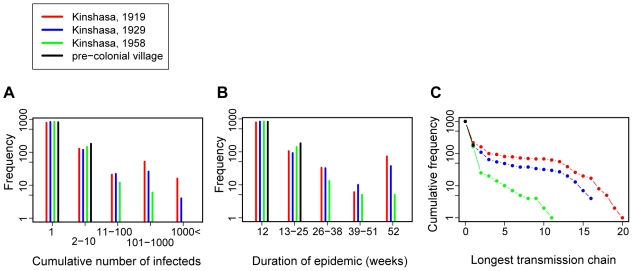
The processes that permitted a few SIV strains to emerge epidemically as HIV groups remain elusive. Paradigmatic theories propose factors that may have facilitated adaptation to the human host (e.g., unsafe injections), none of which provide a coherent explanation for the timing, geographical origin, and scarcity of epidemic HIV strains. Our updated molecular clock analyses established relatively narrow time intervals (roughly 1880-1940) for major SIV transfers to humans. Factors that could favor HIV emergence in this time frame may have been genital ulcer disease (GUD), resulting in high HIV-1 transmissibility (4-43%), largely exceeding parenteral transmissibility; lack of male circumcision increasing male HIV infection risk; and gender-skewed city growth increasing sexual promiscuity. We surveyed colonial medical literature reporting incidences of GUD for the relevant regions, concentrating on cities, suffering less reporting biases than rural areas. Coinciding in time with the origin of the major HIV groups, colonial cities showed intense GUD outbreaks with incidences 1.5-2.5 orders of magnitude higher than in mid 20(th) century. We surveyed ethnographic literature, and concluded that male circumcision frequencies were lower in early 20(th) century than nowadays, with low rates correlating spatially with the emergence of HIV groups. We developed computer simulations to model the early spread of HIV-1 group M in Kinshasa before, during and after the estimated origin of the virus, using parameters derived from the colonial literature. These confirmed that the early 20(th) century was particularly permissive for the emergence of HIV by heterosexual transmission. The strongest potential facilitating factor was high GUD levels. Remarkably, the direct effects of city population size and circumcision frequency seemed relatively small. Our results suggest that intense GUD in promiscuous urban communities was the main factor driving HIV emergence. Low circumcision rates may have played a role, probably by their indirect effects on GUD.
允许少数 SIV 株系演变为 HIV 群体的流行的过程仍然难以捉摸。典范理论提出了可能有利于适应人类宿主的因素(例如,不安全的注射),但没有一个因素能为 HIV 株系的时间、地理起源和稀缺性提供连贯的解释。我们更新的分子钟分析为 SIV 向人类的主要转移建立了相对狭窄的时间间隔(大致在 1880-1940 年)。在这个时间框架内,有利于 HIV 出现的因素可能是生殖器溃疡病(GUD),导致 HIV-1 的高传染性(4-43%),大大超过了注射途径的传染性;男性割礼的缺乏增加了男性 HIV 感染的风险;以及性别偏向的城市增长增加了性滥交。我们调查了报告相关地区 GUD 发病率的殖民医学文献,重点关注城市,比农村地区受到的报告偏见要少。与主要 HIV 群体的起源同时发生的是,殖民城市爆发了强烈的 GUD 疫情,发病率比 20 世纪中期高出 1.5-2.5 个数量级。我们调查了民族志文献,并得出结论,20 世纪早期男性割礼的频率比现在低,低频率与 HIV 群体的出现空间相关。我们使用从殖民文献中得出的参数,开发了计算机模拟模型,以模拟在病毒估计起源之前、期间和之后,HIV-1 组 M 在金沙萨的早期传播。这些模拟结果证实,20 世纪早期特别有利于异性传播的 HIV 出现。最强的潜在促进因素是高 GUD 水平。值得注意的是,城市人口规模和割礼频率的直接影响相对较小。我们的研究结果表明,在滥交的城市社区中,强烈的 GUD 是推动 HIV 出现的主要因素。低割礼率可能发挥了作用,可能是通过对 GUD 的间接影响。