Pérez de León Adalberto A, Strickman Daniel A, Knowles Donald P, Fish Durland, Thacker Eileen, de la Fuente José, Krause Peter J, Wikel Stephen K, Miller Ryan S, Wagner Gale G, Almazán Consuelo, Hillman Robert, Messenger Matthew T, Ugstad Paul O, Duhaime Roberta A, Teel Pete D, Ortega-Santos Alfonso, Hewitt David G, Bowers Edwin J, Bent Stephen J, Cochran Matt H, McElwain Terry F, Scoles Glen A, Suarez Carlos E, Davey Ronald, Howell Freeman Jeanne M, Lohmeyer Kimberly, Li Andrew Y, Guerrero Felix D, Kammlah Diane M, Phillips Pamela, Pound Joe M
Knipling-Bushland U,S, Livestock Insects Research Laboratory, USDA-ARS, Kerrville, TX, USA.
Parasit Vectors. 2010 Apr 8;3(1):36. doi: 10.1186/1756-3305-3-36.
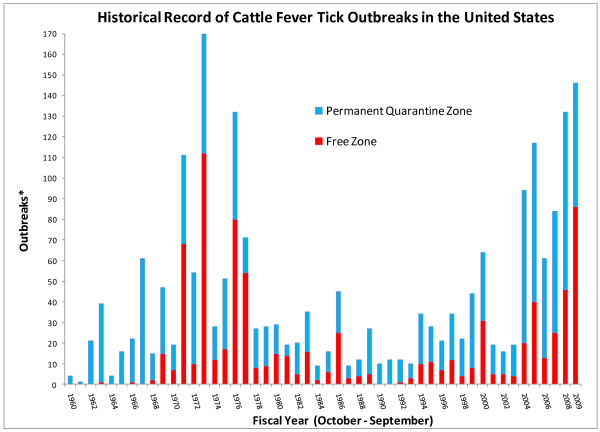
Babesia are emerging health threats to humans and animals in the United States. A collaborative effort of multiple disciplines to attain optimal health for people, animals and our environment, otherwise known as the One Health concept, was taken during a research workshop held in April 2009 to identify gaps in scientific knowledge regarding babesioses. The impetus for this analysis was the increased risk for outbreaks of bovine babesiosis, also known as Texas cattle fever, associated with the re-infestation of the U.S. by cattle fever ticks.
The involvement of wildlife in the ecology of cattle fever ticks jeopardizes the ability of state and federal agencies to keep the national herd free of Texas cattle fever. Similarly, there has been a progressive increase in the number of cases of human babesiosis over the past 25 years due to an increase in the white-tailed deer population. Human babesiosis due to cattle-associated Babesia divergens and Babesia divergens-like organisms have begun to appear in residents of the United States. Research needs for human and bovine babesioses were identified and are presented herein.
The translation of this research is expected to provide veterinary and public health systems with the tools to mitigate the impact of bovine and human babesioses. However, economic, political, and social commitments are urgently required, including increased national funding for animal and human Babesia research, to prevent the re-establishment of cattle fever ticks and the increasing problem of human babesiosis in the United States.
巴贝斯虫对美国的人类和动物健康构成了新出现的威胁。2009年4月举行的一次研究研讨会上,多学科共同努力以实现人类、动物和环境的最佳健康,即所谓的“同一健康”概念,旨在找出有关巴贝斯虫病科学知识方面的差距。此次分析的推动力是牛巴贝斯虫病(又称得克萨斯牛热)爆发风险增加,这与牛热蜱重新侵入美国有关。
野生动物参与牛热蜱生态系统,危及州和联邦机构使全国牛群免受得克萨斯牛热侵害的能力。同样,在过去25年里,由于白尾鹿数量增加,人类巴贝斯虫病病例数也在逐步上升。由与牛相关的分歧巴贝斯虫和类分歧巴贝斯虫生物引起的人类巴贝斯虫病已开始在美国居民中出现。本文确定并介绍了人类和牛巴贝斯虫病的研究需求。
预计这项研究成果将为兽医和公共卫生系统提供工具,以减轻牛和人类巴贝斯虫病的影响。然而,迫切需要经济、政治和社会方面的承诺,包括增加国家对动物和人类巴贝斯虫研究的资金投入,以防止牛热蜱重新出现以及美国人类巴贝斯虫病问题日益严重。