Institut National de Santé et de Recherche Médicale, U674, Génomique Fonctionnelle des Tumeurs Solides, Paris, France.
Diabetes. 2010 Jul;59(7):1836-44. doi: 10.2337/db09-1819. Epub 2010 Apr 14.
Maturity onset diabetes of the young type 3 (MODY3) is a consequence of heterozygous germline mutation in HNF1A. A subtype of hepatocellular adenoma (HCA) is also caused by biallelic somatic HNF1A mutations (H-HCA), and rare HCA may be related to MODY3. To better understand a relationship between the development of MODY3 and HCA, we compared both germline and somatic spectra of HNF1A mutations.
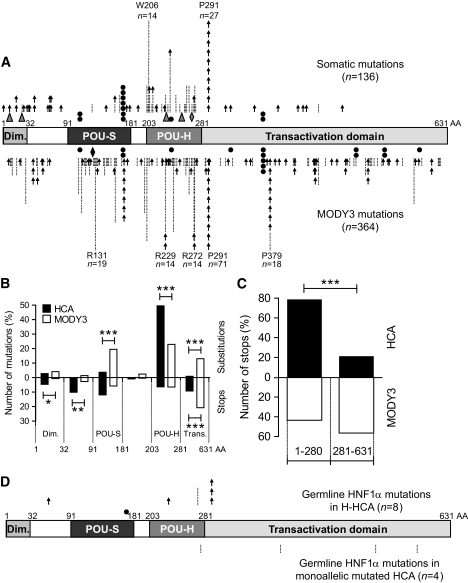
We compared 151 somatic HNF1A mutations in HCA with 364 germline mutations described in MODY3. We searched for genotoxic and oxidative stress features in HCA and surrounding liver tissue.
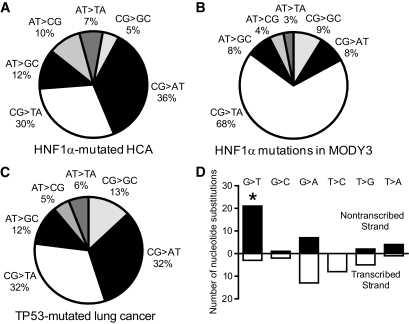
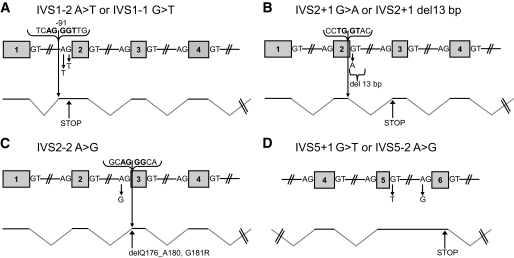
A spectrum of HNF1A somatic mutations significantly differed from the germline changes in MODY3. In HCA, we identified a specific hot spot at codon 206, nonsense and frameshift mutations mainly in the NH(2)-terminal part, and almost all amino acid substitutions were restricted to the POU-H domain. The high frequency of G-to-T tranversions, predominantly found on the nontranscribed DNA strand, suggested a genotoxic mechanism. However, no features of oxidative stress were observed in the nontumor liver tissue. Finally, in a few MODY3 patients with HNF1A germline mutation leading to amino acid substitutions outside the POU-H domain, we identified a different subtype of HCA either with a gp130 and/or CTNNB1 activating mutation.
Germline HNF1A mutations could be associated with different molecular subtypes of HCA. H-HCA showed mutations profoundly inactivating hepatocyte nuclear factor-1alpha function; they are associated with a genotoxic signature suggesting a specific toxicant exposure that could be associated with genetic predisposition.
年轻起病的成年型糖尿病 3 型(MODY3)是由 HNF1A 种系突变引起的。肝细胞腺瘤(HCA)的一个亚型也是由双等位基因体细胞 HNF1A 突变(H-HCA)引起的,而罕见的 HCA 可能与 MODY3 有关。为了更好地了解 MODY3 和 HCA 的发展之间的关系,我们比较了 HNF1A 突变的种系和体细胞谱。
我们比较了 151 例 HCA 中的体细胞 HNF1A 突变与 364 例 MODY3 中描述的种系突变。我们在 HCA 和周围肝组织中寻找遗传毒性和氧化应激特征。
HNF1A 体细胞突变谱与 MODY3 的种系变化明显不同。在 HCA 中,我们在密码子 206 处发现了一个特定的热点,无义和移码突变主要发生在 NH2-末端,几乎所有的氨基酸取代都局限于 POU-H 结构域。高频率的 G-to-T 颠换,主要发生在非转录 DNA 链上,提示存在遗传毒性机制。然而,在非肿瘤肝组织中未观察到氧化应激特征。最后,在少数 MODY3 患者中,HNF1A 种系突变导致 POU-H 结构域外的氨基酸取代,我们鉴定出 HCA 的不同亚型,存在 gp130 和/或 CTNNB1 激活突变。
种系 HNF1A 突变可能与 HCA 的不同分子亚型相关。H-HCA 显示出严重失活肝细胞核因子-1alpha 功能的突变;它们与遗传毒性特征相关,提示存在特定的毒物暴露,这可能与遗传易感性有关。