Fu Junling, Wang Tong, Zhai Xiao, Xiao Xinhua
Department of Endocrinology, NHC Key Laboratory of Endocrinology, Peking Union Medical College Hospital, Chinese Academy of Medical Sciences and Peking Union Medical College, Beijing, 100730, China.
Endocrine. 2020 Mar;67(3):544-551. doi: 10.1007/s12020-019-02138-x. Epub 2019 Nov 21.
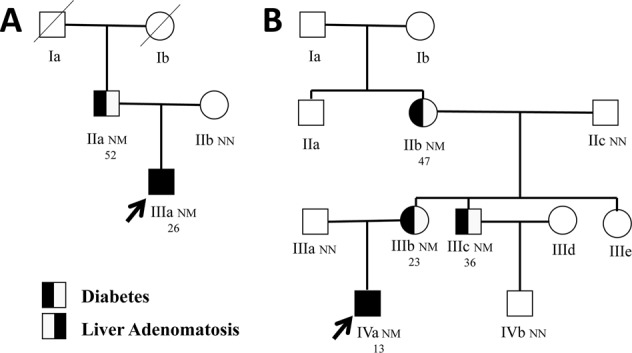
Maturity-onset diabetes of the young type 3 (MODY 3) is a consequence of heterozygous germline mutations in HNF1A, and a subtype of hepatocellular adenoma (HCA) is caused by biallelic somatic HNF1A mutations; rare HCA may be related to MODY 3. This study aimed to investigate the cosegregation of HNF1A mutations with diabetes and HCA in two families.
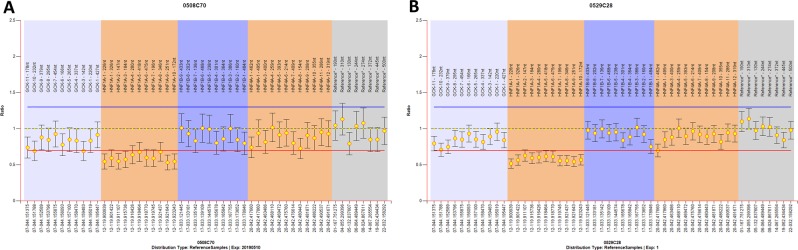
Two patients suffering from HCA and diabetes were screened for HNF1A germline and somatic mutations using direct sequence analysis and methylation-specific multiplex-ligation-dependent probe amplification (MS-MLPA) assay. Further, we screened eight relatives in the two independent families for diabetes, HCA and HNF1A variants. Additionally, we reviewed the literature concerning the phenotypes of MODY 3 and HCA at the background of HNF1A mutations.
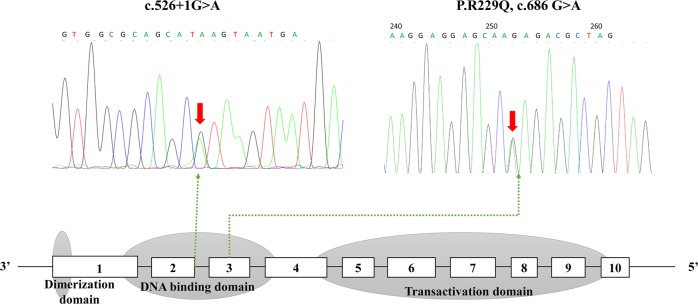
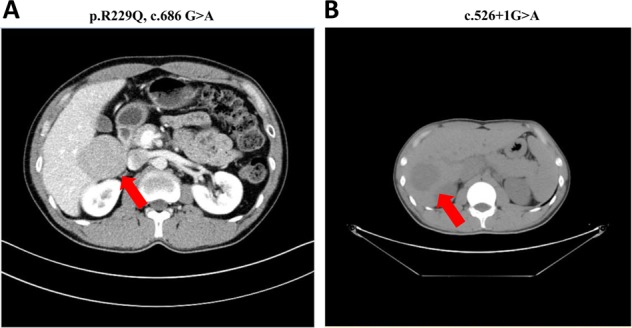
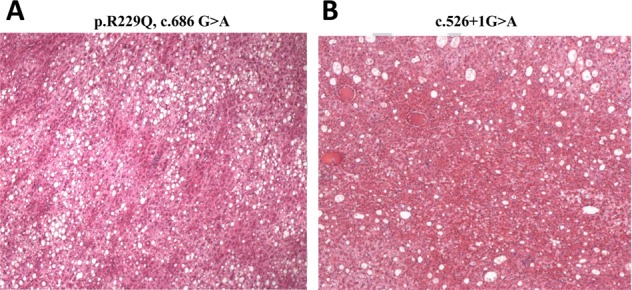
Here we reported two families (a total of six relatives) with two missense germline mutations of HNF1A identified initially using direct sequence analysis (c.686G>A in family A and c.526 + 1G>A in family B). Somatic deletion of the second allele of HNF1A was found in liver tumor tissues in both probands who were diagnosed with HCA. There are a total of ten cases of both MODY 3 and HCA phenotypes reported in the literature to date; incomplete penetrance for HCA was observed, and all the patients with HCA developed diabetes. The onset of diabetes and HCA was highly variable, the treatment of diabetes varied from diet to insulin, and the clinical expression of HCA ranged from silent to hemorrhage. Further, the severity of diabetes mellitus was not related to the occurrence of HCA.
This study describes the association of HCA and MODY 3 at the background of HNF1A mutations and highlights the importance of screening for HCA in MODY 3 families to avoid the possibility of severe complications. Further, the current study indicated that there may be a special mutational spectrum of HNF1A correlated with HCA in MODY 3 families.
青年型成年发病型糖尿病3型(MODY 3)是由肝细胞核因子1α(HNF1A)杂合种系突变引起的,而一种肝细胞腺瘤(HCA)亚型是由双等位基因体细胞HNF1A突变导致的;罕见的HCA可能与MODY 3有关。本研究旨在调查两个家族中HNF1A突变与糖尿病和HCA的共分离情况。
对两名患有HCA和糖尿病的患者,使用直接测序分析和甲基化特异性多重连接依赖探针扩增(MS-MLPA)检测法,筛查HNF1A种系和体细胞突变。此外,我们在两个独立家族中对八名亲属进行了糖尿病、HCA和HNF1A变异的筛查。另外,我们回顾了有关HNF1A突变背景下MODY 3和HCA表型的文献。
在此,我们报告了两个家族(共六名亲属),最初通过直接测序分析鉴定出两个HNF1A错义种系突变(A家族中的c.686G>A和B家族中的c.526+1G>A)。在两名被诊断为HCA的先证者的肝肿瘤组织中,发现了HNF1A第二个等位基因的体细胞缺失。迄今为止,文献中总共报道了10例同时具有MODY 3和HCA表型的病例;观察到HCA的外显率不完全,并且所有患有HCA的患者都患了糖尿病。糖尿病和HCA的发病情况差异很大,糖尿病的治疗从饮食控制到胰岛素治疗不等,HCA的临床表型从无症状到出血不等。此外,糖尿病的严重程度与HCA的发生无关。
本研究描述了在HNF1A突变背景下HCA与MODY 3的关联,并强调了在MODY 3家族中筛查HCA以避免严重并发症发生的重要性。此外,当前研究表明,在MODY 3家族中可能存在与HCA相关的HNF1A特殊突变谱。