Institute of Molecular Systems Biology, ETH Zurich, Zurich, Switzerland.
Mol Syst Biol. 2010 Apr 13;6:356. doi: 10.1038/msb.2010.11.
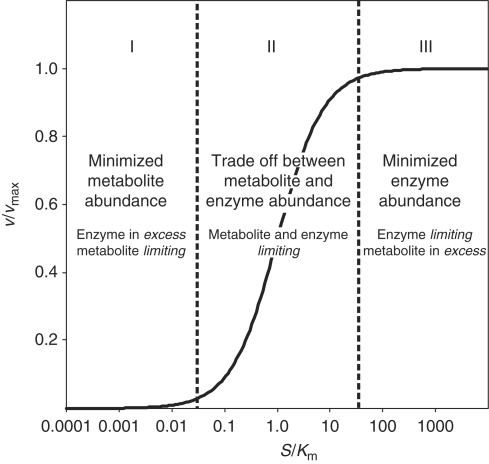
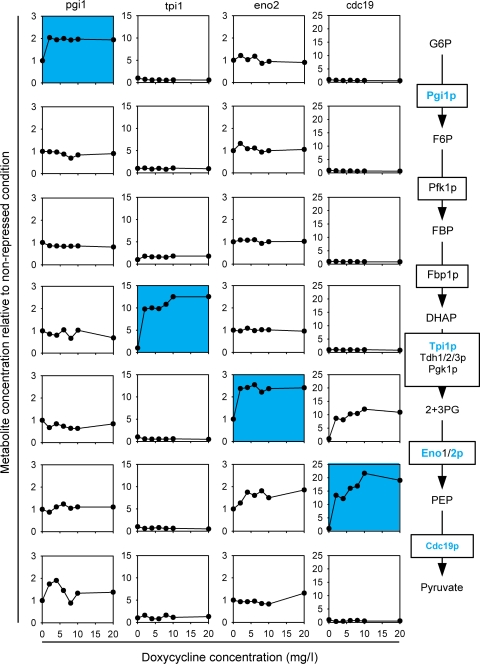
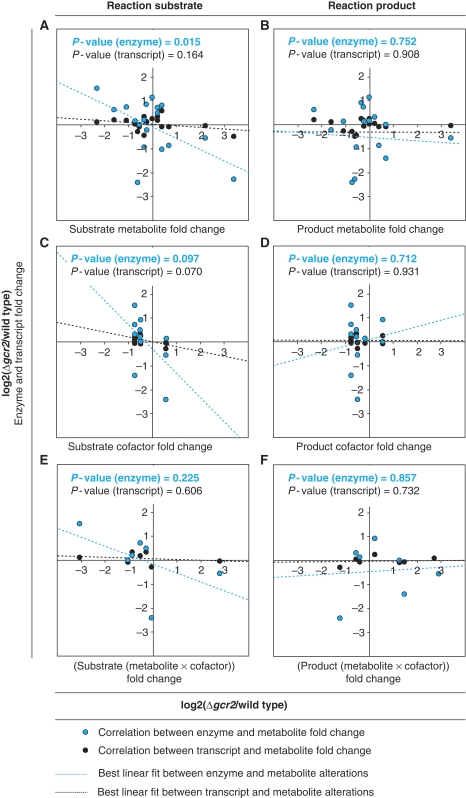
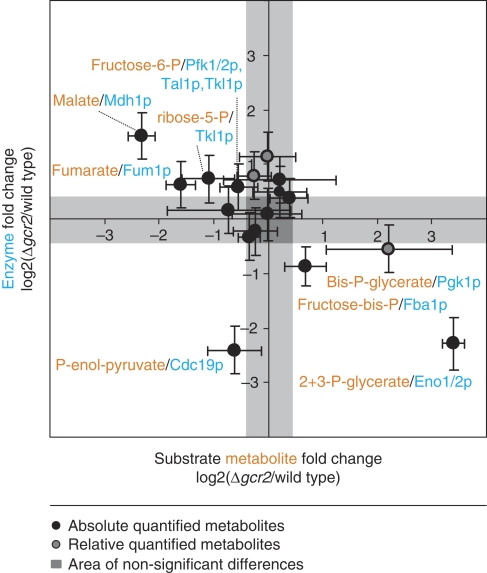
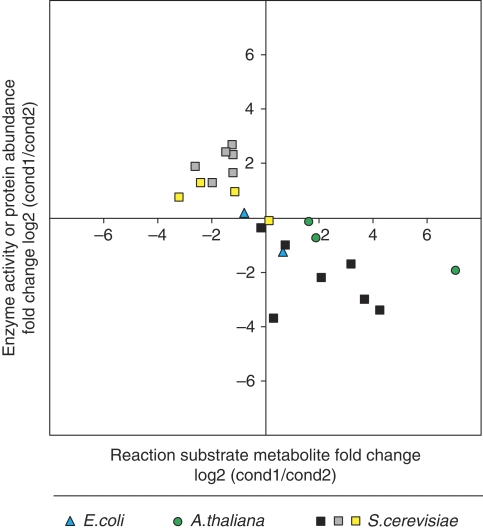
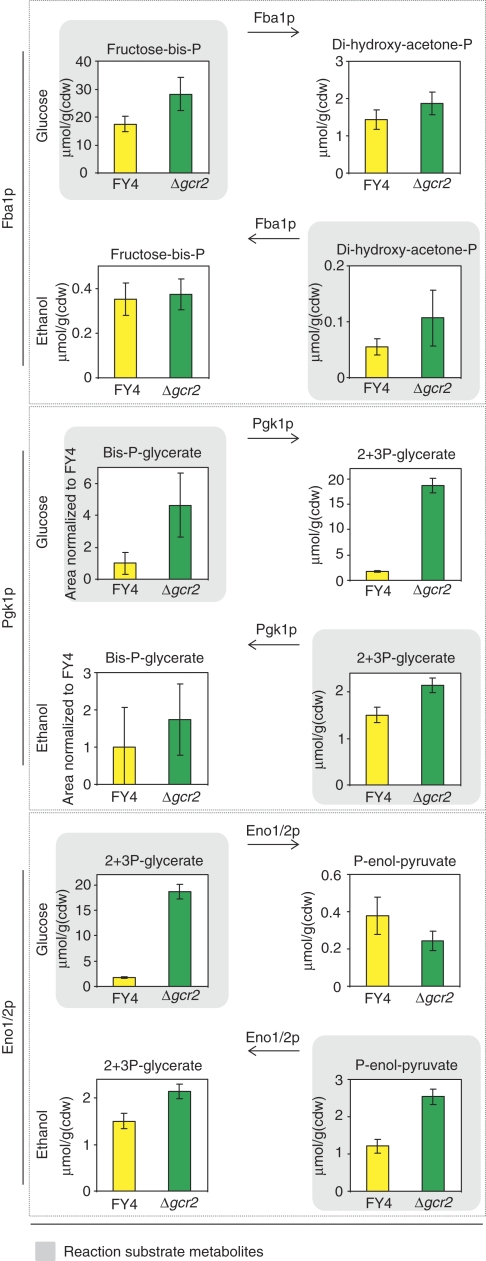
What is the relationship between enzymes and metabolites, the two major constituents of metabolic networks? We propose three alternative relationships between enzyme capacity and metabolite concentration alterations based on a Michaelis-Menten kinetic; that is enzyme capacities, metabolite concentrations, or both could limit the metabolic reaction rates. These relationships imply different correlations between changes in enzyme capacity and metabolite concentration, which we tested by quantifying metabolite, transcript, and enzyme abundances upon local (single-enzyme modulation) and global (GCR2 transcription factor mutant) perturbations in Saccharomyces cerevisiae. Our results reveal an inverse relationship between fold-changes in substrate metabolites and their catalyzing enzymes. These data provide evidence for the hypothesis that reaction rates are jointly limited by enzyme capacity and metabolite concentration. Hence, alteration in one network constituent can be efficiently buffered by converse alterations in the other constituent, implying a passive mechanism to maintain metabolic homeostasis upon perturbations in enzyme capacity.
酶和代谢物是代谢网络的两个主要组成部分,它们之间存在什么关系?我们基于米氏动力学提出了酶活力和代谢物浓度变化之间的三种替代关系;即酶活力、代谢物浓度或两者都可能限制代谢反应速率。这些关系意味着酶活力变化和代谢物浓度变化之间存在不同的相关性,我们通过定量测定酿酒酵母局部(单酶调节)和全局(GCR2 转录因子突变体)扰动时的代谢物、转录物和酶丰度来验证这些关系。结果表明,底物代谢物和其催化酶的变化倍数之间存在反比关系。这些数据为反应速率受到酶活力和代谢物浓度共同限制的假说提供了证据。因此,在酶活力发生变化时,一种网络成分的改变可以通过另一种成分的相反改变得到有效缓冲,这意味着在酶活力发生扰动时,维持代谢稳态存在一种被动机制。